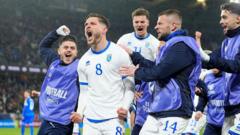
The streets of Pristina don't just feel alive today. They feel electric. If you've never been to Kosovo when the national team is on a winning streak, you're missing one of the most raw, unfiltered displays of national identity in modern sport. This isn't just about eleven guys kicking a ball around a pitch. For a country that only gained FIFA and UEFA membership in 2016, every tackle, every goal, and every clean sheet feels like a validation of statehood. Right now, the dream of a World Cup debut isn't just a fantasy discussed in smoky cafes. It's a tangible, pulsating possibility that has the entire Balkan nation in a state of pure euphoria.
Kosovo represents something that's largely disappeared from the sanitized, corporate world of elite European football. They represent hope. They represent the "Dardanians," a fan base so loyal they make Istanbul's ultras look like they're at a library. While the traditional giants of the sport worry about broadcast rights and shirt sponsorships, Kosovo is playing for the name on the front of the jersey in a way that feels throwback and futuristic all at once.
The Long Road from Isolation to International Recognition
It's easy to forget how recently Kosovo was a ghost in the footballing world. Before 2016, they weren't allowed to play competitive matches. Players with Kosovar roots were scattered across the globe, representing Switzerland, Albania, or Norway because they had no home team to call their own. Think about that for a second. Imagine being a world-class athlete and having no flag to fly under.
When the green light finally came from FIFA, it triggered a massive logistical and emotional scramble. The first competitive match against Finland in September 2016 was more than a game. It was a birth. Valon Berisha’s equalizer in that 1-1 draw didn't just earn a point; it proved Kosovo belonged. Since then, the trajectory hasn't been a straight line. It's been a mountain climb.
The infrastructure struggled to keep up at first. The Fadil Vokrri Stadium in Pristina became a fortress, but the team had to play "home" games in Albania for a while because their own facilities didn't meet international standards. Those days are gone. Now, when teams travel to Pristina, they aren't just facing a squad of hungry players. They're walking into a wall of sound that can rattle even the most seasoned Champions League veterans.
Why This Specific Squad is Different
If you look at the current roster, you'll see a blend of grit and technical flair that defines the modern Kosovar style. It’s a mix of players who grew up in the diaspora and those who stayed home. This "dual identity" is actually their greatest strength. You have the tactical discipline learned in German and Swiss academies combined with the fierce, almost desperate passion of the local league players.
- Vedat Muriqi: The "Pirate." He’s the focal point. At 6'4", he's a throwback target man who can bully defenders, but his hold-up play is what really opens doors for the wingers.
- Milot Rashica: Pure pace and directness. When he’s on form, there aren't many fullbacks in Europe who can keep up with his transition play.
- Edon Zhegrova: The wildcard. He’s the type of player who can do nothing for 80 minutes and then produce a moment of individual brilliance that ends up on every highlight reel in the world.
The tactical shift under recent coaching regimes has moved away from just "trying to survive" to actually imposing a style. They don't sit back anymore. They press. They're aggressive. They play like a team that knows they have nothing to lose and an entire world to gain.
The Diaspora Factor and the Pull of the Homeland
One of the most fascinating aspects of Kosovo's rise is the ongoing recruitment battle. For years, the Swiss national team has been nicknamed "Switzerland-Kosovo" because of stars like Xherdan Shaqiri and Granit Xhaka. These players paved the way, but they also highlight the "what if" scenarios that haunt Kosovar fans.
What if Adnan Januzaj had chosen Kosovo earlier? What if the next generation of Swiss-born talents decides to suit up for the Dardanians instead of the Rossocrociati? We’re seeing a shift. Young players in academies across Europe are no longer seeing Kosovo as a "Plan B." They’re seeing it as a chance to be legends. To be the first. To be the pioneers who took a new nation to the world’s biggest stage.
This emotional pull is a recruitment tool that money can't buy. When a player chooses Kosovo, they aren't choosing a better chance at a trophy. They’re choosing a legacy. They’re choosing to be the face of a national awakening.
Overcoming the Political Minefield of International Football
Let’s be real. Kosovo’s journey isn't just about sports. It’s deeply political. There are still nations that don't recognize Kosovo's independence, and this creates a bizarre dynamic on the pitch. We’ve seen matches delayed, controversial displays in the stands, and even teams refusing to play under the Kosovar flag.
But here’s the thing. Every time an opponent tries to diminish Kosovo’s status, it only fuels the fire. The "us against the world" mentality isn't a cliché here. It’s the literal reality of their existence. When Spain or Greece—nations that don't recognize Kosovo—have to stand on the pitch while the Kosovar anthem plays, it’s a massive symbolic victory for the fans in Pristina.
This resilience translates directly to their playing style. They're used to being told they shouldn't exist. They're used to being the underdog. So when they're down 1-0 in the 80th minute, they don't fold. They've faced much worse than a deficit on a scoreboard.
The Economic Impact of the World Cup Dream
If Kosovo actually makes it to the World Cup, the economic ripple effect will be staggering. We’re talking about a country with one of the youngest populations in Europe and a high unemployment rate. Football is a rare engine for optimism and investment.
- Tourism: A World Cup appearance puts the country on the map for millions of people who couldn't point to it on a globe.
- Infrastructure: The government is already being pushed to invest more in regional training centers and youth academies.
- Brand Value: The "Made in Kosovo" brand gets a massive boost when their athletes are seen competing with Brazil, France, or Argentina.
It’s about changing the narrative. For too long, the international headlines about Kosovo were about war, reconstruction, and tension. Football allows them to write a new chapter. One about talent, joy, and success.
How They Actually Qualify
The path isn't easy. The European qualifiers are a meat grinder. To get to the World Cup, Kosovo needs more than just passion. They need consistency. The biggest struggle has always been the "small" games. They can get up for a match against England or Italy, but they sometimes drop points against teams they should beat on paper.
They need to master the art of the "boring" 1-0 win. They have the flair. They have the attack. What they need is the defensive rigidity to see out matches when the "euphoria" isn't enough to carry them. If they can tighten up the backline and stay healthy, the expanded World Cup format gives them their best shot in history.
What This Means for the Future of Balkan Football
The rise of Kosovo is also shaking up the hierarchy in the Balkans. Historically, Croatia and Serbia have been the powerhouses. But Kosovo’s emergence adds a new, volatile element to the mix. It forces the established powers to take notice. It also provides a blueprint for other small or emerging nations.
You don't need a hundred years of history to be competitive. You need a clear identity, a committed diaspora, and a fan base that treats every match like a final. Kosovo has all three in spades.
Your Move as a Fan or Observer
If you're tired of the same four teams winning everything, start following the Dardanians. Watch their home games. See the sea of blue and yellow. Listen to the roar when Muriqi wins a header. It’s infectious.
The next step for anyone interested in this story is to look at the upcoming fixture list. Don't just check the score. Watch the pre-game ceremonies. Watch the fans. You'll see why this is the most compelling story in the sport right now. The dream is real, and for the people of Kosovo, the World Cup isn't just a tournament. It's the destination of a journey that started long before the first whistle blew in 2016. Keep your eyes on Pristina. The world is about to see what happens when a whole country refuses to stop dreaming.