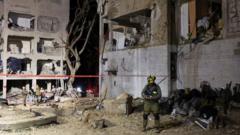
The recent exchange of long-range precision strikes between Iran and Israel represents a fundamental shift from shadow warfare to a doctrine of "calibrated transparency," where both nations utilize kinetic action to define red lines around nuclear infrastructure. When Tehran launched ordnance toward targets near Israeli nuclear facilities following a strike on its own soil, the objective was not immediate destruction but the establishment of a new "cost-of-entry" for future Israeli operations. This cycle functions as a live-fire negotiation where the currency is technical capability and the stakes are the integrity of regional non-proliferation.
The Triad of Deterrence Erosion
The transition from proxy-based skirmishes to direct state-on-state strikes reveals a degradation of the traditional deterrent frameworks that have governed the Middle East for three decades. To understand the current risk profile, one must deconstruct the three pillars supporting this escalation:
- The Geographic Compression of Conflict: Historically, the physical distance between Iran and Israel acted as a natural buffer, forcing reliance on cyberwarfare or third-party militias. The normalization of ballistic missile and UAV flight paths across multiple sovereign borders has effectively "compressed" this geography, making direct strikes a standard operational lever rather than a last resort.
- Targeting Symmetry as Communication: By selecting targets in proximity to nuclear research centers, Iran is employing "reflexive control." This Soviet-era concept involves feeding an adversary information—in this case, via kinetic impact—to or orchestrate a specific response. The message is a mathematical equivalence: an attack on Natanz or Isfahan justifies a proportional response against Dimona.
- Technological Saturation: The efficacy of Iron Dome, David’s Sling, and Arrow-3 systems creates a "defense paradox." Because Israel can intercept a high percentage of incoming threats, Iran feels compelled to increase the volume and sophistication of its salvos to ensure even a single impact. This volume-based approach increases the margin for error and the potential for unintended mass-casualty events.
The Mechanics of Proportionality and Technical Signaling
Precision-guided munitions (PGMs) have transformed the nature of political signaling. In previous eras, a strike was an act of war intended to degrade military capacity. Today, the accuracy of a strike allows a state to hit a specific warehouse or an empty tarmac meters away from a high-value asset to demonstrate "potentiality."
When Iranian officials claimed their nuclear sites were targeted, the subsequent response toward Israeli facilities was a calculated demonstration of reach. The technical variables of this strike—flight time, trajectory, and payload—serve as a data set for Israeli intelligence. If Iran can put a drone within a 100-meter circular error probable (CEP) of a sensitive site, it proves that the only thing preventing a catastrophic hit is political restraint, not technical limitation.
Conversely, Israeli strikes are often characterized by extreme surgical precision, designed to disable specific components of a program—such as centrifuges or power substations—without triggering a wider environmental disaster. This "sub-threshold" kinetic activity aims to delay nuclear timelines while avoiding the legal and military triggers of a full-scale regional war.
The Cost Function of Nuclear Escalation
In strategic analysis, the "cost function" of a military action is the sum of diplomatic isolation, economic sanctions, and the risk of counter-strike. For Iran, the cost function has shifted. The regime has calculated that the risk of remaining passive in the face of strikes on its soil is now higher than the risk of direct retaliation.
Structural Vulnerabilities in the Current Standoff
- Intelligence Asymmetry: Israel’s intelligence penetration of the Iranian defense establishment is deep, as evidenced by the frequency of internal sabotages. This creates a "use it or lose it" mentality in Tehran regarding its mobile missile batteries.
- The "Fog of Automated Defense": As both sides deploy AI-driven early warning systems, the human decision-making window shrinks. When a radar signature is detected, commanders have seconds to determine if it is a stray drone or a nuclear-tipped missile. The risk of "accidental escalation" via automated response is at its highest point in the history of the conflict.
- Hardened vs. Soft Targets: While Israel’s nuclear infrastructure is heavily defended and geographically concentrated, Iran’s program is decentralized and deeply buried. This creates a mismatch in strike objectives. Israel must achieve deep-earth penetration to be effective, whereas Iran can achieve its psychological objectives by hitting surface-level targets near Israeli population centers.
Decoupling Rhetoric from Kinetic Reality
Public statements from both Tehran and Jerusalem serve internal political constituencies but often mask the underlying military logic. Iranian state media’s emphasis on "defending the sanctities" and Israeli officials' focus on "existential threats" are layers of theater that sit atop a very cold, rational exchange of military data.
The core of the issue is the Breakout Timeline.
Every strike and counter-strike is an attempt to manipulate this variable. If an Israeli strike destroys a shipment of carbon fiber intended for centrifuge rotors, they have effectively bought three to six months of "strategic silence." If an Iranian strike demonstrates that Israeli air defenses can be saturated, they have increased the "deterrence premium" that Israel must pay to consider future strikes.
The Role of Electromagnetic and Cyber Domains
Kinetic strikes are often the "loud" part of a much broader, "silent" operation. In the moments leading up to a missile launch, there is a flurry of activity in the electromagnetic spectrum.
- GPS Spoofing: Both actors use regional GPS jamming to throw off the guidance systems of incoming drones. This has the side effect of disrupting civilian aviation and logistics, creating a secondary economic cost to the conflict.
- Network Intrusion: A physical strike is frequently preceded by a cyber-attack on the target’s command and control (C2) nodes. If a radar system "blinks" for even sixty seconds, it provides the window necessary for a low-flying cruise missile to enter the airspace.
- Burying the Lead: Often, the physical damage reported in the news is less significant than the data gathered during the strike. Sensors on the missiles or nearby "observer" drones collect information on radar frequencies and response times, which are more valuable for the next phase of the conflict than the destruction of a single building.
Strategic Recommendation for Risk Mitigation
The current trajectory suggests that the "informal rules" of the Iran-Israel conflict have been discarded. Without a hot-line or a neutral third-party mediator capable of verifying "near-miss" intentions, the probability of a kinetic strike hitting a critical nuclear cooling system or a containment structure increases exponentially.
The move toward "nuclear signaling" via conventional missiles is an unstable equilibrium. To prevent a transition from calibrated strikes to total war, the following strategic pivots are required:
- Establishment of De-confliction Thresholds: Both parties must define what constitutes a "nuclear-relevant strike." Hitting a power line ten miles from a reactor is vastly different from hitting a secondary cooling pipe. Precision must be used to move away from critical nodes, not toward them, if the goal is truly deterrence rather than destruction.
- Decoupling Domestic Survival from Military Response: As long as both leaderships feel that "looking weak" leads to internal collapse, they will be forced into an escalatory spiral. The international community must provide "off-ramps" that allow for de-escalation without a loss of perceived sovereignty.
- Transparency in Non-Nuclear Payloads: The most dangerous moment in this conflict is the launch of a ballistic missile with an unknown payload. Establishing norms or verification mechanisms—even through indirect channels—that clarify the conventional nature of a strike can prevent a pre-emptive nuclear launch by an adversary fearing the worst.
The logic of "an eye for an eye" in the nuclear age eventually leaves both nations blind to the point of no return. The current exchange proves that while the technology of war has advanced to the point of meter-level precision, the diplomatic frameworks to manage that precision remain stuck in the 20th century. The immediate priority is not the cessation of all hostilities—which is unrealistic—but the radical isolation of nuclear infrastructure from the conventional strike cycle.
Would you like me to analyze the specific flight path data of the latest UAV incursions to determine the likely sensor-testing objectives of the Iranian aerospace forces?