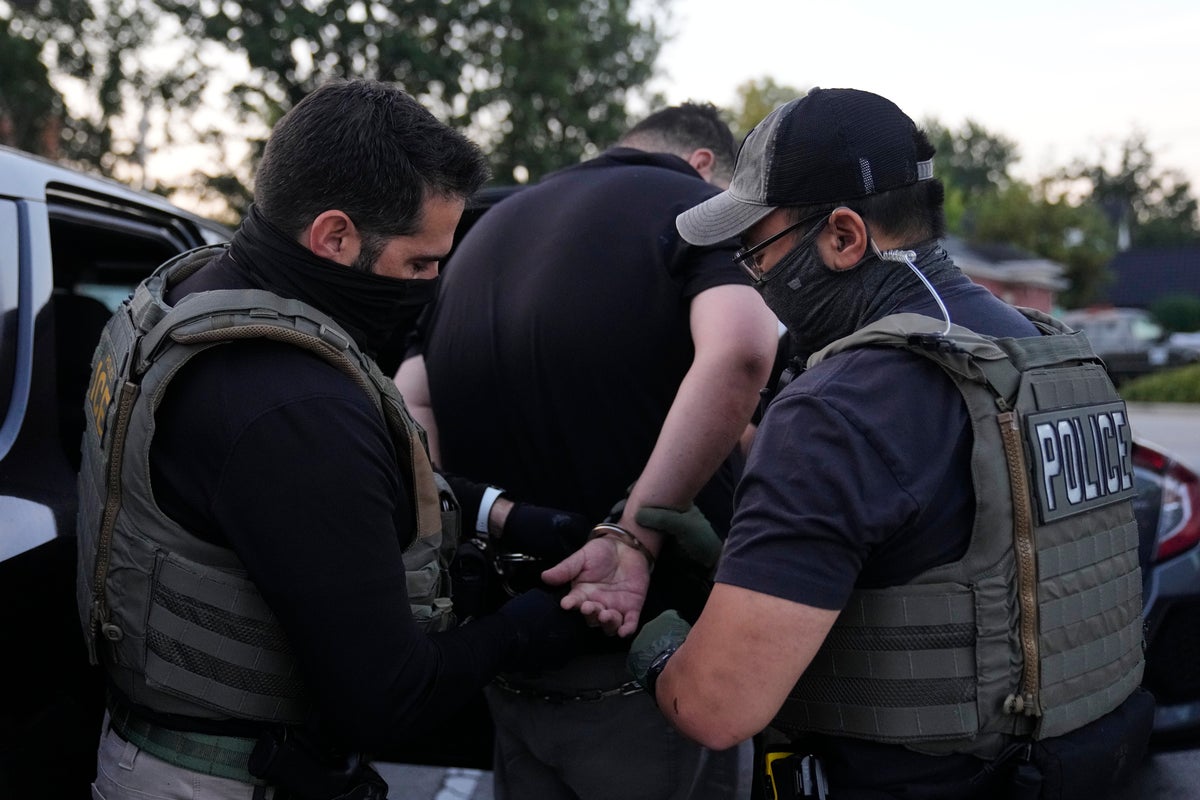
The room is usually small, windowless, and smells faintly of industrial floor wax and recycled air. In these cramped spaces, a person sits before a video screen, waiting for a face to appear from a thousand miles away. This is not a casual call. It is a bond hearing. For the person in the orange jumpsuit, it is the most important conversation of their life.
For years, the script in these rooms followed a predictable, grim rhythm. Immigration and Customs Enforcement (ICE) would argue that the person in the jumpsuit was a flight risk or a danger to the community. The burden of proof felt like an anchor tied to the migrant’s ankles. They had to prove they weren’t a threat. They had to prove they wouldn’t run. If they couldn't, the heavy steel door stayed shut.
But the law recently rediscovered a fundamental truth that had been buried under piles of administrative paperwork. In courtrooms across the country, the script is being flipped. Judges are finally insisting that the government—not the individual—must carry the weight of the evidence.
The numbers tell a story that the dry headlines miss. In just a few months, judges have issued over 7,000 rulings stating that ICE failed to prove these individuals were a danger or a flight risk. Seven thousand. That is not a clerical error. It is a systemic shift in how we define liberty within the borders of a country that prides itself on the "due process" clause of the Constitution.
Imagine a man named Elias. He is a hypothetical composite of the thousands of files currently sitting on mahogany desks. Elias has lived in a small town in Ohio for twelve years. He has three children who are terrified of the dark and a wife who works double shifts at a bakery. One morning, a tail light out on his old truck leads to a detention center.
For months, Elias sits in a cell. He isn't there because he’s been convicted of a violent crime. He is there because the system assumes he might disappear if they let him out. Under the old way of doing things, Elias would have to hire a lawyer he can’t afford to gather documents he can’t access to prove he is "safe."
Now, the judge looks at the government representative and asks a simple, piercing question.
"Where is your proof?"
When the government can’t produce it—when there is no record of violence, no history of skipping court dates, no shadow of a threat—the anchor lifts.
This shift stems from a series of landmark legal challenges that have rippled through the federal court system. The core of the argument is deceptively simple: if the government wants to take away a person's physical freedom, the government must justify it. In any other area of American law, this is a baseline assumption. If you are arrested for a crime, the prosecutor has to show why you shouldn't be granted bail. But for decades, immigration law operated in a parallel dimension where the rules of gravity seemed to work in reverse.
The 7,000 rulings represent a massive course correction. They are a recognition that "detention" is just a polite word for jail. When we lock someone up without a specific, proven reason, we aren't just managing a backlog. We are eroding a principle.
Consider the logistics of a life paused. When ICE locks someone up without proving they are a threat, the ripples move outward. A mortgage goes unpaid. A local construction crew loses its most reliable worker. A child’s grades plummet because they are wondering if they will ever see their father’s face outside of a grainy Zoom window again. These are the "invisible stakes" of the 7,000 rulings. They aren't just legal victories; they are family reunions.
The resistance to this change is often framed in the language of national security and border integrity. There is a fear that if we don't lock everyone up, the system will collapse under its own weight. But the data suggests otherwise. The vast majority of people with pending immigration cases show up for their hearings. They want to resolve their status. They want to follow the rules. Locking them up at a cost of roughly $150 per day, per person, isn't a security strategy. It’s an expensive habit.
The burden of proof is a heavy thing. It should be. It is the only thing that stands between a free society and one where the state can disappear people into a labyrinth of bureaucracy based on a hunch or a checkbox.
What does it feel like to be one of the 7,000?
It feels like the sound of a key turning in a lock from the outside. It feels like the first breath of humid, unfiltered air as you walk out of a facility and see a parking lot that looks like the most beautiful place on Earth. It feels like the sudden, jarring realization that the law actually meant what it said about "liberty for all."
The legal battle isn't over. These 7,000 rulings are being challenged, debated, and scrutinized. Some argue that immigration proceedings are civil, not criminal, and therefore the same protections shouldn't apply. But to the person in the jumpsuit, that distinction is a semantic game. A cage is a cage, regardless of whether the sign on the door says "Civil" or "Criminal."
We are witnessing a quiet revolution in the hallways of our immigration courts. It isn't loud. It doesn't involve protests in the streets or firebrand speeches. It happens in the scratch of a pen on a legal order. It happens when a judge decides that "because we said so" is no longer a valid legal argument for the government of the United States.
The 7,000 people who have been granted their freedom didn't get a "get out of jail free" card. They still have to face their court dates. They still have to navigate the complex, often heartbreaking world of immigration law. But they get to do it from their living rooms. They get to do it while holding their children's hands.
The government’s failure to prove these thousands of people were dangerous isn't a failure of the system. It is the system finally working. It is the moment when the scale, which had been tipped so heavily for so long, finally found its center.
Somewhere tonight, a man like Elias is sitting at a kitchen table. The house is quiet. The kids are asleep. He is looking at his hands, still slightly calloused, still shaking a little from the shock of being home. He isn't a threat. He isn't a flight risk. He is just a man who was caught in a machine until a judge asked the government to prove he belonged there, and the government had nothing to say.
The silence that followed that question is the sound of justice returning to the room.