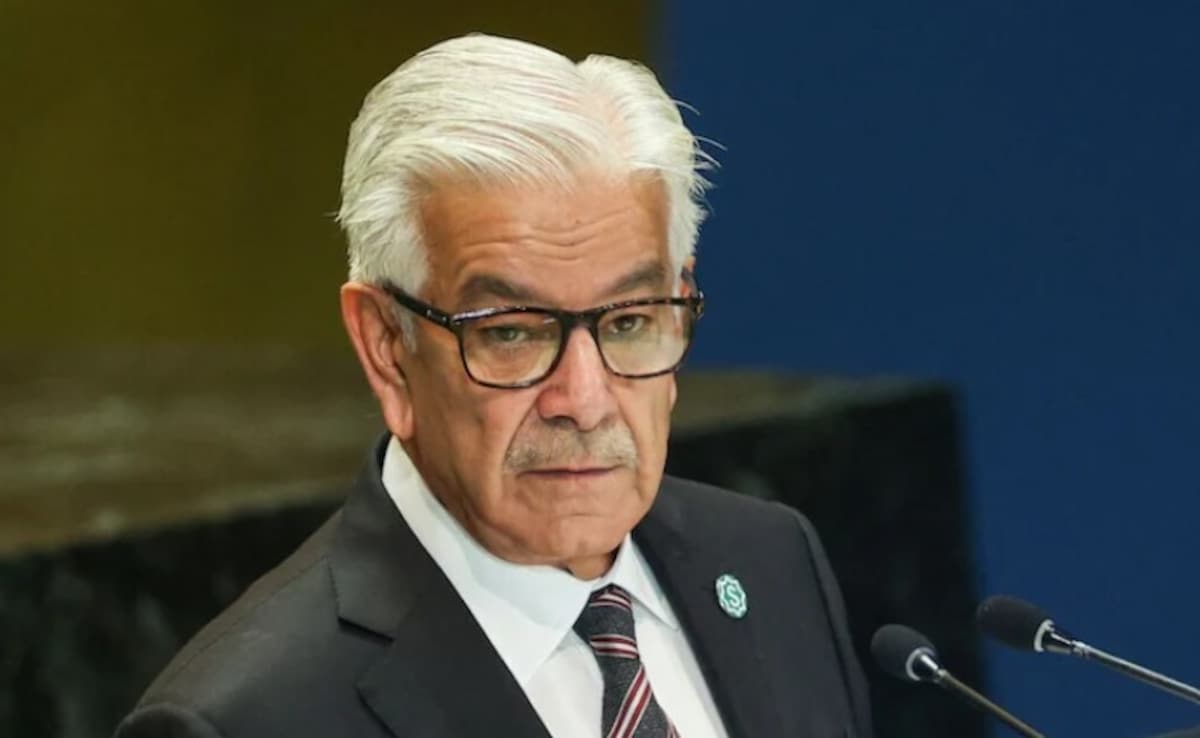
Pakistan’s Defense Minister Khawaja Asif doesn't usually mince words, but his recent take on the escalating tensions between Israel and Iran is particularly grim. He isn't just talking about a border skirmish or a temporary spike in oil prices. He's suggesting a fundamental redrawing of the map where Pakistan and India are forced into roles they didn't sign up for. When a sitting Defense Minister claims there's a blueprint to turn his country into a "vassal state," it's time to stop looking at this as a localized conflict and start seeing the global chess game for what it is.
The core of Asif's argument rests on the idea that the current hostilities aren't just about neutralizing Hamas or Hezbollah. He views the broader strategy as an attempt to establish total hegemony in the region, one that would eventually demand subservience from neighboring nuclear powers. It's a bold, perhaps even paranoid, claim for some, but in the context of South Asian internal politics, it’s a narrative that carries immense weight.
The Vassal State Theory and Why It Matters
When Asif mentions a "vassal state," he's tapping into a deep-seated fear in Islamabad. The idea is that international powers, led by Israel and supported by Western allies, want a Pakistan that’s militarily neutered and politically compliant. This isn't just about losing a few diplomatic arguments. It’s about a total loss of sovereignty over national security and foreign policy.
Why now? The timing correlates with the massive exchange of fire between Israel and Iran. As missiles fly over the Levant, Asif sees a precursor to a larger realignment. He suggests that if Iran is weakened or restructured, the "protective shield" for other Muslim-majority nations vanishes. In his view, the domino effect doesn't stop at the Persian Gulf. It travels straight through the Balochistan border.
Where India Fits into This Predicted Map
Perhaps the most controversial part of Asif’s statement involves India. He claims India is being integrated into this "plan" as a junior partner or a regional enforcer. For New Delhi, this sounds like typical Pakistani rhetoric. However, Asif’s angle is specific. He thinks the West is grooming India to be the anchor of a pro-Western, pro-Israel bloc that would keep Pakistan in check.
It's a complicated accusation. India has historically maintained a delicate balance, keeping strong ties with Tehran for energy and the Chabahar port while building a "no-limits" strategic partnership with Israel. Asif is betting that this balance is a facade. He believes the ultimate goal is a unified front where South Asian dynamics are dictated by Middle Eastern outcomes.
The Reality of the Iran Israel Escalation
We have to look at the facts on the ground. Iran’s missile strikes and Israel’s promised "deadly, precise, and surprising" response have moved the needle past the point of proxy wars. We're in the territory of direct state-on-state conflict.
Pakistan finds itself in a nightmare scenario. It shares a 900-kilometer border with Iran. Any massive instability there spills over immediately. We're talking about refugees, extremist infiltration, and the disruption of the few trade routes Pakistan has left. Asif isn't just theorizing. He's reacting to the very real possibility that his western neighbor could become a war zone, leaving Pakistan squeezed between a hostile India and a burning Iran.
The Nuclear Factor and Strategic Autonomy
Pakistan is the only Muslim-majority country with a nuclear arsenal. That fact alone makes Asif’s "vassal state" comment more than just a soundbite. There is a persistent belief in Pakistani military circles that the ultimate "prize" for global powers is the denuclearization of the country. By framing the Iran war as a step toward making Pakistan a vassal, Asif is signaling to his own population—and the world—that the country’s "strategic assets" are the real target.
Debunking the Rhetoric vs Reality
Does Israel actually have a plan to make Pakistan a vassal? Probably not in the way Asif describes it. Israel’s primary focus is existential and regional. Pakistan, while a vocal critic, isn't an immediate tactical threat to Tel Aviv.
However, the "vassal" label is a powerful tool for domestic consumption. Pakistan is currently grappling with a massive economic crisis and internal political fracturing. Foreign threats are the oldest trick in the book to create national cohesion. If you can convince the public that the very existence of the state is under threat from a global conspiracy involving Israel and India, you can justify almost any internal policy or military budget.
The India-Israel Nexus
It's true that India and Israel have grown incredibly close. From Pegasus spyware to drone technology and agricultural cooperation, the bond is tight. But Asif’s claim that India is "part of the plan" to subjugate Pakistan ignores India’s own strategic autonomy. India doesn't want a chaotic, collapsed Pakistan on its border. A "vassal state" that’s failing is a breeding ground for the kind of chaos that New Delhi spent decades trying to contain.
What Happens if the Conflict Spreads
If Asif’s fears—or his warnings—come true and the Iran-Israel war expands, the economic fallout will hit Pakistan first.
- Energy Prices: Pakistan is already struggling with inflation. A Strait of Hormuz closure would be a death blow.
- Diplomatic Tightrope: Pakistan has to keep Riyadh happy (for the money) and Tehran calm (for the border). A full-scale war makes that impossible.
- Internal Security: Sectarian tensions in Pakistan often mirror Middle Eastern conflicts. A war involving Iran could trigger internal unrest that the government is ill-equipped to handle.
The Path Forward for Regional Stability
The rhetoric coming out of Islamabad reflects a deep anxiety about a world where old alliances are breaking down. To navigate this, the focus needs to shift from conspiracy theories to hard-nosed diplomacy.
You can’t control what happens in the skies over Isfahan or Tel Aviv, but you can control the response at home. Pakistan needs to shore up its border security without falling into the trap of total isolationism. It also needs to realize that its "vassal" status is more likely to come from economic debt than from a secret Israeli-Indian blueprint.
Keep an eye on the diplomatic cables over the next few weeks. If Pakistan starts leaning harder into the China-Russia-Iran axis, Asif’s "vassal" warnings will have been the opening salvo of a major pivot in South Asian geopolitics. Watch the energy markets and the Balochistan border; that’s where the real story will unfold, regardless of the fiery speeches in parliament.