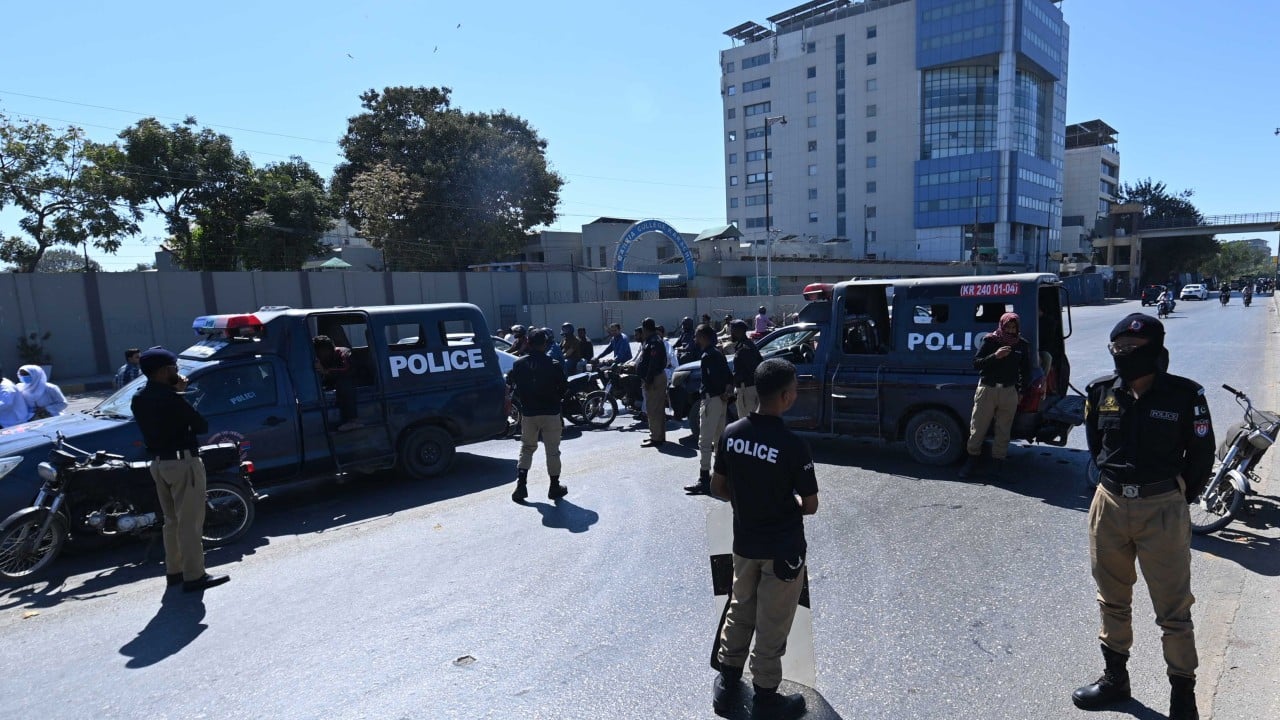
The headlines are screaming about a retreat. They want you to believe that the U.S. State Department is running scared from Karachi and Lahore because a few thousand people are waving banners for Tehran. The narrative is simple: America is losing its grip, the streets are on fire, and the diplomats are packing their bags in a frantic exit.
It is a lie.
If you think this is a sign of American weakness or a geopolitical "pullback," you are reading the wrong map. This isn't a retreat; it’s a recalibration of power. Moving staff isn't about fear—it's about clearing the decks for a much uglier, much more effective style of engagement.
The Security Theater Fallacy
The mainstream media loves the "State Department in Peril" trope. They point to the Authorized Departure orders as if the Taliban is at the gates of the consulate. Let’s look at the actual mechanics of diplomatic security.
Maintaining a massive, static diplomatic footprint in high-friction cities like Karachi is a strategic liability, not an asset. Every staffer at a desk is a target that requires a battalion of local security to protect. By thinning out the "soft" diplomatic presence, the U.S. actually increases its operational flexibility.
When you remove the vulnerable personnel, you remove the leverage the host country—and the protesters—have over you. It’s much harder to blackmail a superpower when its people aren't sitting ducks in a gated compound in the middle of a riot-prone district. I have seen this play out in Baghdad and Cairo. You don't leave because you’re losing; you leave so you can stop playing defense and start playing offense.
The Pro-Iran Protest Smokescreen
The "pro-Iran" angle is the most convenient excuse in the book. Yes, there are protests. Yes, the sentiment is anti-Western. But to suggest that the U.S. is "pulling out" because of some street-level noise is to ignore the deep, structural relationship between the Pentagon and Rawalpindi.
The Pakistani military establishment—the real power brokers—has a long history of letting the "street" blow off steam. It’s a pressure valve. By allowing these protests to look more dangerous than they are, Pakistan’s leadership tries to extract more concessions from Washington. "Look how hard it is for us to support you," they signal.
Washington isn't falling for it this time. By withdrawing staff, the U.S. is effectively saying: "Fine, deal with your own streets. We don't need to be there to see what you're doing."
The Logic of Distance
- Reduced Friction: Fewer Americans on the ground means fewer "incidents" that can be used as diplomatic leverage.
- Operational Shifts: Modern diplomacy happens over encrypted links and through intelligence channels, not over tea in a Karachi villa.
- Cost Realignment: The "War on Terror" era of massive, city-sized embassies is dead. Efficiency is the new doctrine.
The Myth of Iranian Influence in Pakistan
Let's address the elephant in the room. The idea that Pakistan is "flipping" toward Iran is a geopolitical fantasy.
Pakistan is a Sunni-majority nation with deep, existential financial ties to Riyadh. It cannot afford to be an Iranian proxy. The protests are a localized, reactionary phenomenon, not a shift in the state's tectonic plates. The U.S. knows this. They aren't leaving because they fear an Iranian takeover; they are leaving because the current diplomatic model in Pakistan is an expensive, outdated relic of 2005.
Why the "Experts" are Wrong
Most analysts are still using a Cold War playbook. They think presence equals power. They see a shuttered consulate and see a vacuum.
In the 21st century, power is about the ability to project force and influence without being tethered to a physical location. The U.S. is moving toward a "Light Footprint" model. This isn't just about Pakistan; it's a global trend. We saw it in various iterations across the Sahel and Eastern Europe.
The Real Cost of Static Diplomacy
- Security Overhead: 70% of a consulate's budget often goes toward just staying alive.
- Intelligence Blindness: When you’re trapped inside a "Green Zone," you aren't getting real intel; you're getting what the locals want to tell you at the gate.
- Diplomatic Inertia: Large missions become bureaucratic nightmares that prioritize their own survival over national interests.
The Business of Instability
For the private sector, this move is a loud, clear signal. If the State Department is pulling non-essential staff, the risk-adjustment models for Karachi and Lahore just shifted. But here is the contrarian take for investors: this is the best time to look for assets.
When the "official" Americans leave, the price of entry drops. The infrastructure stays. The human capital stays. The Pakistani elite still want U.S. dollars and Western technology. The withdrawal of diplomatic staff creates a vacuum that is often filled by private security firms and "grey" commercial interests that operate with far less oversight and far more efficiency.
I’ve watched companies panic and sell off Pakistani holdings at the first sign of a State Department travel advisory. They leave millions on the table. The smart money knows that a diplomatic drawdown is often a precursor to a more aggressive, less formal economic engagement.
Stop Asking if Pakistan is "Safe"
People constantly ask: "Is it safe to do business in Pakistan right now?"
That is the wrong question. Nothing in Pakistan has been "safe" for forty years. The real question is: "Is the U.S. giving up on Pakistan?"
The answer is a resounding no. You don't give up on a nuclear-armed state that sits between China, India, and Iran. You just change how you handle them. You stop trying to "win hearts and minds" through cultural exchange programs in Lahore and you start managing the relationship through hard-nosed military-to-military cooperation and financial gatekeeping (FATF, IMF).
The Brutal Reality of "Authorized Departure"
When the State Department authorizes a departure, it’s a bureaucratic tool used to put pressure on the host government. It’s a way of saying, "Your security forces are failing, and we’re going to embarrass you on the world stage by leaving."
It’s a slap in the face to the Pakistani Ministry of Foreign Affairs. It’s a maneuver designed to force the Pakistani military to crack down harder on the very protesters the U.S. is supposedly "running" from. It’s a provocation, not a retreat.
The Fallacy of the Iranian Corridor
There is a theory circulating that Iran is building a "land bridge" through Pakistan to counter Western influence. This ignores the basic geography and the fundamental animosity between the Pakistani military and Iranian revolutionary interests.
The border between Iran and Pakistan (the Sistan-Baluchestan region) is one of the most volatile and neglected strips of land on earth. Both sides regularly shell each other’s "militants." To think that a few protests in Karachi mean these two states are suddenly becoming brothers-in-arms is to ignore decades of border skirmishes and ideological warfare.
Dismantling the "Loss of Influence" Narrative
"The U.S. is losing Pakistan to China and Iran."
I hear this every time a U.S. diplomat gets a cold. China has invested billions in the CPEC (China-Pakistan Economic Equilibrium), yet Pakistan is still knocking on the IMF’s door—an institution where the U.S. holds the ultimate veto.
Influence isn't measured by how many diplomats you have in a consulate in Lahore. It’s measured by who controls the debt, who provides the F-16 parts, and who controls the global banking rails. On all three counts, the U.S. remains the only player that matters to the Pakistani elite.
Your Move
Stop reading the "evacuation" as a defeat. Start reading it as a pivot.
The U.S. is stripping away the decorative parts of its relationship with Pakistan. It’s getting rid of the "soft" targets and the bureaucratic bloat. What remains will be a leaner, meaner, and far more transactional relationship.
If you are waiting for the diplomats to return before you move, you've already lost the window. The chaos is the signal that the old rules are gone. The new rules are being written in the silence that follows the departure.
Pack your bags or double down, but don't pretend you weren't warned: the U.S. isn't leaving Pakistan; it's just getting ready to deal with it without the gloves on.