The maritime balance of power in the Indo-Pacific just shifted. While analysts have spent years debating the theoretical "tipping point" of a regional conflict, the Japanese Maritime Self-Defense Force (JMSDF) has quietly moved past the talking stage. By integrating U.S.-made Tomahawk Land Attack Missiles (TLAM) onto its existing destroyer fleet, Tokyo has effectively ended its decades-long era of "shield-only" defense. This is not a routine hardware update. It is a fundamental rewiring of Japan’s military DNA, transforming a navy designed to catch submarines into one capable of striking deep into the Chinese mainland.
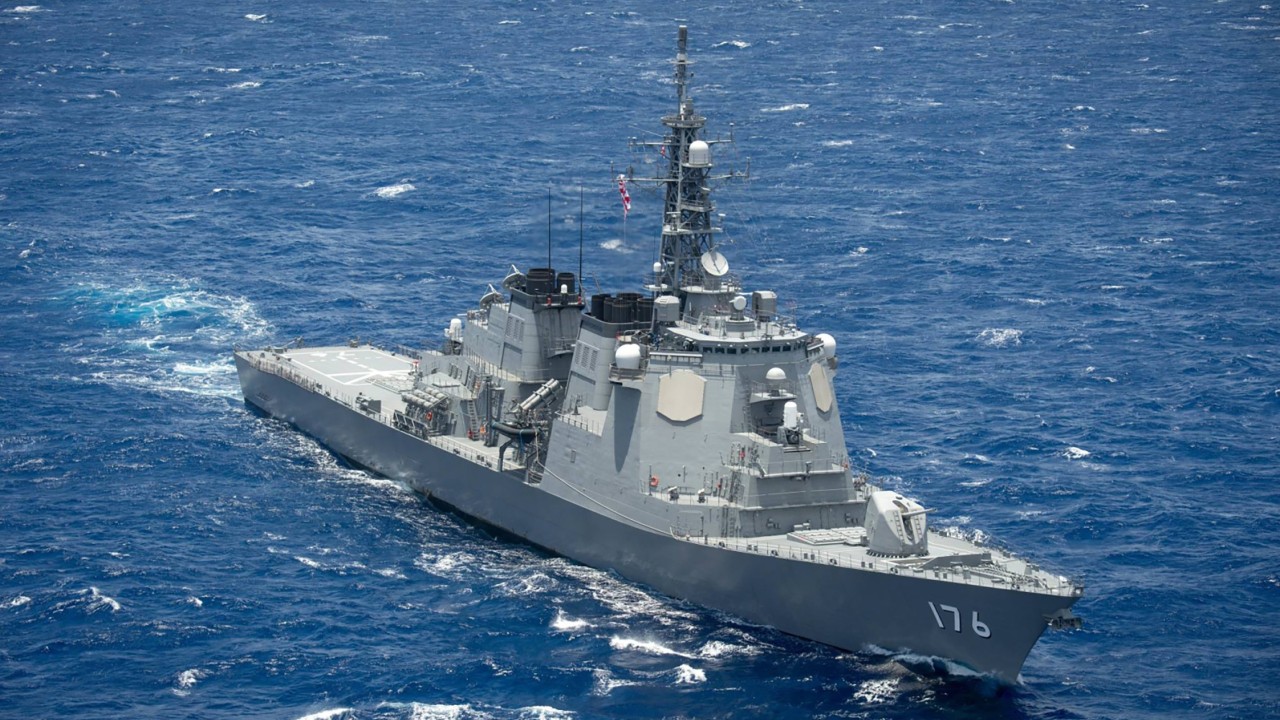
The move centers on the Aegis-equipped destroyers, specifically the Maya and Kongo classes. These ships have always been the gold standard for air defense, but until now, their vertical launch systems (VLS) were filled almost exclusively with interceptors meant to shoot down incoming threats. By swapping or supplementing those interceptors with Tomahawks, Japan gains the ability to hit targets from over 1,600 kilometers away. This creates a massive headache for the People's Liberation Army (PLA) in Beijing. Meanwhile, you can find other events here: The Cold Truth About Russias Crumbling Power Grid.
The end of the shield only doctrine
For the better part of the post-war era, Japan’s military posture was defined by Senshin B防衛 (Exclusively Defense-Oriented Policy). The logic was simple: the United States would be the "spear" while Japan acted as the "shield." Japan would hunt submarines and shoot down planes, while the U.S. Navy and Air Force would handle the offensive strikes.
That division of labor is dead. To see the complete picture, check out the recent analysis by USA Today.
The security environment in the East China Sea has degraded too far for the old rules to apply. Beijing’s rapid expansion of its missile inventory and its increasingly aggressive maneuvers around the Senkaku Islands forced Tokyo’s hand. The Tomahawk acquisition is the physical manifestation of Japan’s new "counterstrike capability." It allows Japan to target enemy bases and command-and-control hubs before a missile is even launched toward Japanese soil. This is deterrence by punishment rather than just deterrence by denial.
Why the Tomahawk changes the math for Beijing
China has spent twenty years building an "Anti-Access/Area Denial" (A2/AD) bubble. They want to make it too risky for U.S. carriers to get close to the "First Island Chain"—the string of islands stretching from Japan through Taiwan to the Philippines.
Japan’s upgraded destroyers punch a hole in that bubble.
- Mobile Lethality: Unlike a fixed land-based missile battery, a destroyer is a moving target. It can hide in the cluttered coastal waters of the Japanese archipelago, pop out to fire a volley of Tomahawks, and disappear again. This complicates the PLA's targeting cycle.
- Saturation Strikes: The Tomahawk is a battle-proven system with a low radar cross-section. When launched in coordination with Japan's homegrown Type 12 anti-ship missiles, they can overwhelm the air defenses of Chinese naval task forces or coastal installations.
- The Taiwan Factor: In a conflict over Taiwan, Japanese destroyers positioned in the Ryukyu Islands could strike PLA staging areas in Fujian province. This forces China to peel away resources from the invasion force to protect its own flank.
Technical hurdles and the Block V reality
Integrating a foreign missile system into a complex naval platform is never as simple as "plug and play." The JMSDF is moving at an accelerated pace, skipping some of the traditional procurement red tape to get these missiles on decks by 2025.
Initially, Japan will receive a mix of Block IV and Block V Tomahawks. The Block V is the real prize. It features improved navigation and communication systems, making it harder to jam. More importantly, the "Va" variant has the capability to hit moving targets at sea. This turns a land-attack missile into a long-range ship-killer, a capability that directly threatens the PLA Navy’s growing fleet of Type 055 "Renhai" class cruisers.
The software integration is the hidden challenge. The Aegis weapon system must be updated to communicate with the Tomahawk Weapon Control System (TWCS). This requires deep cooperation with American defense contractors like Raytheon and Lockheed Martin. Japan isn't just buying hardware; it is buying into a shared target-identification ecosystem with the United States. This level of interoperability means that in a high-intensity fight, a U.S. drone could identify a target and a Japanese destroyer could be the one to pull the trigger.
The political risk at home and abroad
The move hasn't gone unnoticed in the Diet, Japan's parliament. Critics argue that "counterstrike capability" is a euphemism for "preemptive strike capability," which they claim violates Article 9 of the Japanese Constitution. The government’s counter-argument is that waiting to be hit by a hypersonic missile in the 21st century is a suicide pact, not a defense policy.
Regionally, the reaction is predictable. Beijing has labeled the move as a return to "militarism." However, Tokyo’s neighbors in Seoul and Manila have been notably quiet or even supportive. There is a growing realization that a stronger Japan serves as a necessary counterweight to a China that no longer seems interested in the status quo.
Hard truths about the inventory
While 400 Tomahawks sounds like a lot, in a full-scale conflict, that inventory could be depleted in days. Modern warfare consumes munitions at a rate that shocks peacetime planners. For Japan to truly pose a sustained threat to China's military infrastructure, it cannot rely solely on American imports.
This is why the Tomahawk is a bridge.
While the navy learns the ropes of long-range strike operations with the Tomahawk, Japanese industry is working feverishly to extend the range of the Type 12 Surface-to-Ship Missile. The goal is to create a domestic version with a 1,000-kilometer range. By the 2030s, the JMSDF plans to have a multi-layered "arsenal" of both foreign and domestic missiles. The Tomahawk provides the immediate capability Tokyo needs to look Beijing in the eye today.
The logistical tail is the next big hurdle. These missiles require specialized storage, maintenance, and handling facilities that didn't exist in Japan five years ago. Transforming the JMSDF from a defensive escort force into a strike-capable navy requires a massive investment in the "boring" parts of war: warehouses, specialized cranes, and thousands of hours of sailor training.
Japan has stopped pretending that its geography alone is a defense. By putting Tomahawks on its destroyers, Tokyo is signaling that the era of Japanese passivity is over. The "shield" has developed a very sharp edge.
Check the VLS cell counts on the Maya-class destroyers to understand the true scale of the potential firepower increase.