The ground does not just shake when a large-diameter solid-fuel engine ignites. It screams. It is a violent, rhythmic thrumming that climbs through the soles of your boots, vibrates your teeth, and eventually settles in the hollow of your chest like an unwanted heartbeat. In the Sohae Satellite Launching Ground, or perhaps a hidden facility tucked into the jagged folds of the Chagang Province, this sound is the only music that matters.
Kim Jong Un stood in the center of that roar recently. He wasn't there for a ribbon-cutting or a photo op with a basket of fruit. He was there to witness the birth of a new kind of kinetic power. The state media photos show him shrouded in the hazy, gray exhaust of progress, squinting at a massive horizontal test stand. To the casual observer, it is a hunk of metal spitting fire. To the technicians shivering in their thin uniforms, it is the culmination of a thousand sleepless nights and the terrifying weight of a singular expectation.
Solid fuel changes the math of survival.
The Hidden Clock
Imagine you are a technician responsible for the older generation of missiles—the liquid-fueled giants like the Hwasong-15. These machines are temperamental. They are like high-maintenance thoroughbreds that require hours of grooming before they can even think about running. You have to pump highly corrosive, volatile propellant into their bellies right before launch. It is a slow, dangerous, and incredibly visible process. If a satellite is hanging in the silent blackness above, it sees the fuel trucks. It sees the activity. It sees the intent.
The clock is always ticking against you.
But solid fuel? That is a different beast entirely. It is a stable, rubbery compound already packed inside the casing. It is a loaded spring. A missile powered by a solid-fuel engine can sit in a humid underground tunnel for months, or be driven across a snowy mountain pass on a heavy-duty launcher, and fire within minutes of reaching its destination. There is no fueling sequence. There is no warning.
When Kim Jong Un inspected that engine test, he wasn't just looking at a machine. He was looking at a "hide and seek" champion. By mastering this technology, North Korea is attempting to shrink the window of intervention to near zero. It turns a strategic chess match into a high-stakes game of quick-draw.
The Grinding Gears of the New Tank
The focus didn't stop at the clouds. It stayed firmly on the mud, too.
Shortly after the engine tests, the North Korean leader reappeared at a training ground, this time climbing into the commander's seat of a new main battle tank. He didn't just point at it; he drove it. There is a specific kind of theater in a head of state operating a 50-ton killing machine. It signals a shift from the theoretical to the operational.
For decades, the North Korean armored divisions were a rolling museum of Soviet nostalgia. They relied on aging T-54s and T-62s—clunky, loud, and vastly outmatched by the digital precision of modern Western or South Korean armor. But this new tank, first teased at a parade in 2020 and now seen in active maneuvers, looks different. It has the sleek, angular profile of a predator. It features composite armor, smoke grenade launchers, and what appear to be anti-tank missile pods mounted on the turret.
Consider the man inside that steel shell. Hypothetically, let’s call him Pak. Pak is twenty-two. He has spent his life hearing about the "invincible" strength of the revolution, but he knows his old tank was a deathtrap. Now, he sits in a cockpit that feels modern. He sees a digital display. He feels the surge of a more powerful engine. The psychological impact on a soldier when they believe their equipment finally matches their rhetoric is a variable no satellite can measure.
The "human-centric" reality of this military push isn't just about the leaders at the top. It’s about the shift in the collective psyche of an entire military force that is being told, through steel and fire, that they are no longer the underdog in the dirt.
The Economy of the Forge
There is a cost to this metamorphosis.
The metallurgy required for a high-pressure solid-fuel engine casing isn't something you can just order off a website. It requires high-strength maraging steel or carbon-fiber winding—materials that are under the strictest sanctions on the planet. To build these things, North Korea has transformed its entire internal infrastructure into a giant, hungry forge.
While the world discusses the "security dilemma" in academic terms, the people living in the shadow of the Taedong River feel it in the scarcity of everything else. Every gram of high-grade aluminum diverted to a missile fin is a gram not used for a bridge or a tractor. The stakes are invisible until you look at the landscape. The factories aren't making refrigerators; they are making actuators. They aren't refining oil for heating; they are refining chemicals for perchlorate oxidizers.
This is a deliberate choice of survival over comfort.
The logic is brutal but consistent: If the world fears your reach, they cannot ignore your existence. The engine test wasn't a scientific experiment. It was a declaration of presence.
The Echo in the Valley
Why does a leader spend his days standing in the wind, watching a static engine burn for sixty seconds?
Because in that sixty seconds, the geopolitical map of Northeast Asia is rewritten. Every successful vibration of that test stand sends a pulse across the border to Seoul and across the ocean to Washington. It tells the observers that the "strategic patience" of the past decade hasn't resulted in a slowdown. It has resulted in a pivot.
We often talk about these developments as if they are abstract data points on a chart. We see a grainy photo and think, "Another test." But we forget the heat. We forget the deafening noise that lingers in the ears of the workers long after the fire is out. We forget that these machines are built by human hands—hands that are often cold, often hungry, but incredibly disciplined.
The real story isn't the thrust-to-weight ratio of a rocket motor. It’s the sheer, relentless will required to build a 21st-century arsenal while isolated from the 21st-century world. It is a story of incredible engineering performed in a vacuum.
Kim’s inspection of the solid-fuel engine and the new tank represents the closing of a circle. The air power and the ground power are being modernized simultaneously. It is an attempt to create a "seamless" (to use a forbidden word, though the reality is anything but) military posture that can strike from a hidden forest or hold a line in a valley.
As the sun sets over the test grounds, the engineers pack up their notes. The leader's convoy disappears down a paved road that few others are allowed to drive. The smoke clears, leaving only the scorched earth and the lingering smell of chemicals and burnt metal. The silence returns to the valley, but it is a heavy, pressurized silence.
The world waits for the next roar.
It is no longer a question of if the technology works, but how we choose to live in a reality where the "loaded spring" is always sitting in the dark, ready to snap. The iron echo doesn't fade; it just waits for the next spark to bring it back to life.
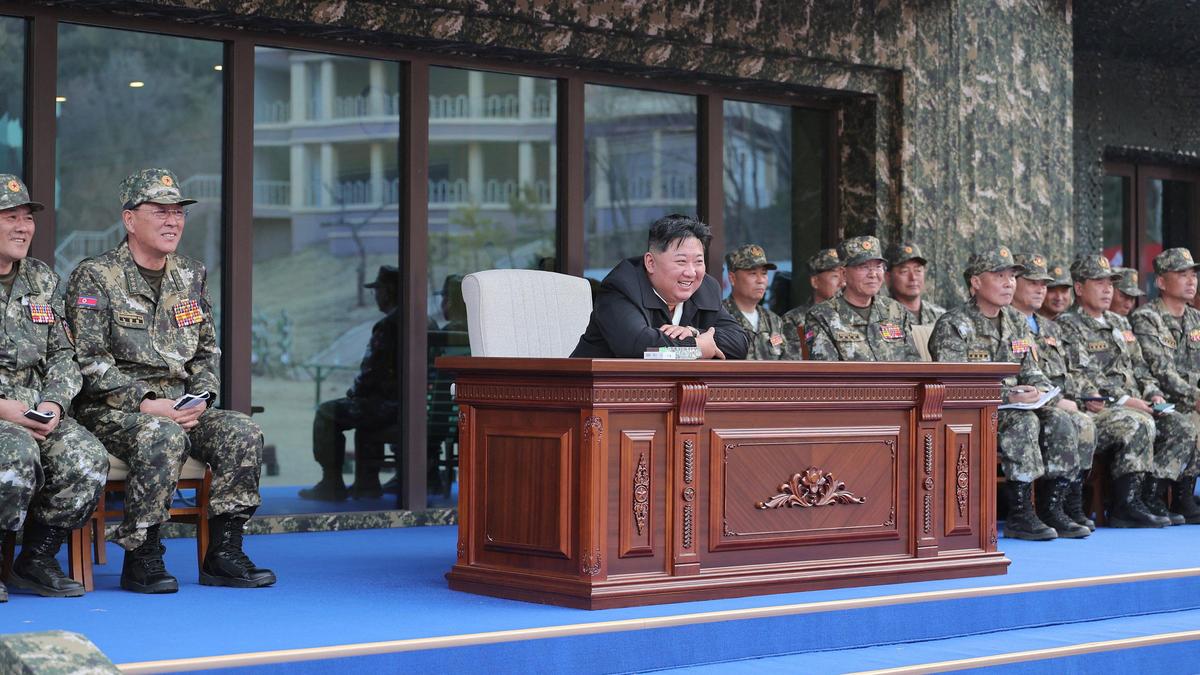
In the end, we are left staring at a photograph of a man in a leather jacket, smiling at a plume of fire, while the rest of the world holds its breath, wondering if the next sound they hear will be the wind or the ground beginning to scream.