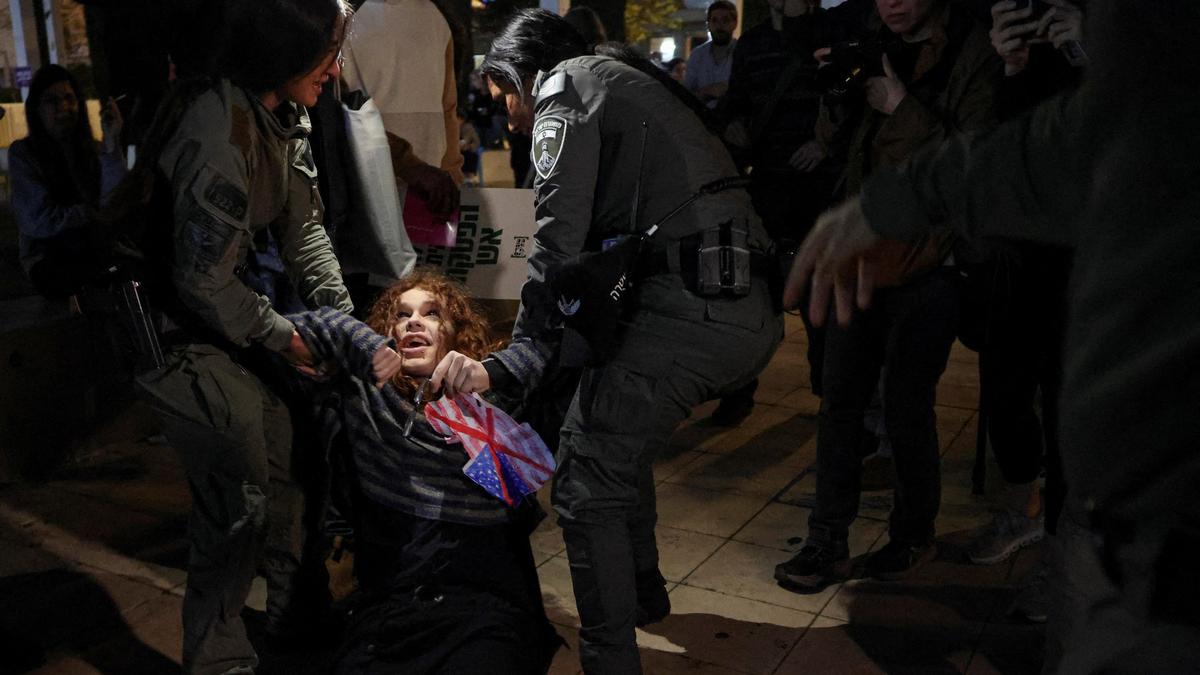
The streets of Tel Aviv and West Jerusalem are no longer just sites of mourning; they have become the primary friction point between a government committed to a long-term military campaign and a civilian population whose patience has hit a hard ceiling. While international headlines often focus on the broad strokes of regional conflict, the internal mechanics of Israeli dissent are shifting. Protesters are moving past simple vigils and into direct, physical confrontations with police forces. This escalation signals a fundamental breakdown in the social contract between the state and its citizens. The core of the anger isn’t just the war itself, but the perceived lack of a clear exit strategy and the secondary status of the remaining hostages in the government's priority list.
The Infrastructure of Civil Unrest
To understand why these protests are turning violent, you have to look at the demographics on the front lines. These are not just fringe activists. We are seeing a convergence of the high-tech workforce, military reservists, and the families of those held captive. When these groups merge, the resulting political pressure is immense. They are organized, they are funded, and they feel a deep sense of betrayal.
Police tactics have hardened in response. Mounted units and "skunk" water—a foul-smelling chemical dispersant—are now standard tools used against groups that, only a year ago, were viewed as the backbone of the country. This shift in law enforcement strategy suggests a directive from the top to suppress dissent before it can paralyze the nation's economy or military logistics.
The tension is most visible at the Kaplan Street intersection. Here, the noise isn't just from megaphones; it's the sound of a society debating its own survival in real-time. Protesters argue that the current path leads to a "forever war" that will drain the country’s resources and soul. On the other side, the state maintains that any sign of internal weakness emboldens external enemies. It is a classic deadlock, but one with live ammunition and heavy-handed arrests.
The Hostage Variable as a Catalyst
The hostage crisis remains the most volatile element in this domestic equation. For the families of those still held in Gaza, every day the war continues without a deal is seen as a death sentence signed by their own leaders. This isn't abstract politics. It is visceral.
The government’s stance is that military pressure is the only thing that will bring the hostages home. The protesters, backed by an increasing number of former security officials, argue the exact opposite. They point to the fact that the most significant releases happened during a pause in fighting, not during heavy bombardment. This disagreement has stripped away the "unity" that defined the early months of the conflict.
Security Failures and Lost Trust
Trust in the security establishment was the first casualty. The failure to prevent the initial breach has left a vacuum that the government hasn't been able to fill with rhetoric. When a population loses faith in the state’s ability to protect them, they stop following the traditional rules of engagement for protest.
We are seeing barricades being burned and highways blocked for hours. This isn't just about traffic disruption. It is a physical manifestation of the desire to stop the country in its tracks until the leadership changes course. The police are caught in the middle, tasked with maintaining order in a situation where the definition of "order" is being rewritten by the minute.
Economic Stagnation and the Cost of Conflict
Beyond the immediate violence of the protests, there is a slower, more grinding pressure building in the background. The Israeli economy is built on stability and global integration. Prolonged conflict and domestic chaos are toxic to these foundations.
- Credit Rating Downgrades: Global agencies have already signaled that the lack of a clear political resolution is a risk factor.
- Labor Shortages: With a significant portion of the workforce in uniform or on the streets, productivity has slumped.
- Tourism Collapse: An industry that once brought in billions is now a ghost of its former self.
The protesters understand these levers. By shutting down the Ayalon Highway, they aren't just making a point to the Prime Minister; they are showing the business community that the status quo is unsustainable. The hope is that the economic elite will eventually force the government's hand.
The Regional Implications of Internal Strife
The world is watching these protests, and so are Israel's neighbors. There is a dangerous perception that internal division equals military vulnerability. This is the argument the government uses to justify crackdowns. However, the counter-argument is that a democracy that cannot handle dissent is already compromised.
The clashes with police are being broadcast across the Middle East. They serve as a propaganda tool for some, but for others, they are a sign of a vibrant, if agonizing, democratic process. The risk is that the state's response—the arrests, the physical force, the rhetoric labeling protesters as traitors—starts to mirror the very regimes it claims to stand against.
The Role of International Pressure
While the protests are domestic, they are fueled by the global stage. As international support for the military operation fluctuates, the protesters feel more empowered to demand a ceasefire. They see the isolation of their country on the UN floor and fear that the current leadership is turning Israel into a pariah state.
This isn't just about optics. It's about the long-term strategic viability of the country. If the youth—the people expected to serve in the military and drive the economy—feel the state no longer represents their values, the brain drain will be permanent.
The Strategy of Escalation
Is there a way out? History suggests that when protests reach this level of intensity, one of two things happens: the government makes a major concession, or it moves toward a more authoritarian posture.
Currently, the trend is toward the latter. The police are being given broader powers to clear crowds. Legal maneuvers are being used to stymie the organization of large-scale rallies. But the protesters are also adapting. They are using decentralized tactics, popping up in multiple locations simultaneously to stretch police resources thin.
This cat-and-mouse game on the streets of Jerusalem and Tel Aviv is a microcosm of a much larger struggle. It is a battle over the definition of Zionism in the 21st century. Is it a commitment to a specific piece of land at any cost, or is it a commitment to a safe, democratic society for its people?
The clashes we see today are the physical manifestation of that ideological split. Every time a police baton falls, the divide grows deeper. Every time a highway is cleared, the resentment simmers until the next night. The government can clear the roads, but it cannot clear the sense of urgent, existential crisis that has taken root in the hearts of a massive segment of its population.
The focus must remain on the specific demands of the protesters: an immediate deal for the hostages and a clear plan for the "day after." Without these, the streets will continue to burn, regardless of how many police are deployed to extinguish the flames.