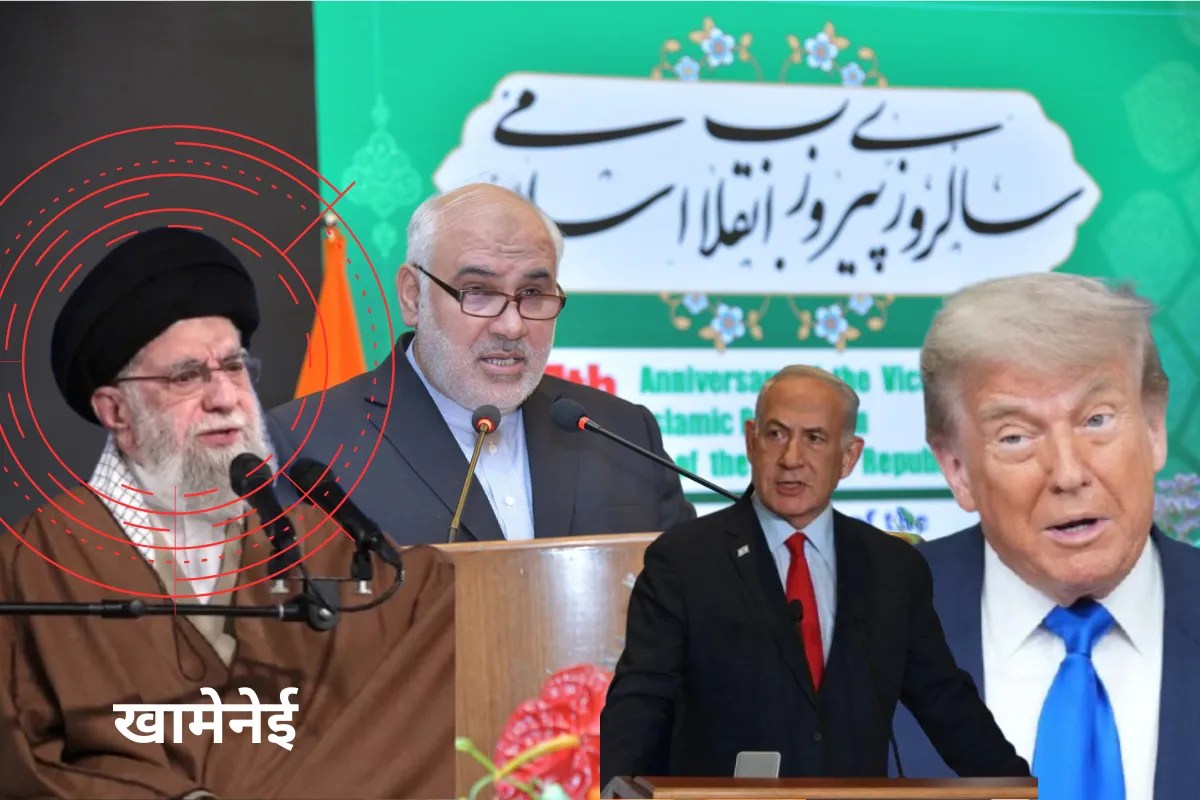
The survival of Iranian Supreme Leader Ali Khamenei is no longer just a matter of internal Persian politics. It has become the central pivot point for the entire Middle Eastern security architecture. Following a series of high-profile Israeli surgical strikes that decapitated the leadership of Hezbollah and dismantled Iranian command structures in Damascus, the question of Khamenei’s physical safety moved from the fringes of intelligence briefings to the center of global headlines. Israeli Prime Minister Benjamin Netanyahu recently signaled that no corner of the Middle East is beyond the reach of the Israeli Defense Forces, a statement widely interpreted as a direct warning to the 85-year-old cleric in Tehran.
While Iranian state media and the nation’s ambassador have rushed to project an image of calm and continuity, the reality on the ground suggests a massive, frantic reshuffling of the Supreme Leader’s security detail. Khamenei has reportedly been moved to a "secure location" within Iran, a move that confirms the gravity of the threat. This is not mere paranoia. For the first time in decades, the "ring of fire" strategy—Iran’s method of using proxies to keep conflict away from its own borders—has collapsed. The fire has reached the center.
The Failure of the Forward Defense Strategy
For forty years, Tehran operated under the doctrine of Forward Defense. By funding, training, and arming groups like Hezbollah, Hamas, and the Houthis, the Islamic Republic ensured that any war with Israel or the United States would be fought in Lebanon, Gaza, or Yemen. This created a buffer zone that protected the clerical establishment from direct kinetic threats.
That buffer died in 2024. The systematic elimination of Hassan Nasrallah, the long-time leader of Hezbollah and Khamenei's most trusted regional lieutenant, was more than a tactical loss. It was a psychological breach. If Israel could penetrate the deepest bunkers of Dahiyeh in Beirut, the logic in Tehran holds that they can penetrate the "Bait-e-Rahbari" (the House of the Leader) in Tehran.
The Iranian ambassador’s public confirmation of Khamenei's safety was intended to project strength, but in the world of high-stakes espionage, such loud denials often signal deep-seated anxiety. Intelligence agencies across the West are watching for shifts in electronic signatures and communication patterns that indicate a leadership in hiding. When a head of state has to be "confirmed alive" by their own diplomats, the aura of invincibility has already vanished.
Netanyahu and the End of Strategic Patience
Benjamin Netanyahu is a leader who has spent his entire political career identifying Iran as the existential threat to the Jewish state. For years, he was constrained by Washington’s desire for regional stability and the hope of diplomatic nuclear curbs. Those constraints have eroded.
The Prime Minister’s recent rhetoric marks a shift from containment to active dismantling. By stating that there is nowhere Israel cannot reach, Netanyahu is engaging in a form of psychological warfare designed to force the Iranian leadership into making mistakes. When a leader is forced to move frequently, their "chain of command" becomes brittle. Communications become slower. Decision-making is hampered by the logistical nightmare of staying off the grid.
Israel’s strategy is clear: make the cost of remaining the Supreme Leader higher than the Iranian establishment can afford. This isn’t just about a single drone strike or a missile. It is about demonstrating total intelligence dominance. If the Israelis know where the IRGC generals are meeting, and they know where the missile caches are hidden, the implication is that they also know the floor plan of Khamenei’s safe house.
The Intelligence Breach from Within
One factor that many analysts overlook is the degree of internal rot within the Iranian security apparatus. You do not lose a dozen top-tier commanders in six months without significant internal leaks. The Mossad has spent decades cultivating assets within the Iranian Revolutionary Guard Corps (IRGC). These are not just ideologues; they are often disillusioned officers or people susceptible to financial incentives.
The threat to Khamenei isn’t just an F-35 flying over Tehran. It is the person serving the tea in the bunker. The paranoia within the Supreme Leader's inner circle is currently at an all-time high. Arrests within the IRGC intelligence wing are frequent, as the regime hunts for the "moles" who provided the coordinates for the recent assassinations. This internal purge further weakens the regime, as it removes experienced officers and replaces them with loyalists who may lack the competence to actually protect the leadership.
The Nuclear Brinkmanship
As the physical threat to Khamenei increases, the likelihood of Iran sprinting toward a nuclear weapon also rises. Historically, when the clerical regime feels backed into a corner, it looks for the ultimate deterrent. The calculus is simple: if you are a nuclear power, the "regime change" rhetoric from the West and Israel becomes much more complicated.
However, this is a dangerous gamble. Any move to enrich uranium to 90% (weapons grade) would likely trigger the very strike that Khamenei is trying to avoid. The United States and Israel have both drawn a hard red line at Iranian nuclearization. We are currently witnessing a period where the Supreme Leader must decide between staying in the shadows to survive or emerging to assert authority, potentially inviting a terminal strike.
The Succession Crisis in the Shadows
If Khamenei were to be eliminated, or even incapacitated by the stress of constant relocation, Iran faces a succession crisis for which it is fundamentally unprepared. The death of Ebrahim Raisi in a helicopter crash earlier this year removed the "heir apparent" from the board.
Currently, the most discussed candidate is Mojtaba Khamenei, the Supreme Leader’s son. However, the Islamic Republic was founded on the rejection of hereditary monarchy. Elevating the son would be a betrayal of the revolution's core tenets and could spark widespread civil unrest. The IRGC, meanwhile, is looking for a leader they can control—someone who will maintain the flow of funds to their vast business empires.
The vacuum at the top is the greatest danger to the regime's survival. Without a clear, charismatic, and religiously sanctioned leader, the various factions within the IRGC and the clergy will likely turn on each other. Israel knows this. The goal of targeting the leadership is not just to kill an individual, but to trigger a systemic collapse of the governing structure.
Logistics of the Deep Bunker
Protecting a high-value target like Khamenei requires more than just bodyguards. It requires a total "blackout" of his environment. This means no cell phones, no internet-connected devices, and no electronic communications of any kind within a certain radius. For a modern head of state, this level of isolation makes it nearly impossible to govern a country of 85 million people effectively.
The IRGC has constructed "passive defense" sites—deep underground bunkers carved into the Zagros Mountains. These facilities are designed to withstand bunker-buster munitions and are stocked with enough supplies to last for months. But a leader in a mountain is a leader in a cage. He cannot address the public in person. He cannot inspect troops. He becomes a ghost. And in a country where the regime relies on the "Cult of the Leader," being a ghost is a recipe for losing the Mandate of Heaven.
Washington’s Delicate Balancing Act
The United States finds itself in a precarious position. While the Biden-Harris administration has provided the intelligence and hardware that allows Israel to operate, they are also terrified of a full-scale regional war that could spike oil prices and drag American boots back onto Middle Eastern soil.
The official line from Washington is that they were "not involved" in the strikes on Hezbollah leadership. Privately, American intelligence officials are likely sharing the same target sets with their Israeli counterparts. The objective is to keep the Iranian regime "off balance" without causing it to explode. But control is an illusion in war. One miscalculated strike that kills Khamenei could set off a chain reaction that no one in the White House or the Pentagon can stop.
The Economic Component of Survival
While the military threat is the most immediate, the economic decay of Iran is the silent killer of the regime's longevity. Sanctions have hollowed out the middle class. The rial is in a freefall. When the Supreme Leader goes into hiding, it sends a message to the markets: the end is near.
If the regime cannot pay the rank-and-file members of the Basij militia or the IRGC, the walls of the bunker won't matter. History shows that most authoritarian regimes don't fall to foreign invasion; they fall because the men with the guns decide it is no longer profitable to protect the old man in the palace. Khamenei’s security is currently tied to his ability to keep the military elite loyal. As Israel continues to hit IRGC assets across the region, that loyalty is being tested by the reality of constant defeat.
Reality of the Shadow War
The conflict has moved beyond the "Shadow War" phase. It is now a direct confrontation between the most advanced air force in the world and an aging theocracy that has overextended its reach. The ambassador's claims that Khamenei is "safe" are technically true for now—he is breathing, he is protected by meters of reinforced concrete, and his location is a closely guarded secret.
But safety is a relative term. A leader who cannot speak to his people, who cannot trust his generals, and who must move in the dead of night to avoid a missile is not a leader in control. He is a leader in retreat.
The next few months will determine if the Islamic Republic can withstand this level of pressure. Israel has shown it has the intelligence, the will, and the technology to strike at the heart of the regime. The Supreme Leader is currently the most protected man in Iran, but he is also the most vulnerable. The air in Tehran is thick with the scent of an ending, and no amount of official denials can change the fact that the architecture of Iranian power is crumbling from the top down.
Every movement Khamenei makes is now a calculation of survival. Every meal is tested. Every room is swept for bugs. This is the life of a man who realized too late that the proxies he built to protect him were never enough. The distance between Jerusalem and Tehran has never been shorter.
Monitor the movements of the IRGC's "Ansar-ul-Mahdi" protection unit; their level of activity is the only true barometer of how much danger the Supreme Leader actually fears. When the elite guards start disappearing from public view, you can be certain that the threats are no longer theoretical. The game of cat and mouse has reached its final, most dangerous stage.