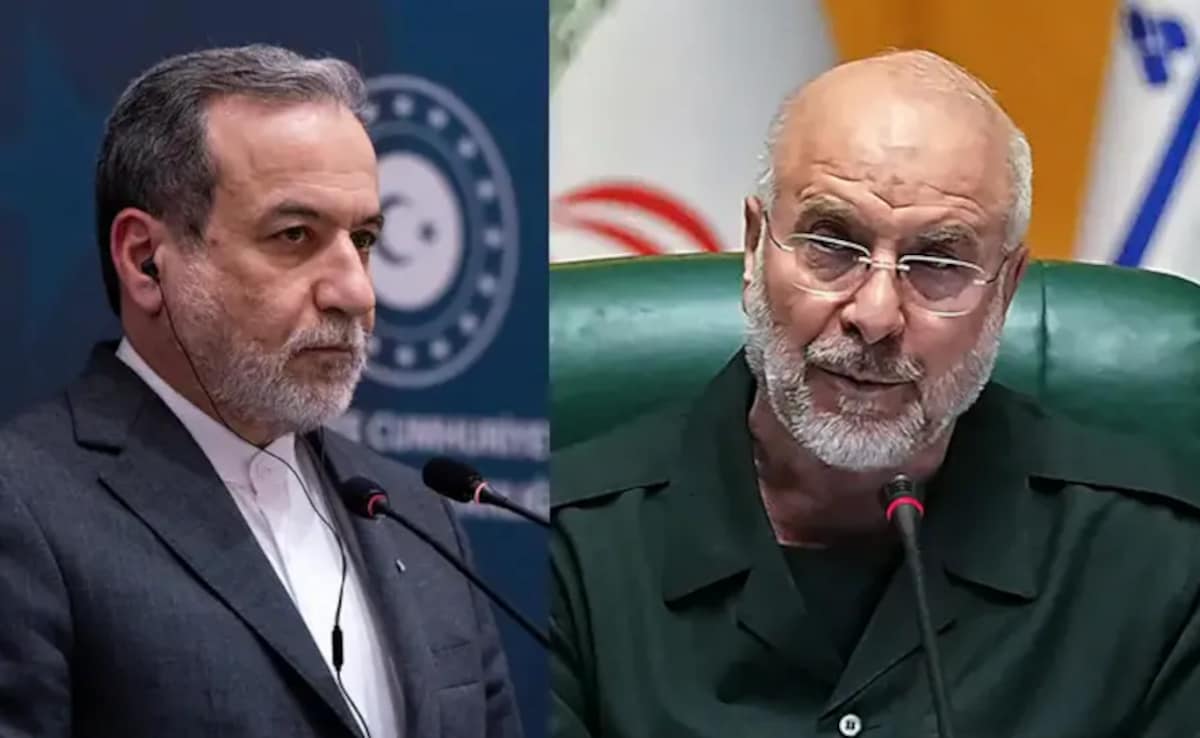
A red laser dot is a terrifying thing until it becomes a pointer for a conversation. In the high-stakes theater of Middle Eastern geopolitics, the difference between a high-value target and a necessary interlocutor is often measured in the breadth of a single heartbeat. For months, the names of Iran’s Foreign Minister, Abbas Araghchi, and Parliament Speaker, Mohammad Bagher Ghalibaf, were whispered in the halls of Israeli intelligence not as diplomats, but as data points. They were variables in an equation of elimination.
Then, the math changed.
To understand why a state would suddenly erase a name from a kinetic hit list, you have to stop looking at maps and start looking at the mechanics of human communication during a firestorm. When the missiles are in the air, you don't need fewer people to talk to. You need more.
The Architect and the Aviator
Consider Mohammad Bagher Ghalibaf. He isn't just a bureaucrat in a grey suit. He is a former commander of the Revolutionary Guard’s Air Force, a man who knows the cockpit of a fighter jet as well as he knows the floor of the Majlis. Recently, he made headlines by personally piloting a plane into Beirut while the city was under the shadow of Israeli bombardment. It was a bravado performance, a signal to the street that Tehran’s elite aren't hiding in bunkers.
In the cold logic of an assassination plot, such a man is a prime candidate for a "decapitation strike." He represents the bridge between the ideological military and the legislative state. Taking him out would be a symbolic and functional blow that would ripple through the very foundations of the Islamic Republic.
But there's a catch.
When a state decides to eliminate its enemies, it is usually operating under the assumption that the target’s death will bring about a more favorable outcome. Yet, if Ghalibaf is removed from the equation, who fills the void? The vacuum of power isn't filled by a moderate. It is filled by a ghost.
Israel’s calculation shifted because they realized Ghalibaf is a pragmatist with a survival instinct. He is a man who knows the cost of war because he has seen it through the canopy of a cockpit. In the middle of an escalation that could set the entire region on fire, he is a conduit. He is a person who can receive a message—not necessarily a friendly one—and understand the consequences of ignoring it.
The Negotiator’s Invisible Shield
Then there is Abbas Araghchi. If Ghalibaf is the pilot, Araghchi is the navigator. He is the Foreign Minister, a seasoned diplomat who cut his teeth on the JCPOA nuclear negotiations. He is a man who speaks the language of the West, the language of treaties, and the language of back-channel de-escalation.
For an intelligence agency, Araghchi is a fascinating problem. His proximity to the Supreme Leader makes him a high-value piece on the board. But his skill as a negotiator makes him something far more rare: a release valve.
Think of a pressure cooker. If you weld the release valve shut, the explosion is inevitable. In the current climate of "maximum pressure," the last thing Israel or its allies want is an Iran with no one left to answer the phone.
Araghchi was removed from the "kill list" not because of a sudden burst of humanitarianism, but because of a cold, hard strategic pivot. By keeping him alive, the opposition keeps a channel open. They maintain a way to communicate red lines that, if crossed, would trigger a catastrophic, multi-front war that no one—not Jerusalem, not Washington, and certainly not Tehran—is truly ready to fight.
The Mathematics of Survival
Every time a precision strike hits a residential building in Beirut or a military compound in Isfahan, the circle of "eligible" targets shrinks. This is where the human element becomes a liability for those seeking total victory. When you kill the generals, you are left with the zealots. When you kill the diplomats, you are left with the silence of a hair-trigger.
The decision to spare Araghchi and Ghalibaf is a quiet admission that even in the most brutal conflicts, there must be a skeleton of a state left to negotiate with.
A target is only useful if its destruction accomplishes a goal. If the goal is to prevent a nuclear breakout or to stop a regional conflagration, then the most effective weapon might not be a Hellfire missile. It might be a phone call to a man who knows he was spared.
This isn't mercy. It is management.
The Weight of the Invisible List
Imagine being the person whose name has been crossed out with a red pen, only to be rewritten in a different color. It’s a strange form of psychological warfare. You are alive because you are useful, and you are useful because you are the only one left who can talk.
This brings us to the core of why these two men are currently safe from the sudden, violent ends that met their predecessors. Israel is currently engaged in what military theorists call "shaping the environment." By systematically removing the operational commanders of Hezbollah and the logistical masterminds of the IRGC, they are thinning the herd.
But they are also creating a hierarchy.
By leaving the political and diplomatic heads intact, they are effectively telling the Iranian leadership: "We can reach anyone, anywhere. We chose not to reach you. Now, what are you going to do to ensure we keep making that choice?"
It is a conversation held in the language of missed opportunities and intentional restraint.
The Cost of a Clean Slate
There is a danger in a clean slate. If Israel were to eliminate every significant figure in the Iranian hierarchy, they would be facing a headless hydra. A headless hydra is unpredictable. It doesn't follow orders because there are no orders to follow. It lashes out in every direction at once.
For the Israeli security establishment, the survival of Ghalibaf and Araghchi is a hedge against chaos. They represent the "rational actor" theory in its most stressed state. If you believe your enemy is rational, you can influence them. If you believe they are merely a target, you can only destroy them.
The invisible stakes here are the lives of millions of people who have never heard of these men. If the channel breaks, the missiles fly. If the missiles fly, the borders dissolve.
By keeping the pilot and the negotiator on the board, the game continues. It is a grim, exhausting, and terrifying game, but it is one that has rules. And as long as there are players who understand those rules, there is a chance—however slim—that the game won't end in a total collapse of the stadium.
The red dot hasn't vanished. It has simply moved to the side of the table, waiting for the conversation to falter.
The silence that follows a strike is often louder than the explosion itself, but the silence between two people deciding not to kill each other is the only thing currently holding the world together.