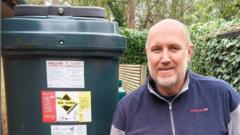
The air in the basement smelled of damp concrete and the faint, metallic tang of fuel oil. I stood there, shivering slightly in the November chill, staring at the gauge on the side of the tank. The little red disc floated near the top. Full. Or so it should have been. According to the receipt in my hand, I had paid for two hundred gallons of heating oil six weeks ago. According to the invoice that had arrived in my inbox this morning, I owed for those same two hundred gallons all over again.
Panic is a cold thing. It starts in the stomach and moves to the throat. For most of us, an unexpected bill for eight hundred dollars isn't just an inconvenience. It is a car repair that doesn't happen. It is a grocery budget slashed to the bone. It is the sudden, jarring realization that the systems we trust to keep our homes warm are governed by math that doesn't always add up.
I called the company. I expected an apology. I expected a quick "our mistake" and a digital eraser to swipe across the debt. Instead, I got a dial tone of bureaucracy.
The woman on the other end of the line was polite, but her voice was flat, polished by years of delivering bad news. She explained that while I had indeed "pre-paid" for my winter oil in August, the price had shifted. The company had undergone a "system migration." In the digital shuffle, my credit had been decoupled from my delivery. To the computer, I was just a house with a full tank and an empty ledger.
This wasn't a glitch. It was a symptom.
The Fiction of the Fixed Price
We like to believe that when we hand over money for a commodity, the transaction is finished. You give, they take, you own. But the energy market operates on a different set of physics. When you buy heating oil, you aren't just buying a liquid; you are buying a promise.
Consider the hypothetical case of a small-town supplier. Let's call them North Star Fuel. They have three delivery trucks, a loyal customer base, and a storage facility that holds fifty thousand gallons. In the summer, the owner sees prices dipping. They offer a "pre-buy" special to their customers. You pay $3.50 a gallon now, and they guarantee that price when the snow starts to fall.
It sounds like a win-win. You get peace of mind. They get an immediate infusion of cash to maintain their fleet.
But then, a refinery in the Gulf shuts down due to a hurricane. Or a pipeline in Eastern Europe is throttled. Suddenly, the wholesale price North Star Fuel has to pay to refill their own tanks jumps to $4.25. Every gallon they deliver to you at your "guaranteed" price is a seventy-five-cent loss for them. If they have a thousand customers like you, they are looking at a quarter-million-dollar hole in their pockets.
When businesses face that kind of pressure, the "glitches" start to happen. The billing errors lean suspiciously in the company’s favor. The fine print in the contract—the part about "transportation surcharges" or "administrative adjustments"—suddenly becomes the most important text in the document.
The Paper Trail is Your Only Armor
I spent three hours that Tuesday digging through my kitchen junk drawer. I needed the physical proof. In a world of digital auto-pay and paperless billing, we have become dangerously disconnected from our own records. We trust the portal. We trust the app.
But apps can be updated. Portals can be wiped.
I finally found the original contract, tucked behind a stack of take-out menus. It was a single sheet of blue paper with a coffee ring in the corner. That blue paper was the only reason I didn't lose eight hundred dollars. It explicitly stated that the price was locked regardless of market volatility or "operational changes."
Many people don't find that paper. They look at the bill, they feel the weight of the company's authority, and they pay. They pay because they are afraid of the alternative: a locked tank and a frozen house.
There is a specific kind of predatory energy in the way essential services are billed. You can choose not to buy a new pair of shoes if the price is too high. You can skip a meal at a restaurant. But you cannot choose to let your pipes burst in January. The companies know this. The leverage is entirely on one side of the scale.
The Ghost in the Machine
We are told that automation makes everything more efficient. In reality, automation often acts as a shield for human error or corporate greed. When a customer service representative tells you, "The system won't let me change that," they are usually lying—or they are working for a company that has intentionally built a system that cannot be reasoned with.
The "double charge" I experienced was blamed on a software update. Think about that. A multi-million dollar corporation managed to "forget" that thousands of people had already paid their bills because they switched from one database to another.
If I had walked into a grocery store, paid for a gallon of milk, and then been stopped at the door by a manager demanding a second payment because "the register rebooted," there would be a scene. It would be recognized as theft. Yet, in the realm of home utilities, we accept these "errors" as part of the modern landscape.
We have reached a point where the burden of proof has shifted entirely to the consumer. You are guilty of owing money until you can prove, with physical evidence and hours of your own uncompensated time, that you are innocent.
The Cost of Vigilance
I eventually won my battle. After three phone calls, two emails with scanned attachments, and a veiled mention of the state attorney general’s consumer protection division, my balance was restored to zero.
There was no "thank you." There was no "we value your business." Just a cold confirmation number sent from a "no-reply" email address.
But the victory felt hollow. I realized that for every person like me who had the time and the temperament to fight, there were ten others who didn't. There was the elderly man down the street who doesn't use email. There was the single mother working two jobs who couldn't spend ninety minutes on hold during business hours.
The "double charge" isn't always a mistake. Sometimes, it’s a stress test. It’s a way for a company to see how much friction the market will tolerate. If they overcharge ten thousand people and only one thousand complain, they have successfully extracted a massive, interest-free loan from the public—or worse, a permanent profit.
The true cost of these errors isn't just the dollar amount on the invoice. It’s the erosion of the social contract. It’s the constant, low-level anxiety that you are being fleeced by a ghost you can’t catch.
As I walked back down to my basement that evening, I looked at the tank again. It was just a big, painted hunk of steel. It didn't care about market rates or "system migrations." It just sat there, waiting to be emptied. I realized then that the only way to survive the modern economy is to be as cold and as precise as the machines that try to overcharge us.
Check the gauge. Save the paper. Trust nothing.
The furnace kicked on, a low rumble that vibrated through the floorboards. The heat began to rise through the vents, invisible and expensive. I stood in the dark for a long time, listening to the sound of my own money burning.