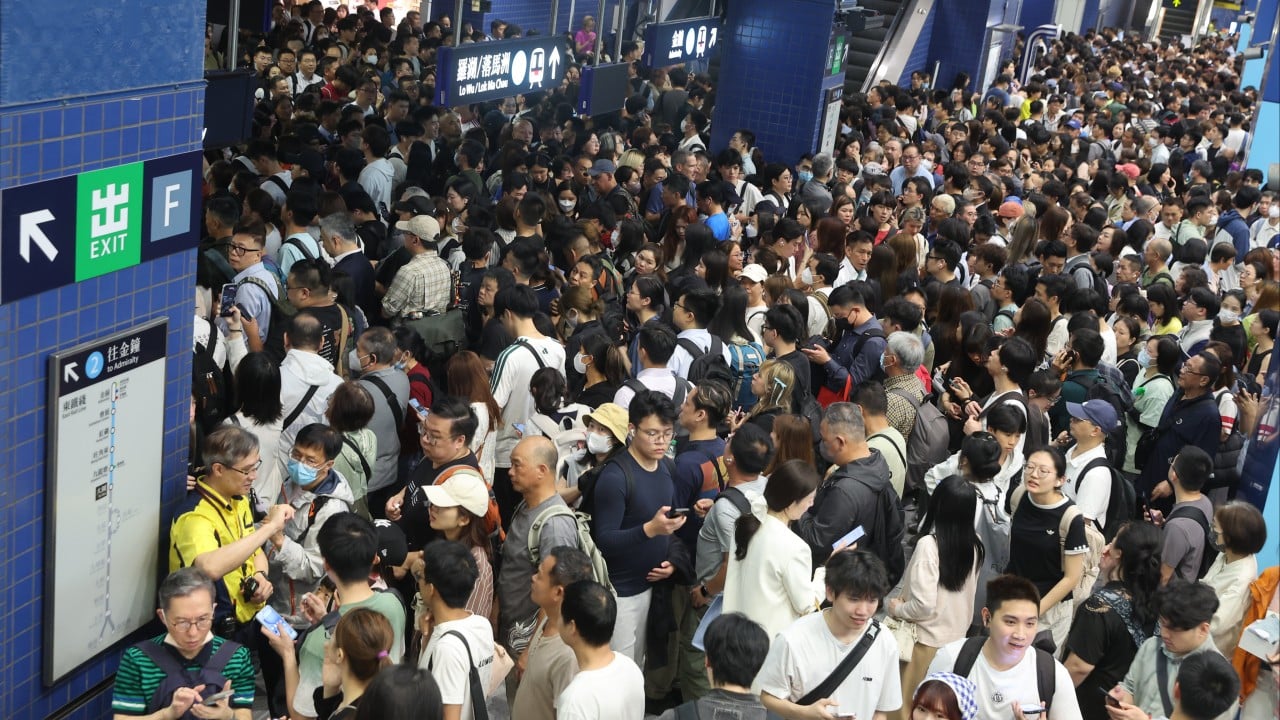
You’re standing on the platform at Admiralty, mid-rush hour, and the overhead display suddenly flips to a "service delayed" warning. The collective groan from the crowd is predictable. Most people assume it’s a mechanical glitch or a signal failure. But more often lately, the culprit is a human being standing exactly where they shouldn't be.
Hong Kong's MTR is arguably the most efficient transit system on the planet. It handles over five million trips on a weekday. When one person decides to hop onto the tracks—whether it's to retrieve a dropped iPhone, take a shortcut, or something more tragic—it doesn't just stop one train. It paralyzes an entire artery of the city. Don't forget to check out our recent post on this related article.
The recent spike in track intrusions has pushed the MTR Corporation and lawmakers into a corner. The current conversation is dominated by two demands: hit offenders with much heavier fines and build more glass doors. But if you think a bigger fine is the magic bullet, you’re missing the bigger picture of why this keeps happening.
The Reality of Track Intrusions in Numbers
It isn't just a "once-in-a-blue-moon" occurrence anymore. In the last year, the MTR has seen a noticeable uptick in cases where unauthorized people ended up on the ballast. While the East Rail Line used to be the primary hotspot due to its lack of platform gates at older stations, the problem has started creeping into other parts of the network. To read more about the background here, Al Jazeera offers an informative summary.
When someone enters the track area, the emergency braking system kicks in. Power gets cut. Then comes the mandatory safety sweep. This process usually takes at least 20 to 30 minutes, even if the person is removed immediately. Multiply those 30 minutes by the thousands of passengers stuck on that line and the connecting lines, and you're looking at a massive hit to the city's economic productivity.
The current penalty under the MTR By-laws for trespassing onto the tracks is a fine of $5,000 HKD. To a high-schooler or someone not thinking clearly, that might seem like a lot. But compared to the chaos they cause? It’s a slap on the wrist. Lawmakers are now pushing to double or even triple that figure.
Why Fines Are a Weak Deterrent
Raising a fine sounds great in a press release. It makes the government look "tough on crime." However, let's be real about who is actually ending up on the tracks.
Usually, these incidents fall into three buckets. First, you have the "accidental-intentional" group. These are people who drop a luxury item—usually a phone or an AirPod— and think they can jump down and grab it before the next train arrives. They aren't criminals. They’re just overconfident and don't understand how the third rail or the braking distance works. Will a $10,000 fine stop them? Maybe. But in that split second of panic over a $12,000 phone, most people aren't calculating by-law penalties.
The second group involves individuals in the middle of a mental health crisis. This is the darkest part of the MTR’s operational reality. A higher fine is completely irrelevant here. You can't "fine" away a public health crisis.
The third group is the most frustrating: the thrill-seekers and the "lost." We've seen an increase in tourists or confused commuters who simply don't follow the signage or, in some bizarre cases, try to use the tracks as a walkway between platforms.
The Platform Screen Door Problem
If you want to stop people from getting onto the tracks, you put a physical barrier in their way. It’s that simple. Most of the urban lines—like the Tsuen Wan or Island lines—are already sealed off with full-height or half-height platform screen doors (PSDs).
The East Rail Line is the problem child. Because it's an older line with different types of trains and varying door positions, installing gates has been a logistical nightmare for the MTR. They’ve been working on it for years, station by station.
But here’s the thing. Even with gates, people find ways. We’ve seen reports of individuals climbing over half-height gates or forcing their way through the gaps as the doors close. The hardware is only as good as the behavior of the people using it. The MTR is currently spending billions to retrofit the remaining stations, but that construction won't be finished tomorrow.
Education Needs to Get Blunter
The current "safety" posters in MTR stations are a bit too polite. They use cute mascots and soft colors to remind you not to cross the yellow line. That’s fine for kids. It doesn't work for a distracted adult with a TikTok addiction.
Public education needs a reboot. We need to move away from "please be careful" and toward "here is exactly what happens when you jump down there."
People need to understand the physics. A train traveling at 60 kilometers per hour cannot stop on a dime. Even if the operator sees you and slams the emergency brake, the momentum will carry those hundreds of tons of steel right over you. Then there’s the electricity. The third rail carries enough voltage to kill you instantly. It isn't a "scare tactic" if it's the literal truth.
The MTR should be showing more "behind the scenes" footage of the aftermath of track intrusions—not the gore, but the massive, grinding halt of the city. Make people realize that their one "quick jump" for a fallen earbud just ruined the day for 100,000 of their neighbors. Social pressure is often a better deterrent than a legal fine.
A Tech Driven Approach to Detection
Fines and gates are old-school solutions. If we're going to fix this, we need to talk about AI and thermal sensing.
The MTR is already experimenting with smart CCTV systems that can detect "unusual movement" near the platform edge. These systems can trigger an alert the moment someone leans too far over or if a person-sized object hits the track bed.
The goal should be to automate the power-cut process. Currently, there’s a human element involved in confirming the intrusion and hitting the "kill switch" for the overhead lines. If AI can shave 10 seconds off that response time, it’s the difference between a close call and a fatality.
What You Should Do Instead of Jumping
It happens to the best of us. You’re looking at your phone, the train doors open, someone bumps you, and your phone bounces into that gap. It feels like a disaster.
But here is the only thing you need to know: The staff can get it for you.
Every station has "grabbers"—long-handled tools designed specifically to fish items out of the track area. You find a staff member, tell them the platform number and the approximate location, and they will coordinate a retrieval. It might not happen during the rush hour peak because they have to wait for a gap in the schedule, but you will get your stuff back.
Jumping down yourself is essentially betting your life against the value of a piece of plastic and glass. It's a bad bet.
The Immediate Next Steps for the City
The government is likely to move forward with the increased penalties by the end of this legislative session. Expect the fines to hit the $10,000 to $15,000 range. But don't expect the delays to stop just because the law changed.
If you want to stay safe and keep the city moving, start by being the person who actually pays attention. Put the phone away when you're walking toward the platform edge. If you see someone acting erratically or looking like they might jump, don't just film it. Find the nearest emergency call button on the platform.
The MTR is our shared resource. We pay for it with our fares, and we pay for it with our time. It’s time we started treating the track area like the high-voltage, high-speed danger zone it actually is.
If you've dropped something, go to the station control room immediately. Don't be the reason five million people are late for dinner.