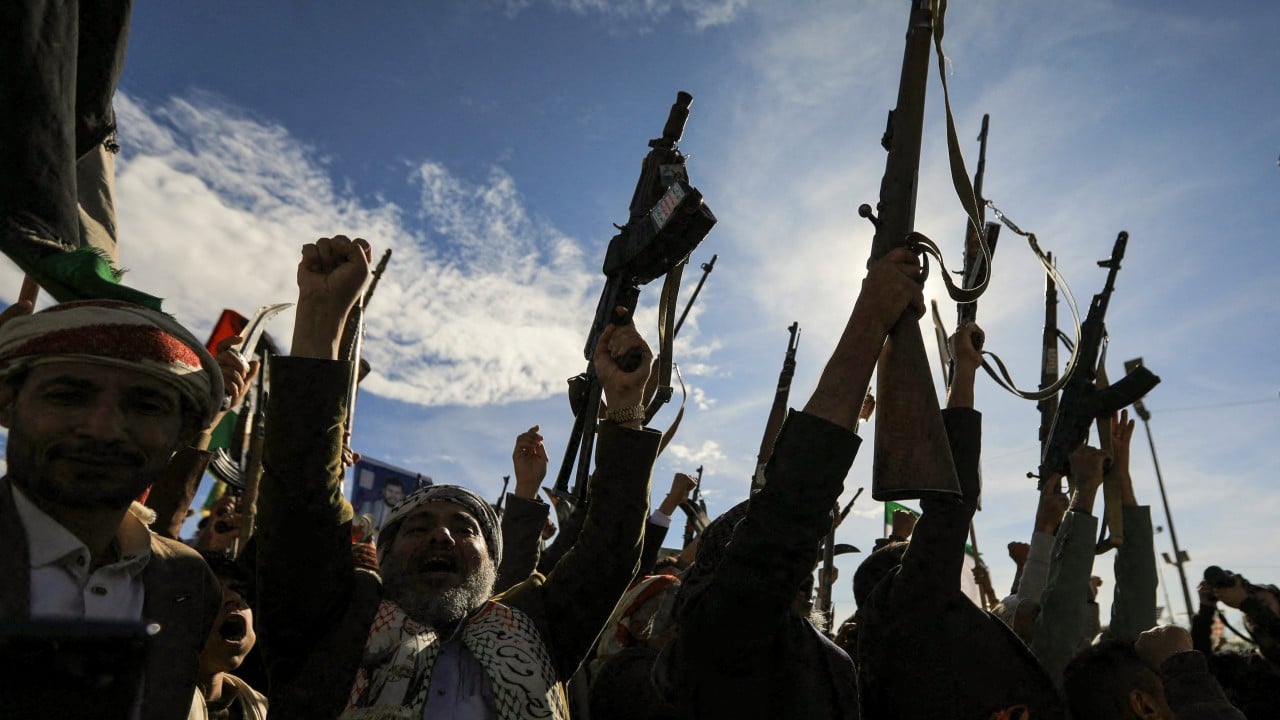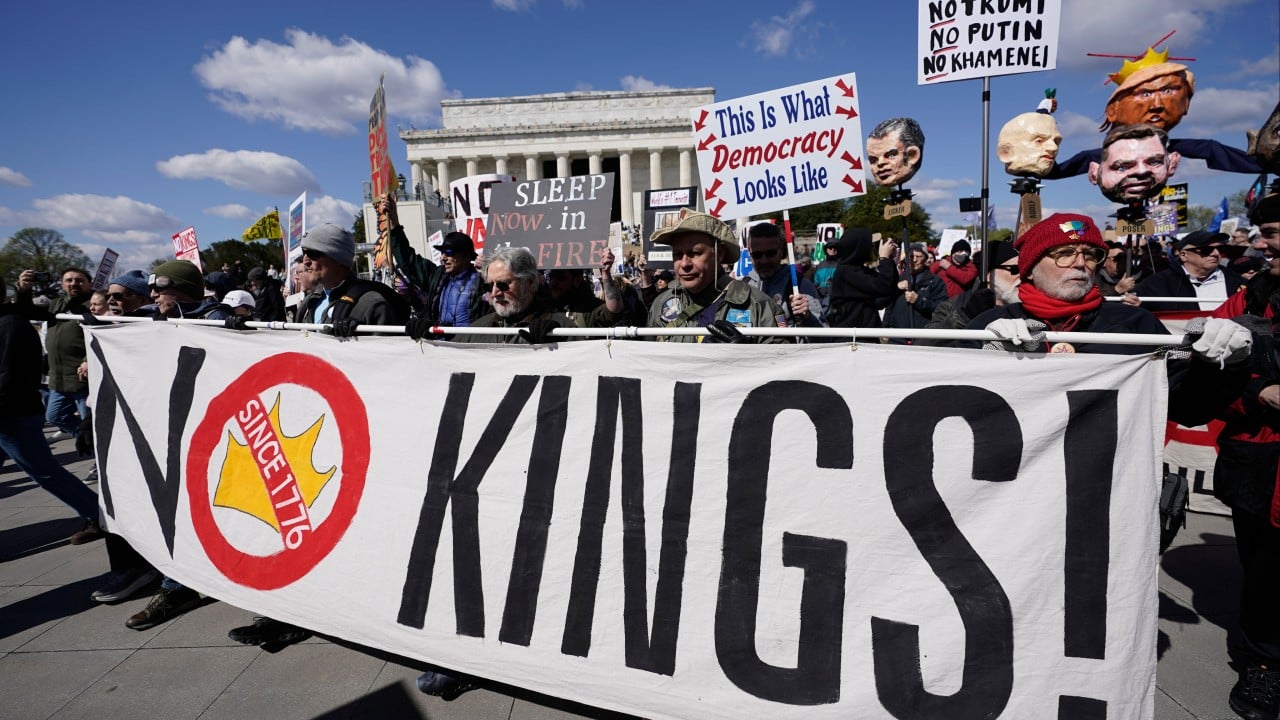
The current escalatory spiral involving United States and Israeli kinetic operations against Iranian interests represents a fundamental shift from strategic ambiguity to a high-frequency conflict model. This shift is not merely a series of tactical exchanges but a calculated recalibration of regional power dynamics that triggers specific domestic political feedback loops within the United States. When examining the intersection of the "No Kings" protests and the broadening Middle Eastern theater, we must evaluate the structural integrity of US foreign policy through three specific analytical lenses: the Attrition Equilibrium, the Domestic Legitimacy Gap, and the Sovereign Constraint.
The Attrition Equilibrium in Trilateral Warfare
Military engagement in the Middle East has moved beyond the traditional "deterrence" model into a state of active attrition. In this framework, the objective is not necessarily the total destruction of the adversary’s capability, but the systematic exhaustion of their economic and political capital. Iran operates through a decentralized network of proxies, creating a "cost-asymmetry" where the US and Israel spend millions on interceptors and precision munitions to neutralize low-cost drone and rocket technology. Meanwhile, you can read other stories here: The Cold Truth About Russias Crumbling Power Grid.
- The Interdiction Ratio: For every $1,000 Iran invests in offensive suicide drones, the US-led coalition often spends upwards of $1,000,000 in naval surface-to-air missiles. This 1000:1 ratio is unsustainable over a multi-year horizon without significant congressional appropriations that compete with domestic infrastructure or social spending.
- Kinetic Creep: What began as targeted strikes against IRGC leadership has expanded into a broader campaign against supply chains and financial nodes. This expansion forces the US to maintain a higher carrier strike group presence, straining the Navy’s rotational readiness for other theaters, such as the Indo-Pacific.
- The Intelligence Bottleneck: Maintaining high-tempo operations requires a constant stream of actionable signals intelligence (SIGINT) and human intelligence (HUMINT). As the conflict scales, the margin for error narrows, increasing the risk of collateral damage that fuels the domestic protest movements currently coalescing in American urban centers.
The Domestic Legitimacy Gap and the No Kings Framework
The "No Kings" protests, ostensibly timed with Presidents' Day or specific political anniversaries, serve as a proxy for a deeper skepticism regarding executive overreach in war-making. From a structural standpoint, these protests highlight a growing misalignment between the executive branch's "Grand Strategy" and the populace's "Social Contract."
The protesters’ rhetoric focuses on the concept of the "Unitary Executive." This legal theory suggests that the President possesses the power to control the entire federal executive branch. In the context of the US-Israel-Iran conflict, anti-Trump and anti-war factions argue that the bypass of formal Congressional declarations of war constitutes a monarchical shift in American governance. To explore the bigger picture, we recommend the excellent article by Al Jazeera.
The friction is quantified through public sentiment data which shows a bifurcation:
- The Security Realists: Believe that immediate kinetic intervention is the only way to prevent a nuclear Iran and maintain global energy price stability.
- The Constitutional Strict-Constructionists: View the lack of an Article I, Section 8 authorization (the Power to Declare War) as a systemic failure that threatens the democratic foundation of the Republic.
This internal tension creates a "Political Friction Coefficient." The higher this coefficient, the less freedom the administration has to escalate the conflict without risking significant electoral blowback or civil unrest that disrupts economic hubs.
The Sovereign Constraint: Economic and Diplomatic Limits
The assumption that the United States can sustain a high-intensity conflict indefinitely ignores the reality of the Sovereign Constraint. This constraint is defined by the limits of debt-financed military expansion and the diminishing returns of international sanctions.
Iran has developed a "Resistance Economy," pivoting its trade toward Eurasian partners to mitigate the impact of Western financial isolation. This shift reduces the effectiveness of the "Sanctions Tool" in the US foreign policy kit, leaving only military force as a viable lever. However, the military lever is tethered to the US Treasury. With the national debt exceeding $34 trillion, the cost of a sustained war against a state actor like Iran necessitates a re-evaluation of the "Guns vs. Butter" model.
Furthermore, the diplomatic cost of the US-Israel alignment is measurable in the "Global South Alienation Index." As the conflict persists, traditional allies in the Middle East and Southeast Asia are forced to hedge their bets, moving toward a non-aligned posture to avoid the economic volatility associated with closed shipping lanes in the Strait of Hormuz or the Red Sea.
Deconstructing the Protest Logic: Anti-Trumpism as a Catalyst
The "No Kings" day protests are not a monolith; they represent a convergence of traditional anti-war sentiment and specific opposition to the perceived "imperial presidency" associated with the Trump era and its potential return. The logic follows a specific syllogism:
- War in the Middle East requires centralized, swift executive power.
- The "No Kings" movement views centralized executive power as an inherent precursor to authoritarianism.
- Therefore, opposing the war is functionally equivalent to opposing the return of a "King-like" figure to the White House.
This creates a feedback loop where foreign policy decisions are no longer judged solely on their geopolitical merits but on their domestic symbolic value. This "Symbolic Load" makes it difficult for policymakers to execute nuanced maneuvers, as every drone strike is filtered through the lens of domestic partisan struggle.
The Failure of Current Strategic Metrics
Most analysts track the "Success" of the US-Israel-Iran war through "Battle Damage Assessments" (BDAs)—how many sites were hit, how many commanders were eliminated. This is a flawed metric. A more accurate measurement would be the "Strategic Displacement Rate."
- Displacement Rate: The speed at which Iran can replace lost assets compared to the speed at which the US can maintain political consensus for the cost of those strikes.
- Resilience Quotient: The ability of the Israeli domestic economy to withstand prolonged mobilization and rocket fire without a total collapse of its high-tech sector.
If the Displacement Rate of Iranian proxies exceeds the US political will to fund interdictions, the US is strategically losing, regardless of how many individual tactical victories it records.
Logistics of the Third Front: Cyber and Information Warfare
The war is not confined to the Levant or the Persian Gulf. A "Third Front" exists in the digital and cognitive realms. Iran’s cyber capabilities have matured significantly, targeting critical infrastructure in both Israel and the US. Simultaneously, the information war is fought on social media platforms, where "No Kings" organizers leverage real-time footage of the conflict to mobilize activists.
The "Information Decay" of government narratives is a critical bottleneck. In previous decades, the state held a monopoly on conflict imagery. Today, decentralized reporting creates a "Competing Reality" that the administration must constantly combat. This requires a diversion of resources into counter-disinformation units, further bloating the cost of the conflict.
Strategic Recommendations for Stability
The path toward de-escalation requires moving beyond the "Reaction-Action" cycle. Strategic stability can only be achieved by addressing the core drivers of the conflict rather than the symptoms.
- Re-establishing Congressional Oversight: To reduce domestic "No Kings" friction, the executive branch must seek a specific, time-bound Authorization for Use of Military Force (AUMF). This forces a public debate and shares the "Legitimacy Burden" with the legislative branch, cooling domestic protests.
- Transitioning to Defensive Tech-Centricity: Investing in laser-based directed energy systems (such as Israel’s Iron Beam) to flip the cost-asymmetry. Reducing the cost-per-kill from $1,000,000 to $10 would effectively neutralize the "Resistance Economy" drone strategy.
- Regional Integration Projects: Shifting focus toward the "IMEC" (India-Middle East-Europe Economic Corridor) to provide an economic alternative to the Iranian-aligned trade routes. Economic interdependence remains the only historically proven hedge against total war between regional powers.
The current trajectory suggests a deepening of the conflict that will continue to spark domestic unrest until the underlying tension between executive war powers and democratic accountability is resolved. The "No Kings" protests are not an outlier; they are an early warning system for a state approaching its strategic and social limits.
The administration must immediately pivot toward a "Legislative Consent" model for all future kinetic operations. Failure to do so will result in a total breakdown of the domestic consensus required to sustain a long-term presence in the Middle East, leaving the US vulnerable to a "Strategic Vacuum" that adversaries are already prepared to fill.