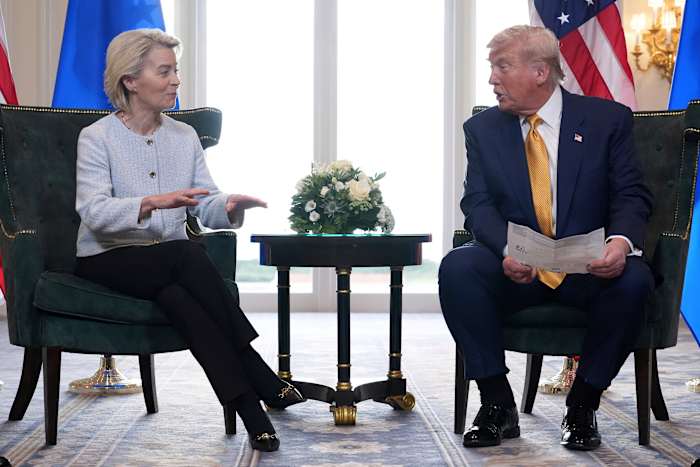
Brussels has finally blinked. After months of posturing and closed-door friction, EU lawmakers have rubber-stamped a sprawling trade agreement with the United States, framed by official press releases as a triumph of Western cooperation. The reality is far less polished. While the deal ostensibly lowers barriers for industrial goods and streamlines regulatory approvals, it does so through a series of "safeguards" that are, in practice, little more than diplomatic trapdoors. This isn't a bridge to a new era of economic harmony; it is a defensive crouch designed to prevent a full-scale trade war that neither side can afford.
The core of the agreement centers on the mutual recognition of safety standards for industrial machinery and electronic components. On paper, this allows a manufacturer in Munich to ship products to Michigan without undergoing a second, redundant round of testing. This sounds efficient. It looks good on a balance sheet. But the "safeguards" added by the European Parliament create a mechanism where either side can suspend these recognitions if they feel their domestic industries are being undercut by "unfair" subsidies.
The Illusion of Frictionless Commerce
Trade deals are often measured by what they include, but their true nature is revealed by what they exclude. This agreement pointedly ignores the two most contentious sectors in the transatlantic relationship: agriculture and digital services. By carving these out, lawmakers have ensured that the most volatile friction points remain unresolved.
European negotiators have spent the last decade obsessed with "strategic autonomy." This is a polite way of saying they are terrified of being squeezed between American capital and Chinese production. The safeguards embedded in this deal—specifically the "Emergency Rebalancing Clause"—allow the EU to reimpose tariffs if US energy prices give American firms a "disproportionate" advantage. It is a trade deal that includes a built-in kill switch.
History shows that when you give politicians a kill switch, they eventually use it. We saw this with the collapse of previous iterations of the Transatlantic Trade and Investment Partnership. The moment a domestic lobby, whether it be French farmers or German automakers, feels a cold draft from foreign competition, they lean on their representatives to trigger the fine print. This deal is no different. It provides the appearance of stability while maintaining the infrastructure for a protectionist pivot.
The Subsidy Arms Race
The most glaring omission in the current discourse is the impact of the US Inflation Reduction Act. For the past two years, the EU has complained that American green energy subsidies are a magnet for European capital, pulling factories across the Atlantic with the promise of cheap land and massive tax credits.
Brussels attempted to use this trade deal to gain "trusted partner" status, which would allow European companies to benefit from those same American subsidies. They failed. Instead, they settled for a lukewarm committee tasked with "harmonizing" subsidy transparency.
Consider the hypothetical case of a hydrogen fuel cell start-up in Lyon. Under this new deal, they might find it easier to export their physical hardware to the US. However, they are still competing against an American rival that receives a direct 30 percent tax credit for every unit produced. The trade deal simplifies the paperwork, but it doesn't level the playing field. European lawmakers know this. The safeguards they added are an admission that they expect to lose this fight in the long run.
Regulatory Drift and the Shadow of 2024
The timing of this approval is not accidental. With elections looming on both sides of the Atlantic, the current leadership in Brussels and Washington needed a "win" to show that the Western alliance is functioning.
But there is a widening gap in how these two powers view regulation. The EU follows the "precautionary principle," where a product is assumed risky until proven safe. The US follows a more reactive model, where innovation is encouraged until a specific harm is identified. This deal attempts to paper over that fundamental philosophical divide with a series of technical working groups.
These groups are where the deal will actually live or die. Far from the cameras, mid-level bureaucrats will argue over the specific voltage tolerances of circuit breakers and the chemical composition of industrial lubricants. If they cannot agree, the safeguards allow for a "snap-back" to previous tariff levels. This creates a permanent state of uncertainty for businesses. A company cannot plan a five-year investment strategy on a "maybe."
The China Factor
We cannot talk about the US and the EU without talking about Beijing. This trade deal is, at its heart, an attempt to build a unified front against Chinese market dominance in the electric vehicle and semiconductor sectors.
Washington wants Europe to align its export controls with American standards, effectively cutting off China’s access to high-end European technology. The EU is hesitant. China remains the largest market for German cars and Dutch lithography machines. The "safeguards" in the trade deal are partially intended to protect European firms from being caught in the crossfire of an American-led decoupling strategy.
The deal includes a "Third-Party Impact Assessment" clause. This allows the EU to pause cooperation if US trade policy toward China causes "unintended economic harm" to European interests. It is a clear signal to Washington: we will work with you, but we will not go down with your ship.
The Problem with Soft Law
Most of what was approved this week falls under the category of "soft law." These are non-binding agreements and memoranda of understanding that lack the force of a formal treaty. In the US, a formal treaty requires Senate ratification—a high bar that this deal would never clear in the current political climate.
Because it is not a treaty, it can be undone by an executive order or a change in parliamentary majority. This fragility is the deal's greatest weakness. Analysts who call this a "landmark agreement" are ignoring the fact that it is built on a foundation of sand.
Business leaders are already expressing skepticism. In a recent private briefing, a senior executive at a major aerospace firm noted that the cost of compliance with the "simplified" rules might actually be higher than the old system, simply because of the new reporting requirements necessitated by the safeguards. The bureaucracy hasn't been eliminated; it has just been rebranded.
The Real Winners
If the manufacturers aren't winning and the consumers aren't seeing lower prices, who is? The winners are the legal and compliance firms that will be hired to navigate the labyrinth of the new safeguard clauses.
We are entering an era of "managed trade," where the market is no longer the primary driver of exchange. Instead, trade is a tool of statecraft, used to reward allies and punish rivals. This deal is the blueprint for that new world. It is complex, defensive, and deeply cynical.
The EU has protected its regulatory sovereignty, and the US has secured a verbal commitment of cooperation. Both sides can go home and claim victory. But for the global economy, the friction remains. The barriers haven't been torn down; they’ve just been fitted with new, more expensive hinges.
Monitor the first meeting of the "Transatlantic Trade and Technology Council" following this vote. If they fail to produce a concrete list of synchronized standards for even a single sub-sector, like medical devices, the deal is dead on arrival. The paperwork will exist, but the trade will not flow.
Watch the energy markets. If the US continues to pull ahead in low-cost energy production, expect the EU to trigger those safeguards within eighteen months.
Move your supply chain assessments away from "market access" and toward "regulatory resilience." The era of easy globalization is over, replaced by a system where the fine print is more important than the product itself.