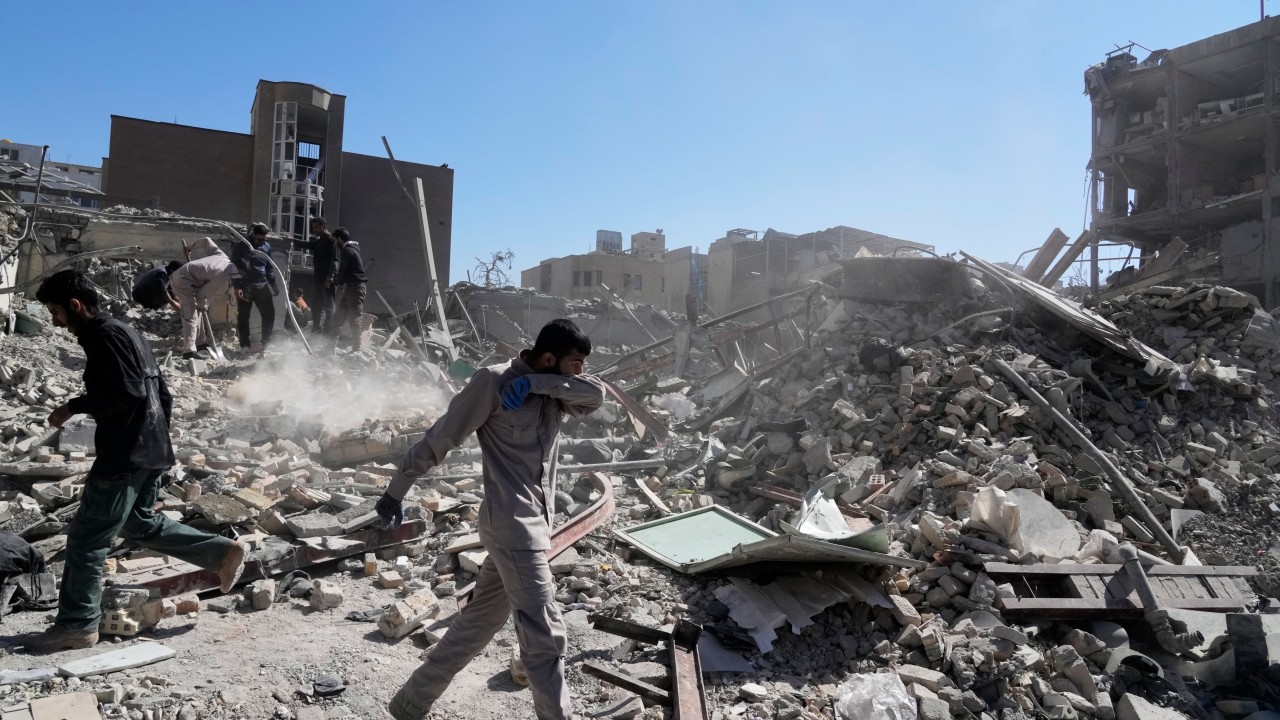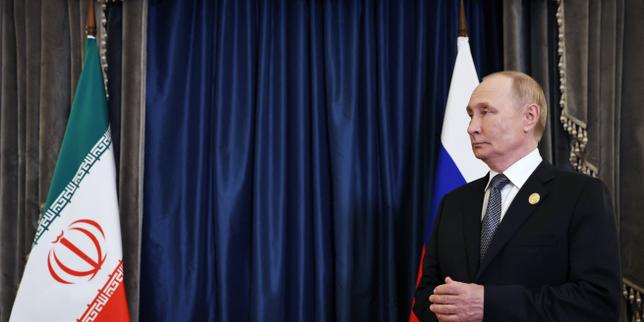
Moscow is currently watching its regional influence evaporate in real-time as the "Axis of Resistance" faces an existential reckoning. For decades, the Kremlin positioned itself as the indispensable alternative to Western hegemony, a security guarantor that could protect its allies with a combination of sophisticated air defenses and diplomatic weight. That image has shattered. As Israeli and American strikes dismantle Iranian infrastructure and proxy networks, Russia’s silence isn't a tactical choice. It is a forced admission of military and logistical exhaustion. The Kremlin cannot help Tehran because it has already gambled its entire strategic reserve on the plains of Ukraine.
The Paper Tiger of Tartus
For years, the Russian naval facility at Tartus and the Khmeimim Air Base in Syria were the crown jewels of Vladimir Putin’s Mediterranean strategy. These outposts were supposed to project power and deter Western intervention. Today, they look more like isolated outposts clinging to survival. Building on this theme, you can also read: Why the Green Party Victory in Manchester is a Disaster for Keir Starmer.
When Israeli jets penetrate Lebanese or Syrian airspace to strike Iranian shipments, the much-vaunted S-400 missile systems remain cold. This isn't just about avoiding a direct confrontation with the Israeli Air Force. It’s about a desperate need to conserve munitions and hardware. Every interceptor missile fired in Syria is one fewer available to defend the Black Sea Fleet or the refineries deep inside Russian territory. The technical reality is that Russia’s integrated air defense network in the Middle East was designed for a world where Russia held the initiative. Now, they are spectators.
The hardware gap is becoming impossible to ignore. While Russia maintains a physical presence, the quality of its "protection" has degraded. Reports from the ground suggest that Russia has even cannibalized some of its regional assets—shifting radar units and specialized personnel back to the Ukrainian front. This leaves Iran and its proxies, like Hezbollah, to face the most advanced electronic warfare and precision-strike capabilities in the world with little more than outdated Soviet-era blueprints and hopeful rhetoric. Observers at The New York Times have shared their thoughts on this matter.
The Broken Promise of the Su 35
Tehran’s frustration is palpable. For over a year, Iranian officials have hinted at the arrival of Su-35 Flanker-E fighter jets. These aircraft were promised as the centerpiece of Iran’s modernized defense, a way to finally contest the skies against F-35s and F-15Is. The jets haven't arrived.
The delay reveals a fundamental friction in the Moscow-Tehran marriage of convenience. Russia needs Iranian drones and ballistic missiles to keep its war machine grinding in Eastern Europe, but it cannot afford to give Iran the tools that might trigger a wider regional war. If Russia provides the Su-35s, it risks losing its remaining "deconfliction" channel with Israel. More importantly, Russia might simply be unable to produce them fast enough. The Russian defense industry is currently optimized for attrition, not high-end exports.
This creates a lopsided dependency. Iran is fueling Russia’s invasion with thousands of Shahed loitering munitions, yet in return, they receive little more than diplomatic cover at the UN—a currency that buys very little when the missiles start flying in Beirut or Isfahan.
The Intelligence Vacuum
The most devastating blow to the Russia-Iran alliance hasn't been a missile, but a failure of information. In previous escalations, Russia provided at least some level of signals intelligence or early warning to its regional partners. That flow has slowed to a trickle.
The Russian GRU and FSB are stretched thin, focusing every available asset on tracking Ukrainian troop movements and Western hardware entering the Donbas. They have effectively ceded the intelligence "high ground" in the Middle East to Mossad and the CIA. When high-ranking Iranian commanders are liquidated in the heart of Damascus, it proves that the Russian security umbrella is full of holes. The Kremlin’s inability to secure even its own backyard in Syria for its allies suggests a systemic collapse of their regional surveillance capabilities.
The Economics of a Disappearing Ally
Geopolitics is often just a balance sheet with guns. Russia’s economic pivot toward the "Global South" was supposed to create a financial bloc immune to Western sanctions. Iran was a key pillar of this plan. However, a country under siege cannot be a stable economic partner.
Russia’s primary export to the region—arms—is now a liability. Potential buyers in the Gulf and North Africa are watching Russian equipment fail or remain absent in the face of Western-backed strikes. They are seeing the "combat-proven" labels peeled off by reality. Why invest in a Russian defense contract when the manufacturer is too distracted to provide maintenance, spare parts, or even basic software updates?
The North-South Transport Corridor, a multi-billion dollar project intended to link Russian ports to the Indian Ocean via Iran, is also in jeopardy. This route was touted as a "Suez Canal killer," a way for Russia to bypass European sanctions. But you can't build a trade corridor through a combat zone. As Israel strikes targets closer to the Iranian logistics hubs required for this corridor, the project moves from a strategic priority to a pipe dream.
A Neutrality Born of Weakness
The Kremlin’s official statements regarding the current escalation are masterpieces of ambiguity. They call for "restraint" and "dialogue" while carefully avoiding any commitment to intervene. This isn't the sophisticated "multi-vector" diplomacy of a superpower. It is the cautious hedging of a power that knows it cannot fulfill its promises.
Consider the optics. While the U.S. moves carrier strike groups and THAAD batteries into the region to support its ally, Russia issues a press release. The contrast is a signal to every middle power in the region—from Riyadh to Cairo—that the Russian security brand is bankrupt. They are no longer a counterweight; they are a distraction.
The Proxy Dilemma
The "Axis of Resistance" was built on the idea that several fronts could be activated simultaneously to overwhelm the West. This strategy relied on the belief that Russia would at least tie down Western resources elsewhere. While Russia is certainly doing that in Ukraine, the "synergy" (a term we avoid, but the concept they use) is missing.
Russia’s involvement in Ukraine has actually simplified the calculus for the U.S. and Israel. It has clarified who the enemies are and unified Western defense production in a way that hadn't been seen in decades. Instead of Russia helping Iran, Russia’s actions have inadvertently ensured that Iran’s enemies are better armed and more alert than ever.
The Logistics of Abandonment
Moving military hardware is an exercise in physics and math. To truly assist Iran against a concerted Israeli-American campaign, Russia would need to establish an air bridge or a secure maritime route. Both are currently impossible.
The Bosporus is closed to most military traffic under the Montreux Convention. The air routes over Turkey are subject to NATO oversight. That leaves a narrow corridor through the Caucasus and the Caspian Sea. Russia is struggling to keep its own troops supplied in Kherson and Zaporizhzhia; the idea that they could spare the transport planes and fuel to resupply Hezbollah or the IRGC during a hot war is logistically illiterate.
Furthermore, Russia’s domestic instability—highlighted by the periodic internal frictions within its own military command—means that any high-risk foreign intervention is off the table. Putin cannot risk a "Black Hawk Down" moment in the Middle East while he is trying to project an image of control at home.
The End of the Post-Cold War Illusion
The current crisis marks the definitive end of the era where Russia could play the role of the "Great Mediator." For twenty years, Putin successfully navigated the complex rivalries of the Middle East, talking to the Israelis, the Iranians, the Saudis, and the Turks all at once. He could do this because everyone believed Russia had the power to tip the scales.
That belief is gone. The scales are tipping, and Russia is just another weight being moved by forces it can no longer control. The Iranian leadership is beginning to realize that their "pivot to the East" led them to a partner who is just as vulnerable as they are.
Russia’s inability to act isn't a secret. It's a loud, ringing silence that echoes across the Levant. Every time an Iranian-linked warehouse explodes in Syria and the Russian radars stay dark, the message is reinforced: you are on your own.
The Kremlin will continue to host delegations and sign "strategic partnership" agreements that aren't worth the paper they are printed on. They will offer lofty rhetoric about a "multipolar world." But in the brutal world of Middle Eastern power politics, rhetoric doesn't stop a bunker-buster. The reality is that Russia has been sidelined by its own ambitions, leaving its allies to face the fire with nothing but empty promises and outdated maps.
If you want to understand the future of this conflict, stop looking at the diplomatic cables coming out of Moscow. Look at the empty hangars in Syria and the overstretched factories in the Urals. The shield is hollow, and the price of that emptiness is being paid in the ruins of the "Axis of Resistance."
Audit your own perspective on regional stability by mapping the actual physical locations of Russian hardware versus their stated defense commitments.