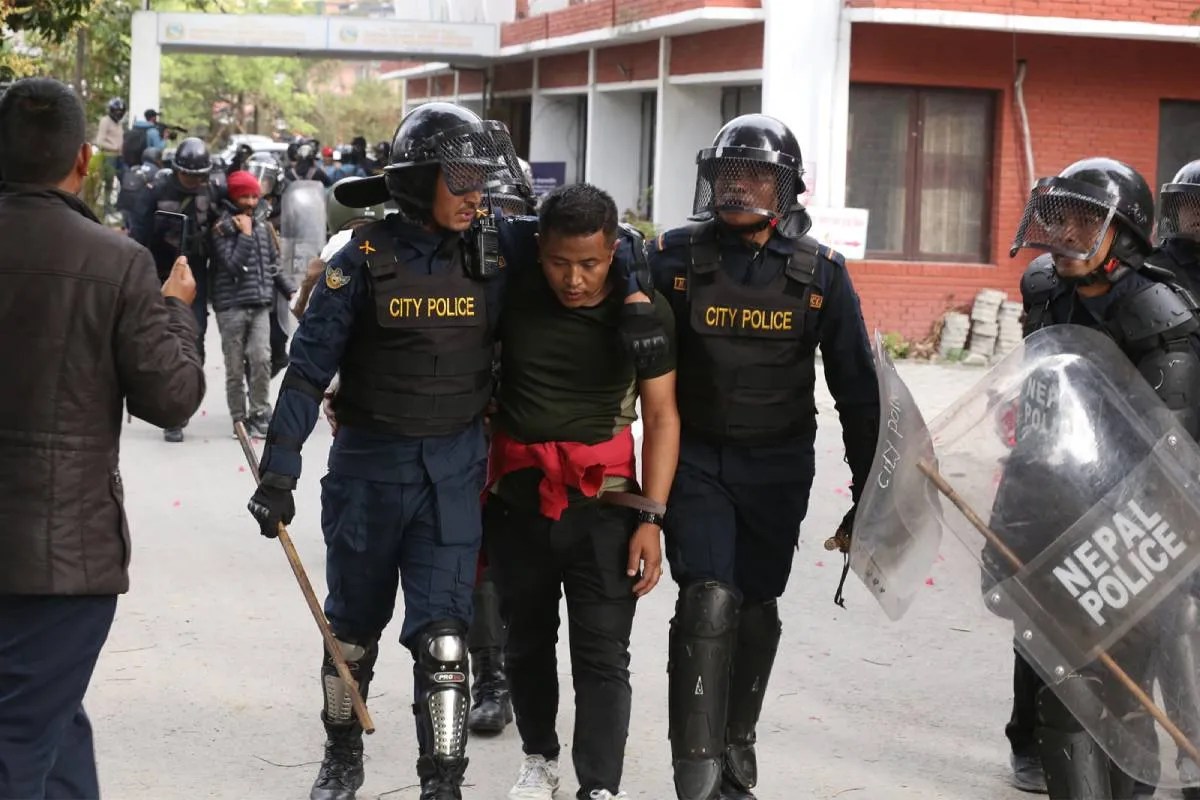
The tear gas drifting through the streets of Kathmandu is a familiar scent for a generation raised on revolution. When news broke of the latest detention involving high-ranking political figures, the reaction was swift, visceral, and entirely predictable. Protesters clashed with police near the Prime Minister’s residence, while the usual suspects in the political theater traded accusations of authoritarianism and corruption. But to view this merely as a localized riot or a standard police action is to miss the structural rot that has defined Nepalese governance since the monarchy fell. This isn't just about one man or one arrest. It is a symptom of a fractured state where the rule of law is frequently sidelined by the rule of the deal.
Nepal stands at a crossroads where every direction seems to lead back to the same dead end. The current volatility, sparked by the aggressive pursuit of political leaders under various charges, has effectively paralyzed the capital. For the average citizen, the sight of burning tires and baton charges is no longer a call to democratic arms; it is a recurring nightmare that stalls the economy and frightens away the foreign investment the country desperately needs.
The Mechanics of Political Retribution
In the complex ecosystem of Kathmandu’s Singha Durbar, the line between justice and vendetta is often invisible. Investigative history shows that whenever a coalition shifts, the incoming power block utilizes the state’s investigative machinery to settle old scores. This cycle creates a "survival of the loudest" environment where policy takes a backseat to self-preservation. When a major political figure like K.P. Sharma Oli or his contemporaries faces legal scrutiny, the response is rarely a quiet courtroom battle. Instead, it is a mobilization of the party's "sister organizations"—the student unions and youth wings—to the streets.
This mobilization serves a specific purpose. It signals to the judiciary and the international community that the individual is too powerful to be processed through standard legal channels without significant social cost. It is a high-stakes game of chicken played with the nation's stability as the ante. The recent flare-ups in Kathmandu demonstrate that the street remains the ultimate arbiter of Nepalese politics, regardless of what the constitution says.
Geopolitical Shadows over the Bagmati
Nepal does not exist in a vacuum. To understand the "why" behind the sudden urgency of these arrests and the subsequent violence, one must look at the northern and southern borders. Kathmandu is currently the site of a silent tug-of-war between New Delhi and Beijing, with Washington increasingly making its presence felt through developmental aid and strategic partnerships.
China’s interest in a stable, unified communist front in Nepal is a matter of public record. Conversely, India prefers a more traditional, pluralistic political landscape that aligns with its security interests. When a prominent leader is sidelined, it shifts the gravitational pull of the entire region. The current unrest suggests that internal factions are being bolstered by external expectations. This isn't a conspiracy theory; it's the reality of being a "yam between two boulders," as King Prithvi Narayan Shah famously described the country. Every brick thrown in Kathmandu echoes in the diplomatic corridors of neighboring capitals.
The Economic Toll of the Chaos
While the headlines focus on the arrests and the brawls, the ledger tells a grimmer story. The Nepalese rupee is under pressure, and the tourism sector—the lifeblood of the economy—recoils every time "heavy tension" is reported in the international press.
- Investment Flight: Foreign investors seek predictability. The sight of a former Prime Minister being embroiled in a legal and physical standoff suggests a lack of institutional continuity.
- Brain Drain: The brightest minds in Nepal are watching these events from the departure lounge of Tribhuvan International Airport. They see a system that rewards loyalty over merit and chaos over commerce.
- Infrastructure Stagnation: Projects related to hydropower and road connectivity, often funded by international grants, stall when the bureaucracy is too afraid to sign off on anything for fear of future prosecution.
The Myth of the Great Reformer
Every leader in Nepal’s modern era has climbed to power on a ladder of promised reforms. Yet, once they reach the summit, the ladder is kicked away. The rhetoric of "anti-corruption" is the most common weapon used in this struggle. It is a convenient banner because it appeals to the disillusioned public, but it is applied with surgical inconsistency.
True reform would require an independent judiciary and a police force that does not change its priorities with every change in the Home Ministry. Currently, the Anti-Corruption Bureau and the police are seen as extensions of the ruling party’s will. This perception is what fuels the violence. When the public believes the system is rigged, they stop trying to fix it through the ballot and start trying to break it through the brick.
The Youth Factor and the Changing Guard
There is a ticking clock that the established political elite chooses to ignore. Over half of Nepal’s population is under the age of 30. These are people who did not fight in the civil war and have no personal loyalty to the aging lions of the 1990s and 2000s. Their frustration is not just with a single arrest; it is with a political class that has remained stagnant for three decades.
The rise of independent candidates and smaller, urban-focused parties in recent elections was a warning shot. The current violence in Kathmandu may be led by party loyalists, but the silence of the wider public is equally telling. There is a profound sense of exhaustion. The "bhajis" and "netas" who have dominated the stage since the transition to democracy are increasingly out of touch with a generation that wants high-speed internet and global job opportunities rather than ideological purity and street protests.
Broken Institutions and the Path of Least Resistance
The crisis reveals that the institutions designed to act as checks and balances are brittle. The Parliament is often prorogued to avoid difficult votes, and the Office of the President has, at various times, been accused of acting as a rubber stamp for the executive. When the formal channels of grievance are blocked, the energy must go somewhere. Usually, it goes into the streets.
We see this play out in the way arrests are handled. Instead of a professional service of a warrant, it becomes a televised spectacle. This is intentional. It is designed to humiliate the opponent and galvanize the base. It is theater masquerading as governance. The "heavy tension" in Kathmandu is the intended output of this process, not an accidental byproduct. It allows the government to declare a state of emergency or impose restrictive orders, further consolidating power.
The Credibility Gap
For any government to successfully prosecute a high-level political figure without causing a riot, it must possess "moral capital." This is where the current administration, and those that preceded it, fail. When the person leading the charge against corruption is himself surrounded by individuals with questionable records, the public sees hypocrisy, not justice.
This credibility gap is why a simple police matter turns into a national crisis. The supporters of the arrested leader don't necessarily believe their hero is innocent; they simply believe the people arresting him are equally guilty. In a country where almost every major project—from the Melamchi Water Supply to the various hydropower deals—has been dogged by allegations of kickbacks, the "corruption" tag loses its sting. It becomes just another word for "politics."
Navigating the Rubble
The immediate future of Nepal depends on whether the current leadership chooses to escalate or de-escalate. History suggests that a compromise will eventually be reached behind closed doors, often involving a "gentleman’s agreement" that allows everyone to save face while the legal charges are quietly mothballed. This "Bhagbanda" (sharing of the spoils) system is the secret engine of Nepalese politics. It keeps the wheels turning, but it moves the country nowhere.
If the violence continues, the risk of military intervention, however slight, begins to enter the conversation. The Nepal Army has traditionally stayed out of active politics, maintaining its role as a neutral guardian. However, if the civilian police lose control of the capital and the political leadership proves incapable of maintaining order, the pressure on the barracks will increase. This would be a catastrophic regression for a democracy that is still trying to find its feet.
The international community’s response has been characteristically muted, focusing on "restraint from all sides." Behind the scenes, however, the pressure is mounting. The United States, India, and China all have a vested interest in ensuring that the instability does not spill over into a full-scale humanitarian or security crisis.
Beyond the Barricades
The smoke will eventually clear from Kathmandu’s squares, but the underlying tensions will remain. Nepal's political class is operating on borrowed time and borrowed money. The youth are leaving, the economy is stagnant, and the geopolitical neighborhood is getting more dangerous.
The real story isn't the arrest of a politician or the clashes in the street. The real story is the persistent failure of a revolutionary generation to transition from "overthrowing" to "building." Until the incentive structure of Nepalese politics shifts from short-term agitation to long-term administration, the capital will remain a city of barricades.
Demand a transparent timeline for the legal proceedings and an independent audit of the state’s investigative agencies to ensure they are not being used as political cudgels.