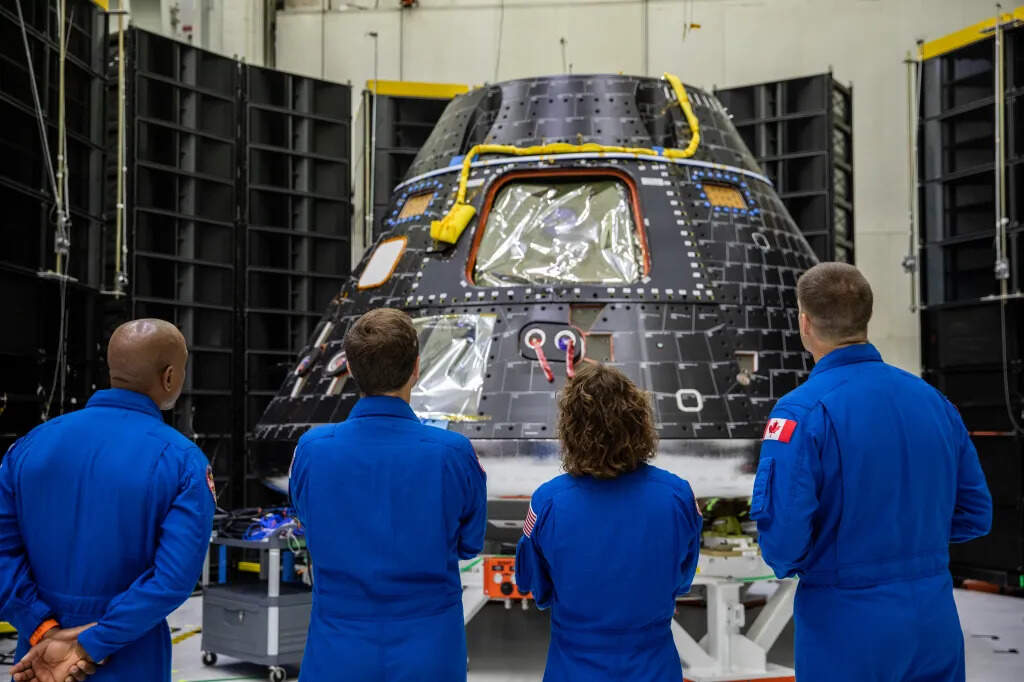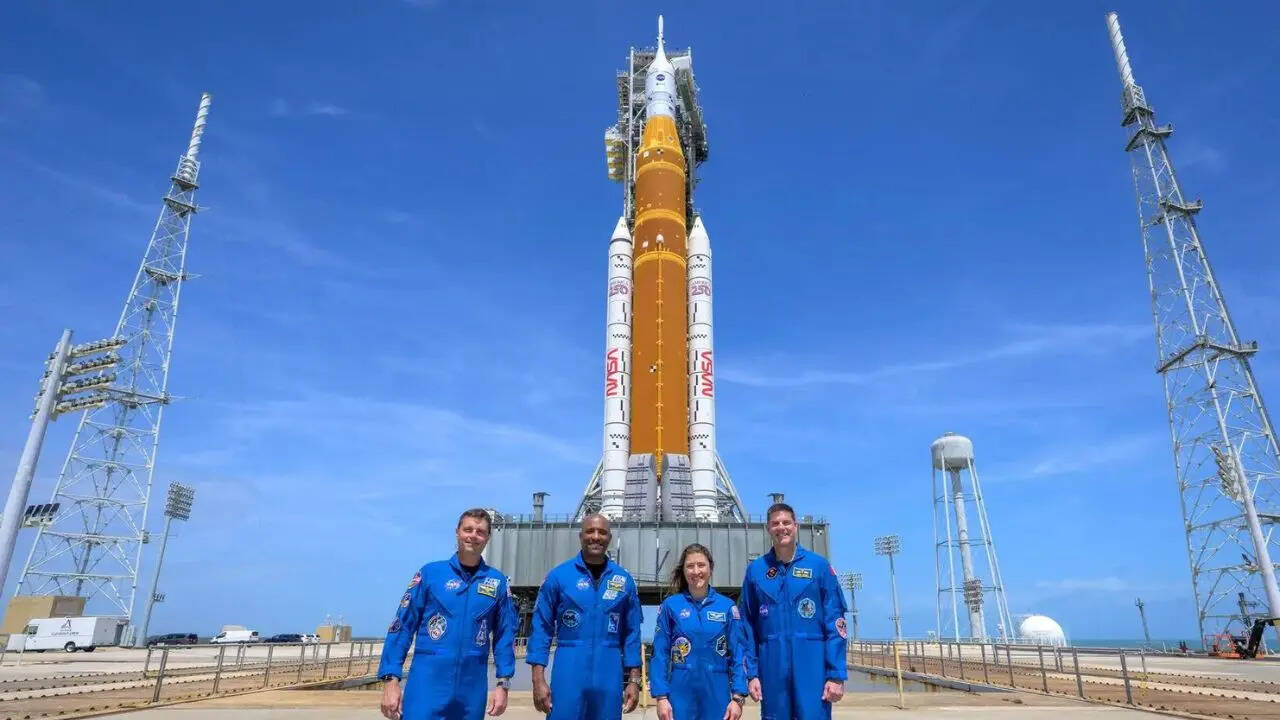
After five decades of low-Earth orbit stagnation, NASA is finally pushing back toward the Moon. Artemis II represents the first crewed mission to the lunar vicinity since the final splashdown of Apollo 17 in 1972. This is not a repeat of history. Unlike the Cold War sprint of the 1960s, this mission is a fragile bridge between government-led exploration and a commercialized future that remains largely unproven. The crew—Commander Reid Wiseman, Victor Glover, Christina Koch, and Jeremy Hansen—are essentially test pilots for a spacecraft that must function perfectly in a radiation environment that has not been human-tested in half a century.
The primary objective is a ten-day flight that will propel the Orion spacecraft on a "free-return trajectory." This means the capsule will use the Moon’s gravity as a slingshot to swing back to Earth without requiring a massive engine burn for the return trip. It is a conservative, safety-first flight path designed to test life support systems, communication arrays, and the heat shield. Don't forget to check out our previous post on this related article.
But beneath the official press releases lies a complex web of engineering risks and political pressures. This mission is the ultimate stress test for the Space Launch System (SLS), a rocket built on legacy technology that costs over $2 billion per launch. If Artemis II succeeds, it validates a multi-billion dollar architecture. If it falters, it may accelerate the shift toward private industry heavy-lifters like SpaceX’s Starship.
The Heat Shield Problem
The most critical technical hurdle facing the Artemis II crew isn't the launch; it’s the return. During the uncrewed Artemis I mission, the Avcoat ablative heat shield on the Orion capsule behaved in ways engineers didn't expect. Instead of wearing away evenly as designed, small chunks of the material charred and broke off in a process called "spalling." To read more about the background here, Wired offers an informative breakdown.
NASA spent over a year analyzing this data. The agency concluded that while the shield remained safe, the root cause was a phenomenon where gases trapped inside the shield's honeycomb structure expanded during the intense heat of reentry. When Orion hits the atmosphere at 25,000 miles per hour, temperatures reach nearly 2,760°C. At those speeds, even a minor structural flaw in the thermal protection system can lead to catastrophic failure.
The decision to fly Artemis II with the existing heat shield design is a calculated risk. Engineers have implemented tighter quality controls and shifted how the material is applied, but the physics of reentry remains the most dangerous variable of the entire mission. The crew is essentially betting their lives on the margin of error calculated by computer models that were slightly off during the last flight.
Living in a Phone Booth
While the Apollo Command Module was notoriously cramped, Orion offers roughly 50% more habitable volume. However, for four adults living together for ten days, it remains an exercise in extreme claustrophobia. The interior is roughly the size of a small SUV.
Unlike the International Space Station, there is no "down" and no private quarters. The crew will eat, sleep, and perform science experiments within inches of each other. This mission will test the Environmental Control and Life Support System (ECLSS) in ways that ground simulations cannot replicate. On Artemis I, the system was only tasked with keeping a mannequin "alive." Now, it must scrub carbon dioxide, manage humidity, and provide breathable oxygen for four high-performance athletes under high-stress conditions.
The mission profile includes a specific period known as the Optical Navigation test. Once the crew reaches high Earth orbit, they will manually fly the Orion capsule relative to the spent upper stage of the SLS rocket. This isn't just for show. It is a vital backup skill. If long-range communications or GPS-like tracking fails near the Moon, the crew must be able to navigate using the stars and the lunar horizon alone.
The Radiation Reality
Once Orion leaves the protective cocoon of Earth’s magnetic field, the crew will be exposed to deep-space radiation. This includes Galactic Cosmic Rays (GCRs) and the potential for Solar Particle Events (SPEs).
NASA has outfitted Orion with specialized shielding in the storage lockers. In the event of a massive solar flare, the crew will have to create a "storm shelter" by piling equipment and water bags around themselves in the center of the capsule. It is a low-tech solution to a high-tech problem. While ten days is a short duration compared to a Mars mission, a poorly timed solar storm could still deliver a significant biological dose of radiation.
The mission also serves as a trial for the Deep Space Network (DSN). Communicating with a ship 240,000 miles away is fundamentally different from talking to the ISS. There is a perceptible delay. Signal strength fluctuates. Artemis II will utilize laser communications for the first time on a crewed lunar mission, allowing for high-definition video feeds that will make the Apollo-era grainy footage look like ancient history.
The Geopolitical Stakes
We are currently in a second space race, but the competitors have changed. China is aggressively pursuing its own lunar landing goals, aiming for a crewed mission by 2030. For the United States, Artemis II is a demonstration of dominance. It is meant to show that the U.S. and its partners—specifically Canada, which provided Jeremy Hansen for the crew—still lead the world in deep-space operations.
However, the "legacy" nature of the SLS rocket is a point of contention. Each SLS launch is an expendable event; hundreds of millions of dollars in hardware drop into the ocean every time the engines fire. This stands in stark contrast to the reusable philosophies of the private sector. If Artemis II experiences significant delays or cost overruns, the political appetite for the SLS may vanish.
The mission is also a test of the Artemis Accords, a set of international agreements intended to govern lunar exploration. By including a Canadian astronaut, NASA is signaling that the Moon is no longer a strictly American playground. It is a diplomatic maneuver as much as a scientific one.
Why the Moon Matters Again
Critics often ask why we are returning to the Moon when we have already been there. The answer lies in the Lunar South Pole. Unlike the equatorial regions visited by Apollo, the South Pole contains "permanently shadowed regions" where water ice is believed to exist in vast quantities.
Water is the "oil" of the solar system. It can be broken down into oxygen for breathing and hydrogen for rocket fuel. Artemis II is the scouting mission that proves we can safely get humans to the lunar vicinity before Artemis III attempts the actual landing near these ice deposits. Without the success of this flight, the plan to build a sustainable base—the Gateway station—cannot move forward.
The Moon is also a proving ground for Mars. The systems being tested on Artemis II—the radiation shielding, the long-range comms, the autonomous navigation—are the exact technologies needed for a three-year round trip to the Red Planet. You don't go to Mars without mastering the Moon first. The Moon is only three days away; Mars is six months. If something goes wrong on Artemis II, the crew has a chance of getting home. On a Mars mission, there is no "free-return" safety net.
The Logistics of the Launch
The SLS rocket will generate 8.8 million pounds of thrust at liftoff. That is 15% more power than the Saturn V. The sheer vibration and acoustic energy of the launch are enough to damage the rocket itself if not properly mitigated by the water suppression system on the pad.
Once the rocket clears the tower, the four RS-25 engines and two solid rocket boosters will push the vehicle to over 17,000 miles per hour in just over eight minutes. After reaching an initial parking orbit, the Interim Cryogenic Propulsion Stage (ICPS) will fire to raise the high point of the orbit.
The crew will spend the first 24 hours in a "High Earth Orbit" to ensure all systems are functioning before the final burn that sends them toward the Moon. This is the "go/no-go" window. If the life support shows even a minor flicker of instability, the mission will be aborted, and the crew will return to Earth immediately. There is no room for "working through the problem" when you are about to head into the void.
The Long Road to Artemis III
The success of Artemis II is the only thing standing between the status quo and the next giant leap. If this mission concludes safely, NASA will have the momentum it needs to attempt a landing. But we must be honest about the timeline. The lunar lander—SpaceX’s Starship HLS—is still in the middle of a rigorous and often explosive testing phase in Texas.
The suits the astronauts will wear on the surface are still being refined. The docking mechanisms are being finalized. Artemis II is the most straightforward part of a very complicated plan. It is a 10-day sprint meant to justify a 30-year program.
Keep a close eye on the telemetry during the mission's third day. That is when the Orion will reach its furthest point from Earth, passing behind the Moon. For a few brief hours, the crew will be the most isolated human beings in existence, cut off from all radio contact with their home planet. In that silence, the reality of the new space age will finally settle in.
Identify the specific point where the Orion spacecraft transitions from Earth-centric communications to the Deep Space Network.
Would you like me to analyze the specific propulsion metrics of the SLS Block 1 compared to the upcoming Block 1B variant?