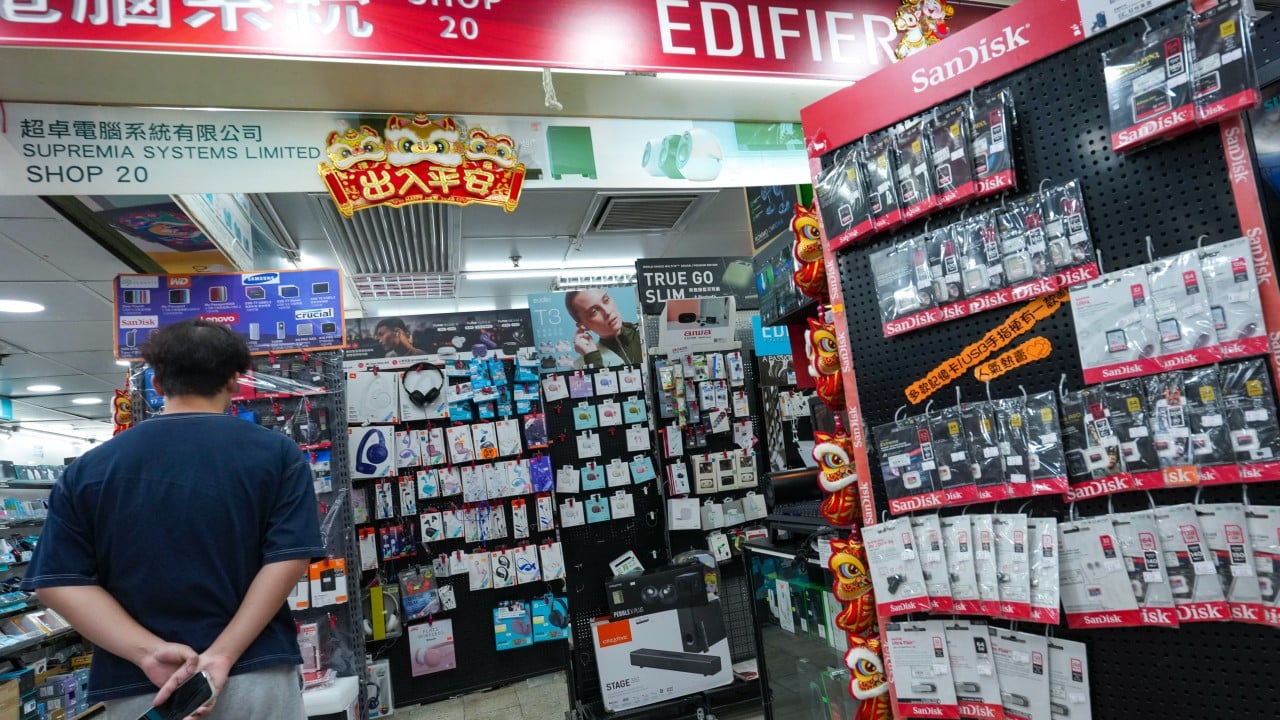
The humidity in Sham Shui Po doesn't just sit on your skin; it clings to the electronics. In the narrow aisles of the Golden Computer Center, the air smells of ozone, soldering flux, and the frantic energy of a thousand cooling fans. Here, tucked between stalls selling glowing keyboards and high-end GPUs, is a trade that looks remarkably like the past but carries the weight of the future.
Men in sweat-stained t-shirts hunch over counters, eyes darting between flickering monitors and plastic trays filled with tiny black rectangles. These aren't diamonds. They are 256GB SD cards. Beside them sit stacks of external hard drives, their metallic casings catching the harsh fluorescent light. In the rest of the world, we have been told that physical storage is a relic—a clumsy ghost of the pre-cloud era. But in Hong Kong, these plastic and silicon chips have become the city’s "digital gold."
The shift happened quietly, then all at once.
The Weight of a Terabyte
Consider a young designer we will call Anson. For years, Anson lived the modern dream. His life existed in the ether. His portfolio was on Adobe’s servers, his family photos lived in Google Photos, and his sensitive documents were tucked away in a Dropbox folder protected by two-factor authentication. It was convenient. It was invisible.
Then came the flickers of instability. A change in terms of service here. A localized internet outage there. A shifting regulatory environment that made "the cloud" feel less like a fluffy white vapor and more like a locked room owned by someone else. Anson realized that if his login credentials ever failed, or if a service provider decided to pull out of the region, ten years of his creative life would simply vanish.
He didn't buy a faster subscription. He went to Sham Shui Po.
He bought a 4TB rugged hard drive. When he got home and began the slow, rhythmic transfer of files, he felt something he hadn't felt in a decade: the physical weight of his own history. It sat on his desk, cool to the touch. It didn't require a password from a server in Virginia to open. It didn't require a monthly tribute of $9.99 to exist.
This isn't just nostalgia. It is a calculated response to a world where "access" is increasingly mistaken for "ownership."
Why the Cloud is Evaporating
The surge in demand for physical storage in Hong Kong is driven by a trifecta of anxiety: privacy, permanence, and the cold math of bandwidth. While the global narrative suggests we are moving toward a disk-less society, the reality on the ground in one of the world's most densely populated tech hubs suggests a massive pivot.
Storage is no longer about convenience. It is about sovereignty.
When you store data on a server, you are participating in a lease. You are renting space on someone else's computer. In a stable world, that lease is rarely questioned. But when the geopolitical weather changes, those leases can be terminated without notice. We’ve seen it happen. Accounts are flagged by algorithms. Regions are geo-fenced. Platforms disappear.
In the face of this, an SD card is a fortress. It is offline. It is un-hackable from a distance. It is a private vault that fits in a coin pocket. For the journalists, the activists, and even the everyday accountants of Hong Kong, these cards represent the only way to ensure that "now" remains "forever."
The prices reflect this urgency. While most consumer electronics drop in value the moment they leave the box, high-capacity, high-speed storage in Hong Kong has maintained a startling price floor. It is a secondary market that functions with the efficiency of a stock exchange. If a shipment of high-end SanDisk or Samsung cards is delayed, the whispers move through the Telegram groups and the prices at the stalls in Mong Kok tick upward by ten or twenty dollars within the hour.
The Invisible Stakes of the Silicon Rush
The data being saved isn't just spreadsheets. It is the cultural DNA of a city in flux.
There is a specific kind of desperation in the way people are archiving local media. Old films, independent documentaries, digital art, and even forum threads from a decade ago are being sucked out of the cloud and injected into spinning platters of magnetic rust.
Think of it as a digital "Seed Vault." Just as scientists bury seeds in the Arctic permafrost to protect biodiversity against a global catastrophe, the residents of Hong Kong are burying their data in hard drives.
But there is a technical hurdle that makes this gold rush different from the ones of the 1800s. Unlike gold, digital data decays. Bit rot is the silent killer of the hardware underground. If you leave a hard drive on a shelf for five years, there is a non-zero chance that the magnetic bits will flip, turning your wedding photos into a colorful smear of digital noise.
This has created a new ritual. The "Data Scrub."
Every few months, the serious collectors—the ones who understand the stakes—plug their drives in. They run parity checks. They migrate data from an old 1TB drive to a new 2TB drive. It is a labor of love, a digital prayer whispered to the machine. They are keeping the information alive through sheer repetition.
The Logic of the Micro-SD
Why the obsession with the micro-SD card specifically? It seems counter-intuitive. They are easier to lose, slower than SSDs, and more fragile.
The answer lies in their invisibility.
If you are traveling, or if you are concerned about your home being searched, a 5TB desktop drive is a glowing neon sign. It screams "I have secrets." But a micro-SD card? It can be taped to the underside of a table. It can be hidden inside the battery compartment of a child’s toy. It can be sewn into the hem of a jacket.
It is the ultimate medium for the modern era because it bridges the gap between the digital and the physical with almost zero footprint. It is the "gold" you can swallow if you have to.
We see this reflected in the sales figures of high-end cameras and "dumb" phones. Devices that don't constantly ping a central server, but instead write directly to a card, have seen a resurgence. People are opting out of the "Smart" ecosystem because "Smart" usually means "Someone else is watching."
The Cold Math of the Hardware Store
Let’s look at the numbers, because the emotion of the situation is backed by brutal logic.
A 2TB cloud storage plan might cost you roughly $100 a year. Over five years, that’s $500. For that same $500, you can buy three 5TB external hard drives in Sham Shui Po. That is 15TB of storage versus 2TB.
Even if you account for the fact that one of those drives might fail, you are still ahead by an order of magnitude. In a city where the cost of living is astronomical and every square foot of an apartment costs a fortune, the "digital square footage" of a hard drive is the only real estate that is actually getting cheaper.
The people lining up at the stalls aren't just Luddites. They are the most tech-literate people on the planet. They understand that the cloud isn't a place; it's a power structure. And they are choosing to secede from it.
The Sound of the Future
If you stand in the middle of a crowded electronics market long enough, you start to hear it. It’s a low-frequency hum. It’s the sound of millions of spindles turning, millions of laser heads reading and writing, millions of lives being backed up.
It is a frantic, beautiful, and slightly terrifying sound.
It tells us that we have reached a tipping point in our relationship with technology. The era of blind trust is over. We are entering the era of the digital prepper. We are realizing that the only things we truly own are the things we can hold in our hands.
Last week, I saw an elderly woman at a stall in Wan Chai. She didn't look like a hacker or a corporate spy. She looked like someone’s grandmother, carrying a bag of groceries. She held out a crumpled piece of paper to the clerk. It had a specific model number for a high-end SSD written on it in careful, shaky script.
She paid in cash. She took the small, boxed drive and tucked it deep into her grocery bag, nestled between a head of bok choy and a carton of soy milk.
She wasn't just buying hardware. She was buying a guarantee that her family’s story wouldn't be deleted by an algorithm she didn't understand. She was taking her piece of the gold and heading home to lock it away.
In the end, the cloud is just someone else’s weather. But a hard drive? A hard drive is your own patch of solid ground.
As the humidity continues to rise and the political winds shift, the people of Hong Kong will keep going to the markets. They will keep buying the tiny black chips and the silver boxes. They will keep filling them with everything they hold dear.
They know something the rest of us are only beginning to realize.
Memory is a fragile thing. If you don't hold onto it, it blows away.