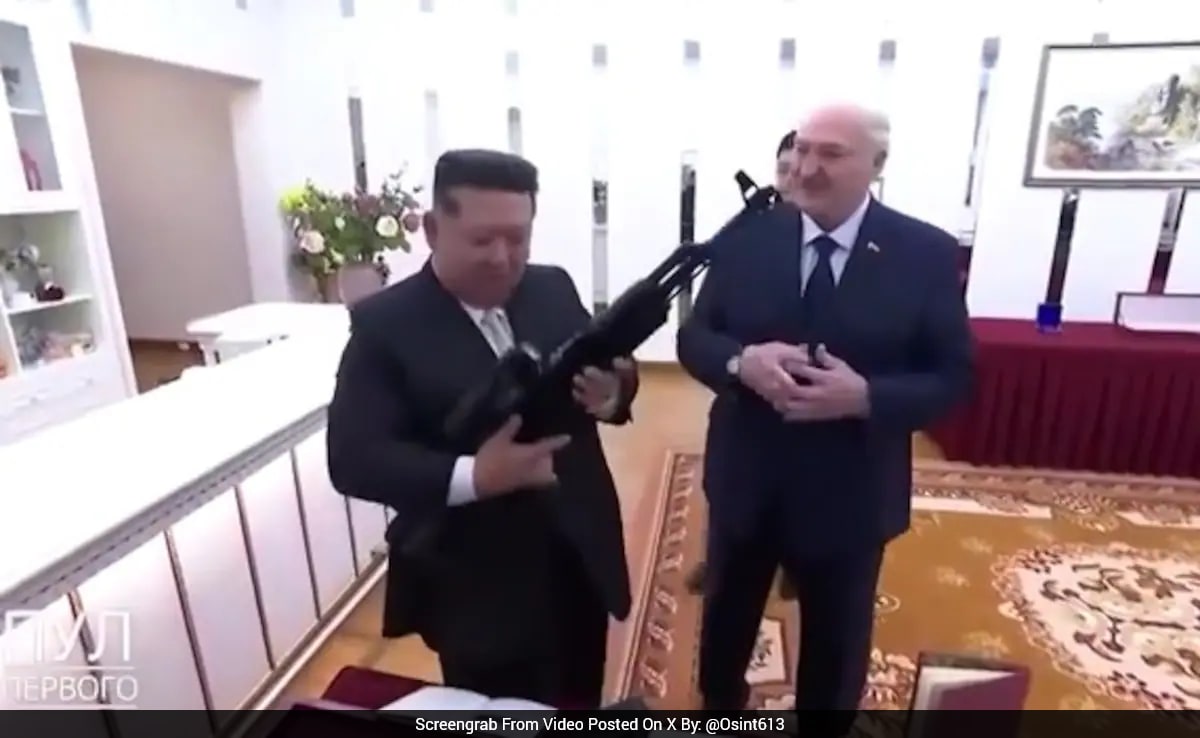
The media is obsessed with the prop. When Aleksandr Lukashenko handed Kim Jong Un a rifle during their meeting, the Western press treated it like a scene from a B-movie. They saw two "outcasts" sharing a hobbyist’s trinket. They focused on the optics of the wood grain and the "just in case enemies appear" quip.
They missed the freight train. Recently making headlines in related news: The Kinetic Deficit Dynamics of Pakistan Afghanistan Cross Border Conflict.
If you think this was about a single firearm, you are the mark. In international diplomacy, especially among states operating under heavy sanctions, the physical object is rarely the point. The gift isn't the story; the supply chain is. While pundits laugh at the "primitive" nature of a bolt-action or semi-auto gift, they ignore the fact that these two nations are currently engineering a workaround for the entire global financial order.
The Myth of the "Desperate" Dictator
The lazy consensus suggests that Belarus and North Korea are huddled together for warmth because they have no other friends. This is a comforting lie that Western analysts tell themselves to avoid admitting a strategic failure. Further information regarding the matter are detailed by NPR.
Lukashenko isn't giving Kim a gun because North Korea is short on small arms. North Korea is a country that literally manufactures its own tactical nuclear missiles. They don't need a rifle from Minsk. What they need—and what this gift signals—is the formalization of a dual-use technology corridor.
Belarus remains a sleeper cell of high-end Soviet-era industrial engineering. They produce heavy-duty vehicle chassis, precision optics, and microelectronics that are "good enough" to bypass the need for Western components. When a rifle is handed over, it’s a handshake on a much darker deal: the exchange of Belarusian heavy machinery for North Korean labor and ammunition.
Why the "Isolation" Narrative is a Security Risk
Western intelligence often treats sanctions like a digital fence. They assume that if you cut a country off from SWIFT, they stop moving forward. I’ve watched analysts make this mistake for decades: they mistake a lack of "luxury" for a lack of "capability."
North Korea and Belarus are not isolated; they are integrated into a shadow economy that the West cannot track, tax, or terminate.
- The Precision Gap: Belarus holds the keys to specialized CNC machining and heavy tractor units (MZKT) that move mobile missile launchers.
- The Labor Arbitrage: North Korea offers a disciplined, cheap, and technically literate workforce that can bypass the labor shortages currently strangling Eastern European manufacturing.
By focusing on the "absurdity" of the gift, we ignore the high-stakes logistical marriage happening in the background. It’s not a bromance. It’s a merger.
The Ritual of the Weapon
In the world of high-stakes arms dealing, the "gift" is a benchmark of trust. You don't give a rifle to someone you don't trust with your life—or your secrets.
Consider the mechanics of the exchange. A rifle is a mechanical system. It requires specific tolerances, metallurgy, and propellant chemistry. By gifting a specific model, Lukashenko is effectively offering a technical blueprint. It’s a physical manifestation of a technical standard. If their small arms are compatible, their artillery is compatible. If their artillery is compatible, their frontline logistics are unified.
The West laughs at the "medieval" nature of the gift while the East is building a unified military-industrial block that operates $100%$ outside the dollar-denominated world.
The Fallacy of the "Primitive" Tech
There is a dangerous arrogance in the way we view "obsolete" technology. We assume that because a piece of gear doesn't have a touchscreen or a cloud connection, it’s useless.
In a high-intensity conflict, "smart" tech is fragile. It relies on GPS, satellites, and rare-earth minerals sourced from hostile territory. A Belarusian rifle is "dumb" tech. It works in the mud. It works when the satellites are jammed. It works when the power grid is down.
By mocking the gift, we expose our own vulnerability: our total dependence on a fragile, high-tech ecosystem that our enemies have already learned to live without.
Dismantling the "Sanctioned and Starving" Trope
"People Also Ask" online: Is North Korea's military actually a threat?
The answer is usually a patronizing "only because of nukes."
Wrong.
North Korea’s threat lies in its ability to mass-produce "attrition-ware." While the US struggles to produce enough 155mm shells to keep up with current global demand, the North Korean factory lines are humming 24/7. Belarus provides the industrial lubricants, the ball bearings, and the logistics software to keep those lines running.
The rifle isn't for Kim to shoot. It’s a sample of the finish, the fit, and the reliability that Belarus is prepared to export at scale. It’s a trade catalog disguised as a souvenir.
The Invisible Pipeline
Imagine a scenario where the "Western Rules-Based Order" is simply bypassed. Not fought, not defeated—just ignored.
This is what the Minsk-Pyongyang axis represents. They aren't trying to join our club. They are building their own. When Lukashenko says "just in case enemies appear," he isn't talking about a burglar. He’s talking about a fundamental shift in the global security architecture where the "enemies" are the very people laughing at his gift on Twitter.
- Financial Autonomy: They are trading in bartered goods and sovereign-backed digital ledgers.
- Resource Independence: Belarus has the potash and the food; North Korea has the minerals and the hardware.
- Sovereign Immunity: Neither leader answers to an electorate or a board of directors. They can plan in decades, while the West plans in four-year election cycles.
Stop Looking at the Gun
If you want to understand the threat, stop looking at the wooden stock and start looking at the shipping manifests. Look at the railway agreements. Look at the joint-venture announcements in the "agricultural" sector—which is almost always a front for dual-use chemical and mechanical engineering.
The rifle is a distraction for the masses. It’s a meme-able moment that keeps the public focused on "crazy dictators" rather than "efficient autocrats."
Lukashenko didn't give Kim a weapon; he gave him a confirmation of an alliance that is specifically designed to make Western sanctions irrelevant. While we analyze the "optics," they are analyzing the ballistics of a new, unified supply chain that stretches from the borders of Poland to the Sea of Japan.
The joke isn't on them. It's on anyone who thinks a gift is just a gift.
Stop looking at the rifle. Start looking at the factory that built it.