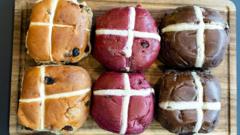
The air in the local bakery used to smell of yeast, scorched flour, and the sharp, medicinal bite of mixed peel. It was a scent that announced the arrival of spring more reliably than any calendar. You knew where you stood with a hot cross bun. It was a dense, slightly stodgy affair, cross-hatched with a flour-and-water paste that tasted of nothing, designed to be split, toasted until the edges charred, and drowned in enough salted butter to make a doctor wince. It was a humble tradition. It was enough.
But walk into that same bakery today and you are greeted by a neon-lit existential crisis. Recently making news in related news: Why Renting for Under £1000 a Month is Getting Harder in 2026.
Nestled in the wicker baskets where the currants once reigned, you will find something called a Tiramisu bun. Beside it, a Banoffee hybrid oozes caramel onto a salted caramel brownie egg. There are buns injected with West Country cream, buns infused with Earl Grey, and buns that have abandoned the "cross" entirely in favor of a chocolate drizzle. We have reached a point of confectionary saturation where the original product is no longer the star, but merely a delivery vehicle for a frantic, sugary arms race.
This is the Great Sugar Schism. On one side stands the purist, clutching a bag of spiced dough and muttering about "tradition." On the other is the modern consumer, a creature of the scroll, hunting for the next hit of novelty that will look as good on a smartphone screen as it tastes on the tongue. Additional details regarding the matter are covered by Vogue.
The stakes are higher than a simple change in recipes. We are witnessing the slow erosion of seasonal anticipation, replaced by a permanent state of sensory escalation.
The Architect of the Hybrid
Consider a hypothetical baker named Elias. Twenty years ago, Elias spent his March mornings perfecting the spice blend for his buns. He worried about the hydration of the dough and the plumpness of the sultanas. If he sold out by noon, it was a good day. Success was measured in consistency.
Today, Elias is a technician in a laboratory of viral trends. He knows that a standard hot cross bun, no matter how perfectly fermented, will not trigger an algorithm. To survive in a market dominated by supermarket giants and "foodie" influencers, he must innovate. He must create the "Cruffin" egg or the Cookie-Dough-Hot-Cross-Loaf.
He isn't just competing with the bakery down the street anymore; he is competing with the entire internet's collective boredom.
The data backs up his anxiety. Retail analysts note that seasonal "limited edition" products now account for a massive portion of Q1 revenue for major grocers. The more "out there" the flavor, the higher the engagement. We aren't buying these treats because we are hungry for Tiramisu-flavored bread. We are buying them because they represent a "moment." They are a conversational currency.
But when everything is a "limited edition" miracle, nothing is special. The thrill of the new has become a baseline requirement, leaving the simple pleasures of the past looking gray and malnourished by comparison.
The Vanishing Middle Ground
The problem with the Tiramisu bun isn't necessarily its flavor. Mascarpone and coffee are, objectively, a delight. The problem is the loss of the "threshold."
Historically, Easter treats were defined by their restraint or their specific, unchanging identity. The hot cross bun was the bridge between Lenten fasting and Paschal feasting. It occupied a specific niche in our culinary calendar. When we move the goalposts—when we decide that a bun isn't a bun unless it’s stuffed with a liquid chocolate core and topped with gold leaf—we lose the ability to appreciate the subtle.
Our palates are being colonised by "hyper-palatability." This is a scientific term for foods engineered to hit our reward centers so hard that natural flavors begin to taste like cardboard. If you spend your week eating doughnut-infused Easter eggs, a piece of fruit or a lightly spiced piece of toast feels like a chore.
We are training ourselves to reject the ordinary.
This isn't just about sugar; it’s about the "invisible stakes" of our attention economy. Every time a brand launches a "wacky" new flavor, they are participating in a gold rush for our fleeting interest. The "Franken-food" phenomenon is a symptom of a culture that can no longer sit still. We require the jolt of the unexpected just to feel like we’re celebrating.
The Cost of the Upgrade
There is a financial reality tucked inside these brioche folds, too. A standard four-pack of traditional buns might cost a few pounds. The "artisan, triple-chocolate, sea-salt-and-rosemary" variants often command double or triple that price. We are being sold a premium version of nostalgia, repackaged with enough bells and whistles to justify a luxury markup.
It is a clever trick. By adding a "gourmet" twist, retailers can take a commodity item and turn it into a specialty good. They aren't just selling you bread; they are selling you an "experience."
But ask yourself: when was the last time a piece of toast changed your life?
The irony is that as these treats become more complex, the human connection to them becomes more superficial. We take a photo, we take a bite, and we move on to the next thing. The ritual is gone. The "human element" that used to define these foods—the shared understanding of what a specific time of year tasted like—has been fragmented into a thousand different niche flavors.
The Resistance of the Plain
There is a quiet counter-revolution brewing. In small pockets of the country, people are seeking out the "old" ways. Not out of a sense of snobbery, but out of a desperate need for something grounding.
They want the bun that tastes like yeast. They want the egg that is just chocolate, without the popping candy, the biscuit bits, or the dehydrated marshmallow fluff.
Consider the sensory experience of a plain, well-made hot cross bun.
The crust is slightly sticky from a sugar glaze. The interior is soft but has a structural integrity that stands up to the toaster. The raisins are little bursts of concentrated sunlight. When the butter melts into the crumb, it creates a texture that is both fatty and spicy. It is a slow flavor. It doesn't scream at you. It whispers.
In a world of Tiramisu-flavored noise, there is something radical about the quiet.
We are told that progress is a one-way street. That we must always have more choice, more flavor, more "disruption." But in the realm of the kitchen, disruption is often just a fancy word for clutter. We are burying the lead. The lead, in this case, is the simple joy of a seasonal marker that doesn't try too hard to be your friend.
The supermarket shelves will continue to groan under the weight of the "Doughnut Egg" and the "Prosecco-infused Hot Cross Muffin." There will be press releases and social media campaigns. There will be "must-try" lists and taste tests.
But tomorrow morning, when the sun is low and the kitchen is quiet, I will be reaching for the bag with the currants. I will be looking for the cross that is made of flour and water, not white chocolate. I will be looking for the taste of 1994, or 1954, or any year before we decided that "enough" was a four-letter word.
Because when you strip away the gold leaf and the coffee-infused cream, you’re left with something much more valuable than a viral moment. You’re left with a memory. And memories, unlike Tiramisu buns, don't need a gimmick to stay sweet.
The butter is already on the counter, softening in the morning light. The toaster is waiting. The currants are ready.
One. Simple. Bite.