The air inside the warehouse in São Paulo doesn't smell like incense or old hymnals. It smells like overpriced espresso, expensive hair wax, and the ozone scent of a fog machine working overtime. If you stumbled in off the street, you might think you’d found a private launch party for a fintech startup or a boutique gym.
Then the drums start.
It isn’t the polite tapping of a church organist. It is a physical force. The floor vibrates through the soles of your sneakers. On a stage bathed in violet LED light, a man in a perfectly tailored denim jacket and designer glasses grips a wireless microphone. He doesn’t shout. He speaks with the hushed, urgent cadence of a TED Talker revealing a life-changing secret.
This is the new face of the Brazilian Evangelical movement. It has shed the dusty suits and the rigid prohibitions of the past to embrace a aesthetic that is indistinguishable from a Coachella after-party. But beneath the strobe lights and the Instagram-friendly decor, a much deeper transformation is rewriting the social fabric of Latin America’s largest nation.
The Death of the Wooden Pew
For decades, the Evangelical image in Brazil was one of austerity. It was the world of the crente—the believer who wore long skirts, avoided makeup, and stayed far away from the "sinful" rhythms of Samba and pop culture. It was a subculture defined by what it rejected.
That world is dying.
In its place, a movement called the Igreja de Comunidade or "Contextualized Churches" has emerged. They realized a simple, brutal truth: you cannot reach a generation that lives on TikTok by reciting liturgy from the 19th century. To capture the hearts of Brazil’s urban youth, the church had to stop looking like a courtroom and start looking like a lounge.
Consider a hypothetical young woman named Gabriela. She is 22, lives in a cramped apartment in the North Zone, and works a grueling job in digital marketing. To Gabriela, the Catholic cathedrals of her grandparents feel like cold, echoing museums. The traditional Pentecostal churches of her parents feel like restrictive social clubs full of judgment.
When she walks into a "modern" church, she finds "The Lab"—a workspace with high-speed Wi-Fi where she can answer emails before the service. She finds a coffee bar serving oat milk lattes. She finds a community that tells her that her tattoos aren't a stain on her soul, but a form of personal expression.
The church has become a lifestyle brand.
The Architecture of Belonging
The shift is visible in the very bones of these buildings. Traditional steeples have been replaced by matte-black industrial facades. The "pulpit" is now a "platform." The "sermon" is a "keynote."
This isn't just a cosmetic makeover. It is a sophisticated psychological pivot. By adopting the visual language of globalized youth culture, these churches bypass the natural skepticism that Gen Z holds toward institutions. When the environment feels familiar—resembling a coworking space or a concert venue—the message becomes easier to swallow.
The statistics back the visual shift. Data from the Brazilian Institute of Geography and Statistics (IBGE) suggests that if current trends hold, Catholics will no longer be the majority in Brazil by 2032. The growth isn't coming from the old-school, fire-and-brimstone tents. It’s coming from these slick, urban centers that offer a sense of "belonging" in a fragmented, digital world.
But there is a tension here. You can’t help but wonder: if the church looks exactly like the world it claims to transcend, what is it actually offering?
The Influencer as Prophet
In these spaces, the pastor is rarely called "Father" or "Reverend." They are leaders, mentors, or simply by their first names. They are often influencers in their own right, boasting hundreds of thousands of followers on Instagram. They post gym selfies, unboxing videos, and travel vlogs interspersed with verses from the New Testament.
This creates a powerful, if complicated, dynamic. The gospel being preached isn't just about the afterlife; it’s about "Kingdom Productivity." It’s a remix of the Prosperity Gospel for the gig economy. The message is that God wants you to be the best version of yourself—successful, fit, mentally healthy, and, yes, influential.
For a young Brazilian navigating a stagnant economy and a polarized political climate, this message is incredibly seductive. It provides a framework for ambition. It turns the hustle of daily life into a spiritual mission.
I watched a service recently where the speaker used a metaphor about "clearing your cache." He compared sin to a background app that drains your phone’s battery. The audience, mostly people in their twenties holding iPhones aloft to record the moment, nodded in unison. The analogy was perfect for them. It took an abstract theological concept and turned it into a hardware issue.
The Invisible Stakes
Critics argue that this is "Church Lite"—a hollowed-out version of faith that prioritizes vibes over virtue. They worry that by chasing the "cool" factor, these institutions are creating a fickle fan base rather than a resilient community.
There is also the political shadow. Brazil’s Evangelical vote is a monolithic force that has reshaped the country's leadership. While the "cool" churches often project a more inclusive, progressive image on the surface, they often remain deeply conservative in their core tenets. The cool lighting can mask a very traditional agenda.
But for the person in the seat, the stakes are more personal than political.
Brazil is a lonely place for many young people. The traditional family structures are fraying. The promise of the university degree has lost its luster as unemployment lingers. In the neon glow of the modern church, they find a "tribe." They find people who will notice if they don't show up.
One evening, I spoke to a young man outside a service in Belo Horizonte. He had a fade haircut and wore a t-shirt that said "GRACE" in a font that mimicked a famous streetwear brand. I asked him why he came here instead of a traditional church.
"Because here, I don't have to leave half of myself at the door," he said. "I can be a skater, I can love electronic music, and I can still talk to God. The music sounds like what I listen to on Spotify. The people look like me. It doesn’t feel like I’m visiting the past. It feels like I’m building the future."
The Pulse of the New Faith
As the service reaches its climax, the "worship leader" signals for the lights to drop. Only a single blue spotlight remains. The music shifts from a driving rock beat to a cinematic, ambient swell.
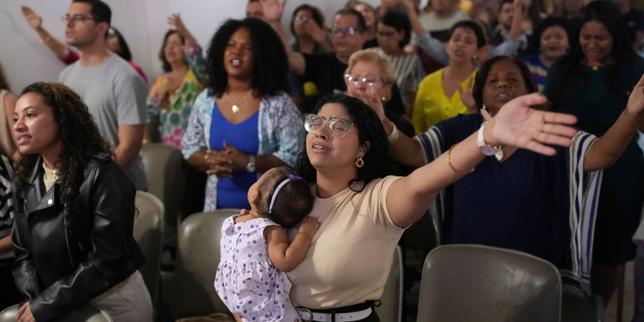
This is the "emotional hit." It is carefully choreographed. The transition from high-energy celebration to intimate vulnerability is designed to break down the barriers of the modern ego. People begin to cry. They raise their hands, not in the frantic way of the old Pentecostals, but with a quiet, swaying intensity.
It is a masterclass in experiential marketing. But to call it only that feels dismissive of the genuine catharsis happening in the room. In a world that demands constant performance and "personal branding," these spaces offer a rare moment of collective surrender.
The traditionalists might scoff. They might say that a church without a cross is just a club with a different playlist. They might argue that the "hip" pastor in the Yeezys is a sign of the end times.
But as the crowd pours out into the humid Brazilian night, tapping on their phones to call Ubers, they don't look like people who have been tricked. They look like people who have been seen. They look like people who found a way to bridge the gap between their digital identities and their spiritual hunger.
The drums have stopped, but the rhythm remains. It’s a steady, pounding heartbeat that suggests the old cathedrals aren't coming back. The future of faith in Brazil won't be written in stone or stained glass. It will be coded in pixels, amplified through subwoofers, and shared via a story that disappears in twenty-four hours, leaving only the craving for the next update.
The light in the warehouse flickers off, and the matte-black door clicks shut. Would you like me to analyze how this "lifestyle" branding approach is affecting other traditional institutions in South America?