High Speed 2 was sold to the British public on a promise of velocity. It was supposed to be the spine of a modernized Britain, a $250\text{ km/h}$ to $360\text{ km/h}$ marvel that would finally drag the North and Midlands into the orbit of London’s economic engine. But as costs have spiraled from an initial estimate of £33 billion to figures north of £100 billion, the project is facing a fundamental downgrade. Civil servants and engineers are now quietly weighing a move that would have been unthinkable a decade ago: slowing the trains down to save what remains of the budget.
This isn't just about shaving a few minutes off a journey. It is a desperate attempt to salvage a project that has become a sinkhole for public funds. By reducing the maximum operating speed from the planned $360\text{ km/h}$ to something closer to $300\text{ km/h}$ or even $250\text{ km/h}$, the government hopes to slash energy costs, reduce wear on the tracks, and potentially simplify the complex signaling systems required for ultra-high-speed travel. Yet, in doing so, they risk stripping the project of its only remaining selling point.
The Physics of Failure
Rail engineering is governed by uncompromising laws of physics. As a train accelerates, the energy required to overcome aerodynamic drag doesn't just increase; it explodes. Drag increases with the square of the speed. This means a train traveling at $360\text{ km/h}$ encounters significantly more resistance than one at $300\text{ km/h}$.
The financial implications are massive. To maintain those top speeds, the rolling stock requires more powerful motors, more frequent maintenance, and an immense amount of electricity. In an era of volatile energy prices, the "all-out speed" model looks increasingly like a Victorian relic in a net-zero world. If HS2 slows down, the Treasury saves on the day-to-day subsidy required to keep the lights on and the wheels turning.
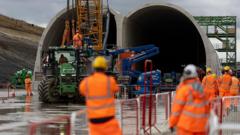
However, the track itself is already being laid. The curves are designed for high-speed banking. The tunnels are bored to handle the pressure waves of a $360\text{ km/h}$ pass-through. Slowing down now is like buying a Ferrari and permanently capping it at 40 miles per hour because you can’t afford the premium petrol. You still paid for the Ferrari.
Why Speed Was the Wrong Metric From the Start
The obsession with speed was a marketing choice, not a transport necessity. For years, critics argued that HS2 should have been branded as a "capacity" project. The real bottleneck in British rail isn't that the trains are too slow; it's that the tracks are too full. By moving long-distance express services onto a dedicated line, you free up space on the existing West Coast Main Line for local commuters and freight.
But "capacity" doesn't win elections. "London to Birmingham in 45 minutes" does.
By pivoting to a slower model now, the government is admitting that the "High Speed" in HS2 is negotiable. If the speed drops significantly, the time savings compared to the existing tilting trains on the West Coast Main Line become marginal. We are approaching a point where the multi-billion pound investment offers a return of only fifteen or twenty minutes. For a businessman in Manchester or a student in Birmingham, that time is negligible. For the taxpayer, the cost-per-minute saved becomes an absurdity.
The Hidden Costs of Braking
There is a technical debt associated with slowing down a project mid-stream.
- Rolling Stock Contracts: The trains have already been ordered from a joint venture of Hitachi and Alstom. These are bespoke designs intended for high-intensity, high-speed operation. Renegotiating these specifications or changing the maintenance schedules involves legal minefields that often eat up the very "savings" the government is chasing.
- Signaling Shifts: The European Train Control System (ETCS) Level 2, intended for HS2, is designed to manage high-speed intervals. Changing the speed profile requires recalibrating the entire digital backbone of the line.
- Energy Efficiency vs. Journey Time: While slower trains use less power, they also stay on the track longer. This affects fleet utilization. If a journey takes longer, you might need more train sets to maintain the same frequency of service. More trains mean more capital expenditure.
The Northern Betrayal
It is impossible to discuss HS2 without addressing the phantom limb of the project: the North. The cancellation of the northern legs—the spurs to Leeds and Manchester—already turned HS2 into a "stub" line. If that stub is now also a "slow" line, the value proposition for the Midlands and the North evaporates entirely.
The original vision was an integrated network. Now, we are looking at a premium shuttle service between Old Oak Common (in West London) and Birmingham Curzon Street. Without the high-speed connection to the northern hubs, the project fails to rebalance the economy. It merely extends the London commuter belt.
Industry analysts have noted that the current "savings" measures are a form of managed decline. By trimming the speed, the government can claim they are being fiscally responsible while effectively gutting the infrastructure's long-term utility. It is a short-term fix for a hundred-year asset.
The International Comparison
Look at the French TGV or the Japanese Shinkansen. These nations didn't build high-speed rail to save ten minutes; they built it to transform their geography. They didn't blink when the costs rose because they understood that infrastructure is the platform upon which the rest of the economy runs.
The UK, by contrast, seems trapped in a cycle of "value engineering." This is a polite term for making things worse to make them cheaper. In Spain, the AVE network connects distant cities with relentless efficiency. They didn't achieve this by cutting corners on speed or capacity. They committed to the vision. Britain’s hesitation sends a signal to global investors that we can no longer deliver "mega-projects" without compromising the core objectives.
A Question of Noise and Environment
One of the primary arguments for slowing the trains is environmental—but not in the way you might think. High-speed trains are loud. The "whizz" of a train at $360\text{ km/h}$ is a significant concern for residents in the Chilterns and other rural areas the line bisects.
By dropping the speed, the noise profile drops significantly. This reduces the need for expensive, high-spec sound barriers and deep cuttings. It is a way to appease local constituencies who have been the project's most vocal opponents. But once again, we are prioritizing local comfort over national progress. We are building a high-speed line that is too afraid of its own shadow to actually go fast.
The Economic Reality Check
Let’s look at the numbers. The Treasury uses a "Benefit-Cost Ratio" (BCR) to justify projects.
"Every pound spent on HS2 was originally projected to return over £2 in economic benefits. With the current cuts to speed and the cancellation of the Northern legs, some estimates suggest that ratio has plummeted to near parity, or even below £1."
If the BCR falls below 1.0, the project is technically a net loss for the taxpayer. Slowing the trains further reduces the "user benefit" (time saved), which is the largest component of that ratio. We are effectively spending tens of billions on a project that the government’s own math might soon struggle to justify.
The Procurement Trap
We must also look at how we build. Britain has the highest per-mile cost for high-speed rail in the world. This is due to a combination of gold-plated planning requirements, constant political interference, and a fragmented supply chain.
Slowing the trains down doesn't fix the underlying rot in British procurement. It just masks it. The real savings wouldn't come from a $50\text{ km/h}$ reduction in speed; they would come from a streamlined planning process that doesn't allow a single protected species or a vocal parish council to add £500 million to the bill through delays and redesigns.
The Logistics of the "Slow" HS2
If the speed is reduced to $250\text{ km/h}$ (roughly 155 mph), the "High Speed" label becomes a misnomer. For context, the existing InterCity 225 trains on the East Coast Main Line were designed for 140 mph back in the 1980s. We would be spending 21st-century money for 20th-century performance.
This leads to a nightmare scenario for the Department for Transport. If the performance gap between HS2 and the old lines isn't wide enough, passengers won't pay the "premium" fares likely required to recoup the construction costs. If the trains aren't full, the subsidy rises. If the subsidy rises, the Treasury demands more cuts. It is a death spiral of ambition.
Is There a Way Out?
The government is at a crossroads. They can either:
- Commit to the original spec: Accept that the cost is the price of entry for a modern nation and finish the job properly.
- The "Slow" Pivot: Reduce speed, save on energy and maintenance, and accept that HS2 is just a very expensive relief valve for the West Coast Main Line.
- The Hybrid Model: Build the infrastructure for high speed but run the trains slower for the first decade to manage energy costs, increasing velocity as the power grid becomes more decarbonized and efficient.
The third option is the most likely, but it requires a level of long-term planning that has been noticeably absent from the HS2 saga. It allows the government to save face today while keeping the door open for the original vision tomorrow.
A Project Without a Pilot
The real tragedy of the HS2 speed debate is what it says about British ambition. We have become a nation that starts marathons and decides to walk the last ten miles because the shoes are too expensive. We are building the most expensive railway in history and then debating whether we should let it do the one thing it was designed for.
If we don't run these trains at the speeds they were engineered for, we aren't being "fiscally responsible." We are being wasteful. True waste isn't just spending money; it's spending money and getting an inferior product that doesn't solve the problem it was meant to address.
The decision to cut speeds isn't a clever accounting trick. It is a white flag. It is the sound of a country hitting the brakes because it's forgotten where it was trying to go.
Demand a full audit of the current rolling stock contracts to see if a speed reduction actually triggers penalty clauses that outweigh the energy savings.