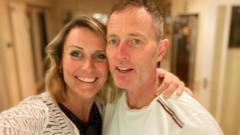
The silence of a concrete cell isn’t actually silent. It hums. It’s a low-frequency vibration of cooling fans, distant heavy doors striking metal frames, and the rhythmic, maddening sound of your own pulse thumping against an eardrum pressed toward a floor that never warms up. For a British couple currently held within the limestone grip of an Iranian prison, this isn't a metaphor for a bad holiday. It is the literal perimeter of their existence.
We often consume news about international detainees as if we are reading a scoreboard. We count the days. We weigh the diplomatic "leverage." We look at grainy passport photos and try to project ourselves into their shoes, but our imagination usually fails at the threshold of the cell door. To understand why their situation has shifted from "concerning" to "life-threatening," you have to stop looking at the geopolitics and start looking at the biology of despair.
Isolation does not just hurt the mind. It erodes the body's basic operating systems.
The Geography of a Six-Foot World
Imagine living in a space no larger than a walk-in closet. Now, remove the clothes. Remove the light. Remove the certainty of when the door will next open. When this British couple describes their situation as life-threatening, they aren't just talking about the threat of a sentence or the harshness of an interrogation. They are talking about the slow-motion collapse of the human spirit under the weight of indefinite uncertainty.
In these environments, the lack of medical care isn't an oversight; it's a variable. A simple infection becomes a crisis. A toothache becomes a fever. A persistent cough, in a damp, poorly ventilated room, becomes a precursor to pneumonia. When you are a foreign national in a high-security wing, you are not a patient. You are a bargaining chip that the house is failing to maintain.
Consider the physical toll of chronic stress. When the brain perceives a threat it cannot escape—month after month—it floods the system with cortisol. In the short term, cortisol helps you survive. In the long term, it acts like acid on the internal organs. It thins the skin, spikes the blood pressure, and melts away muscle mass. For this couple, every day spent waiting for a phone call that never comes is a day where their bodies are essentially consuming themselves from the inside out.
The Weight of the Invisible Chessboard
Behind the cold stone of the prison walls lies a game of high-stakes poker played by people in air-conditioned rooms in London and Tehran. This is the "invisible stake." The couple is caught in the middle of a debt dispute that dates back decades, a tangled web of tank contracts and unreturned millions that has nothing to do with who they are, and everything to do with what they represent.
To the guards, they are symbols of a Western power. To the British government, they are a diplomatic "complication" that requires "careful navigation." But to their families at home, they are empty chairs at the dinner table. They are voices on a scratchy, monitored phone line that grow thinner and more desperate with every passing season.
The tragedy of the "bargaining chip" strategy is that the chip has a shelf life. Human beings are fragile. They break. And once the psychological tether to the outside world snaps, the damage is often irreversible. The couple’s warning that the situation is life-threatening is a plea for the players at the table to realize that the stakes are no longer just financial or political. They are visceral.
The Sensory Deprivation of Hope
Hope is a caloric requirement. Without it, the body loses the will to process nutrients. There are reports of hunger strikes, a desperate, final tool used by those who have nothing left to trade but their own physical existence. It is the ultimate "no" in a world that demands a constant "yes" to every demand and every interrogation.
A hunger strike isn't just about not eating. It’s a systematic shutdown.
By day three, the hunger pangs disappear, replaced by a hollow, floating sensation. By day seven, the body begins to scavenge its own fat stores. By day fourteen, it moves on to the muscles. The heart, being a muscle, eventually begins to atrophy. For a couple already weakened by the psychological meat-grinder of a foreign legal system, this isn't a protest. It’s a countdown.
We often assume that "diplomatic efforts" are moving at a pace that matches the urgency of the crisis. They rarely do. Diplomacy is a language of "perhaps" and "eventually." It moves with the glacial shift of tectonic plates. But a human heart beats roughly 100,000 times a day. It doesn't have the luxury of glacial time. It needs a resolution before the clock runs out.
The Ripple Effect of the Cell
When we read that their lives are at risk, we must also look at the families left behind. The trauma of a wrongful or political detention doesn't stop at the prison gate. It radiates outward, infecting children, parents, and siblings with a specific kind of "ambiguous loss." It is the grief of a funeral that hasn't happened yet.
They live in a state of permanent hyper-vigilance, jumping every time the phone rings, scouring every news report for a hidden meaning in a spokesperson's dry statement. They are the secondary victims of the cell, their lives frozen in the same amber as the couple in Tehran. They are fighting a war against a bureaucracy that views their loved ones as assets to be traded rather than humans to be protected.
The reality of being "British in Iran" in this specific context is to be a ghost while still breathing. You are a ghost to your own government until the public pressure becomes too loud to ignore. You are a ghost to your captors, who see you only as a line item in a budget negotiation.
Beyond the Headlines
The facts are these: two people are in a room. The room is getting smaller. The air is getting thinner. The world outside is arguing about money and treaties while the biological clock of two human beings ticks toward a zero that no one wants to admit is coming.
It is easy to look away because the problem feels too big, too complex, or too far away. It is easy to dismiss it as the "risk of travel" or a "political mess." But strip away the flags and the bank accounts, and what remains is a husband and a wife whose only crime was being in the wrong place when the wrong people decided to settle an old score.
The danger isn't just that they might die. The danger is that they might be forgotten while they are still alive.
The hum of the cooling fans continues. The heavy doors continue to strike their frames. And somewhere in a cell that never sees the sun, two people are holding onto each other's hands, wondering if the world remembers they are still there. They are waiting for a sound other than the hum. They are waiting for the sound of a key that turns not to lock, but to let the light back in.
The floor is still cold. The pulse is still thumping. But for how much longer?
Would you like me to draft a letter to your local representative or an advocacy group to help keep this story in the public eye?


