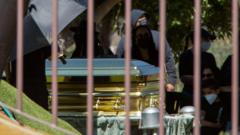
The dirt in the hills of Jalisco doesn’t care about the price of gold. It is heavy, reddish, and indifferent. But for a few hours under a bruising sun, that dirt was pushed aside to make room for a spectacle that felt less like a funeral and more like a coronation of the dead.
Nemesio Oseguera Cervantes, the man the world whispered about as "El Mencho," has spent a decade as a phantom. He was a collection of grainy photographs and intercepted radio bursts. He was the shadow behind the Cártel de Jalisco Nueva Generación (CJNG). Now, if the reports filtering out of the Mexican highlands are to be believed, the ghost has finally found a permanent home. He didn’t go quietly. He went into the ground inside a coffin plated in 24-karat gold.
Wealth in the underworld is a strange, liquid thing. It is measured in kilometers of territory, in the loyalty of men with blackened fingernails, and in the sheer volume of fear one can generate. But when the breathing stops, that power has to crystallize into something the living can see. A golden box is not just a container for a body. It is a middle finger to the state, a final ledger entry for a life defined by excess, and a signal to every soldier left behind that the king was indeed a god.
The Architecture of a Myth
To understand the weight of a golden coffin, you have to understand the man who supposedly occupies it. El Mencho was not a creature of vanity like the narcos of the eighties. He didn't crave the cameras or the high-society parties. He was a former policeman, a man who understood the mechanics of order and the utility of chaos. He built an empire not on charisma, but on logistics and terrifying, surgical violence.
Consider the perspective of a young man in a village like Aguililla. Imagine you are twenty years old. The government is a rumor that only arrives when it’s time to collect taxes or demand a bribe. The "Patrón," however, is real. He provides the paved road. He provides the security against rival gangs. He is the economy. When that man dies and is buried in a casket that costs more than your entire village earns in a decade, the message is clear. It tells you that the life of a criminal is the only life that matters.
The funeral was reportedly a closed-circuit event. No press. No uninvited eyes. Only the inner circle, the men who hold the keys to the methamphetamine labs and the shipping ports. They stood in the heat, watching a fortune in precious metal disappear into a hole. It is a perverse inversion of the Egyptian pharaohs. They buried gold to take it to the afterlife; the modern drug lord buries it to ensure he never truly leaves this one.
The Ledger of the Lost
There is a hollow sound to a golden lid closing. It’s the sound of a debt that can never be repaid. While the coffin shone, the statistics surrounding El Mencho’s reign remain dark. Under his watch, the CJNG became one of the most prolific distributors of synthetic drugs on the planet. Fentanyl and crystal meth didn't just move across borders; they moved into the veins of millions, leaving a trail of "ghosts" in cities from Los Angeles to Chicago.
We often talk about drug cartels in terms of "market share" or "supply chains," as if they were Silicon Valley startups with more guns. But the real cost is human. For every ounce of gold on that casket, there is a mother in Jalisco searching for a clandestine grave. For every shimmering hinge, there is a family in the American Midwest mourning a son who took a pill that turned out to be a death sentence.
The tragedy of the golden coffin is that it is built on the ruins of thousands of ordinary lives. It is a monument to a zero-sum game. For El Mencho to have his gold, the world had to lose its peace.
A Throne of Sand and Silt
The irony of such a burial is that it rarely marks the end of the story. In the world of the cartels, a vacuum is a physical ache. It demands to be filled. If the king is truly in the ground, the men standing around that golden box aren't just mourning. They are calculating. They are looking at the man to their left and the man to their right, wondering who will be the first to reach for the crown.
History is a cruel teacher in this regard. When a figure as dominant as Oseguera Cervantes falls, the structure he built often begins to fracture. The "New Generation" is now the old guard, and there is always a hungrier, more ruthless generation waiting in the tall grass. The gold doesn't buy stability. It only raises the stakes.
The authorities have spent years chasing a man who seemed to be everywhere and nowhere. They tracked his kidney ailments, his hideouts in the mountains, and his family’s business dealings. If he is dead, the hunt for his person ends, but the hunt for his shadow begins. A golden coffin is a stationary target, but an empire in transition is a wildfire.
The Silence After the Gold
There is a specific kind of silence that follows a narco-funeral. It’s the silence of a town holding its breath, waiting to see if the rules have changed. In the plazas of Guadalajara and the mountains of Michoacán, people look for signs. Does the price of protection go up? Do the patrols of armored trucks become more frequent?
We tend to obsess over the shiny objects. We focus on the gold, the tigers in private zoos, and the diamond-encrusted pistols. These are distractions. They are the stage lights meant to blind us to the reality of the play. The reality is a man who died in hiding, unable to enjoy the world he helped shape, buried in a box that he will never see.
The gold will eventually dull. The earth will reclaim the site. Years from now, the coffin will be nothing more than a curious footnote in a bloody history book. But the scars on the landscape—the fractured families, the corrupted institutions, and the cycle of violence—those remain.
A coffin made of gold doesn't make the occupant a king. It just makes the hole in the ground more expensive.
As the last shovelful of Jalisco dirt hit the shimmering surface of the lid, the men walked away. They left him there, alone with his riches. They went back to the trucks, back to the radios, and back to the war. The ghost was finally still, but the machine he built was already turning, fueled by the same greed that turned a policeman into a monster and a monster into a myth.
The sun went down over the hills, turning the dust into a temporary, mocking gold. Then, the darkness took everything.