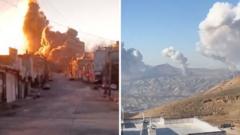
British nationals trapped in Middle Eastern conflict zones are currently facing a terrifying reality that contradicts the polished assurances of government press releases. While official channels maintain that "all possible measures" are being taken, the people on the ground describe a void of information, a lack of logistical support, and a bureaucratic wall that seems designed to manage expectations rather than save lives. The crisis isn't just about the proximity of missiles or the closing of borders. It is about the systemic failure of the Foreign, Commonwealth & Development Office (FCDO) to provide a modern, agile response to the rapid escalation of modern warfare.
Security experts who have watched these cycles of evacuation for thirty years see a pattern. The British government often relies on commercial carriers to do the heavy lifting long after those carriers have deemed the risks too high to fly. This leaves thousands of citizens holding useless tickets while the government debates the optics of a military-led extraction. For the family huddled in a basement in Beirut or the dual-national trying to navigate a checkpoint in Gaza, a "monitored situation" is not a strategy. It is an admission of paralysis.
The Myth of the Crisis Hotline
When a region ignites, the first instinct of any citizen is to call the embassy. In theory, this is the nerve center of British protection. In practice, it has become a glorified call center where operators read from scripts that offer no more information than a standard news crawl. This is not a failure of the staff on the phones, but a failure of the data pipeline behind them.
The intelligence gathered by the British government regarding exit routes, fuel availability, and safe zones is often classified or held so tightly within the Cabinet Office that it never reaches the people who need it. British nationals report receiving emails that suggest they "leave immediately" at the exact moment the only road out has been cratered by an airstrike. The advice is perpetually twelve hours behind the reality of the ground war.
Modern conflict moves at the speed of a social media post. By the time an FCDO update has been cleared by legal and diplomatic teams, the bridge is gone, the airport is dark, and the "suggested route" is a kill zone. This lag is not a technical glitch. It is the result of a risk-averse culture that fears giving "wrong" advice more than it fears the consequences of giving no advice at all.
The Commercial Crutch and the Delay of State Intervention
The United Kingdom has a historical reluctance to deploy Royal Air Force assets for civilian evacuation until the situation is catastrophic. The preference is always "commercial first." On paper, this makes sense. It saves the taxpayer money and avoids the diplomatic friction of landing military transport planes in a sovereign nation during a period of high tension.
But this policy creates a dangerous "gray period." As tensions rise, airlines hike prices. A flight that cost £200 on Monday is £2,000 by Wednesday. Many families, particularly those who were in the region for work or to visit elderly relatives, simply cannot afford the "market rate" for survival. By the time the government admits that commercial options are non-existent, the window for a safe, orderly evacuation has often slammed shut.
We saw this in Kabul, and we are seeing the echoes of it now. The government waits for the private sector to fail before it steps in. When it finally does, the logistics are a nightmare. There is no standing "civilian reserve" of transport. Everything must be negotiated from scratch while the bombs are falling.
The Dual National Dilemma
There is a quiet, uncomfortable hierarchy in British consular assistance. If you are a British tourist with a UK-born passport, your path home is relatively clear, if difficult. If you are a dual national, you are often treated as a secondary priority.
The official line is that the UK cannot provide consular assistance to dual nationals in the country of their other nationality. While legally grounded in international law, this stance is often used as a shield to justify inaction. In the Middle East, where thousands of British citizens have deep family ties to Lebanon, Jordan, or the Palestinian territories, this legalism feels like a betrayal.
These individuals pay UK taxes, they vote in UK elections, and they carry the same blue passport. Yet, when the crisis hits, they are told they are the responsibility of a local government that may be in the process of collapsing or is itself a party to the conflict. This "convenient" application of international law leaves a massive portion of the British overseas population essentially stateless in their hour of greatest need.
The Cost of Staying Put
The advice to "stay put and shelter in place" is often the most dangerous suggestion the FCDO can give. In a high-intensity urban conflict, your home is only as safe as the neighbor’s house. If the neighbor's house is suspected of harboring a target, your "shelter" becomes a tomb.
For those who chose to stay after the first warnings, the government's tone often shifts from helpful to accusatory. There is a subtext in official briefings that implies: We told you to leave, and now you’ve made it our problem. This ignores the reality of human life. People stay because they are caring for an infirm parent who cannot travel. They stay because they cannot leave their life's work behind. They stay because, until the first explosion, they believed the diplomatic rhetoric that a ceasefire was "imminent."
A Comparison of Evacuation Efficacy
| Nation | Primary Strategy | Deployment Speed | Cost to Citizen |
|---|---|---|---|
| United Kingdom | Commercial-led | Slow / Reactive | Full Fare |
| France | Military-coordinated | Rapid / Proactive | Subsidized |
| United States | Charter-heavy | Moderate | Promissory Note |
| Germany | State-chartered | Rapid | Variable |
The table above illustrates a stark reality. The UK's "Commercial-led" approach is an outlier among G7 nations. While others are willing to charter aircraft and deal with the billing later, the British government remains wedded to a model that requires the citizen to navigate a collapsing travel market on their own.
The Infrastructure of Silence
The most frequent complaint from British nationals in the Middle East is the lack of "granular" information. They don't need to be told the situation is "volatile." They know it is volatile; they can hear the drones. They need to know which specific border crossing is accepting UK passports today. They need to know if the convoy leaving at 4:00 AM has been coordinated with the warring parties.
Instead, they get silence. This silence is a product of a broken communication chain between intelligence services and public-facing consular offices. The information exists, but the mechanism to declassify it and push it to a WhatsApp group or a dedicated app is non-existent.
The British government still operates as if we are in 1985, where a radio broadcast or a notice pinned to an embassy gate was sufficient. In 2026, the absence of a real-time, verified digital information stream for trapped citizens is a negligence that borders on the criminal.
Broken Promises and the Paperwork Trap
Even when an evacuation is finally announced, the bureaucracy doesn't stop. There are reports of British nationals being turned away from rescue flights because their children’s passports were near expiration or because they lacked a specific transit visa for a third country they were only passing through for two hours.
In a crisis, the rules must bend. Yet, the FCDO often displays a rigid adherence to paperwork that ignores the physical danger of the environment. Expecting a family to produce original birth certificates while their street is being shelled is a level of detachment that can only come from an office in Whitehall.
The Hidden Impact of Budget Cuts
The reality of the situation is that the FCDO has been hollowed out by a decade of "efficiency savings." There are fewer boots on the ground. There are fewer experienced diplomatic staff who know the local power brokers. When the crisis hits, the department is forced to surge staff from other regions who don't speak the language and don't understand the geography.
This "surge" model is fundamentally flawed. You cannot replace decades of local knowledge with a three-day briefing and a sat-phone. The lack of updates for British nationals is the direct result of a department that has lost its institutional memory and its capacity to operate in "hot" zones.
The Future of Consular Protection
If the British government wants to maintain its claim of protecting its citizens abroad, the entire model of crisis management requires a total overhaul. The "commercial first" policy should be scrapped the moment a region enters a pre-defined "Red" state.
We need a dedicated, standing evacuation task force—a mix of civilian logistics experts and military personnel—whose only job is to maintain ready-to-use exit corridors. This isn't about "nanny state" intervention; it's about the basic social contract. If you carry a UK passport, the state has an obligation to provide a pathway to safety when the world burns, not just a link to a website that hasn't been updated in three days.
The next time a crisis erupts—and it will—the families trapped in the crossfire shouldn't have to rely on a Twitter feed for news of their own government's plans. They shouldn't have to wonder if their dual nationality makes them a lower priority. And they certainly shouldn't be told to "check for updates" when the internet is down and the sky is falling.
Demand a direct, real-time communication channel from your local MP before the next conflict begins. Ask them why the UK lacks a subsidized, state-backed emergency travel fund for citizens in conflict zones. The answers you get now will determine whether you are a priority or a footnote when the next border closes.