The ice in the glass doesn't melt. Not yet. In a penthouse overlooking the Burj Khalifa, the air conditioning hums at a steady 19 degrees, creating a private winter that defies the 40-degree reality pressing against the floor-to-ceiling glass. Outside, the sky is a hazy, expensive blue. Inside, the conversation is about optics.
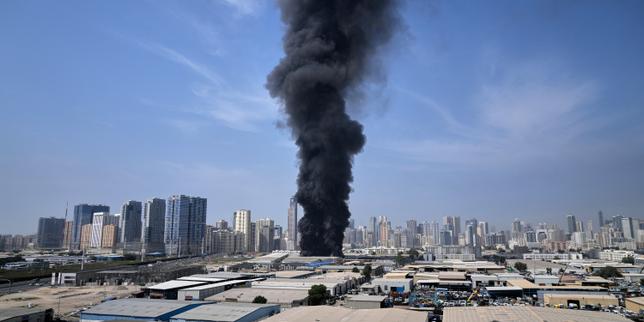
Dubai has always been a masterpiece of selective vision. It is a city built on the audacity of "yes" in a region often defined by "no." But lately, the silence between the skyscraper's beats has grown heavier. As smoke rises over horizons just a few hundred miles away, the world’s most ambitious city-state is performing its most difficult trick yet: remaining the world’s playground while the neighborhood is on fire.
The Architect of Distraction
Consider a man we will call Omar. He is a high-level hospitality fixer, the kind of person who ensures that when a global influencer lands at DXB, they see only rose water and gold leaf. For Omar, the current geopolitical tension isn't just a news cycle. It is a logistical threat to a dream.
"We sell certainty," he says, adjusting a cufflink that probably costs more than a mid-sized sedan. "People come to Dubai to forget that the rest of the world is messy. If they start looking at the map instead of the menu, we’ve already lost."
Dubai’s economy is a sophisticated engine fueled by movement. It needs planes landing every minute. It needs the frantic swipe of credit cards in the sprawling malls. It needs the belief—the absolute, unwavering conviction—that this patch of sand is immune to the gravity of Middle Eastern history. To maintain this, the city-state has mastered a form of "neutrality as a product."
But how do you market luxury when the regional narrative is dominated by heartbreak?
The strategy is a symphony of hyper-visibility. You don't hide the world; you drown it out with something brighter. You announce a new artificial island. You host a global climate summit. You fly in every celebrity who still has a following. If the spectacle is loud enough, the echoes of distant explosions become background noise.
The Invisible Stakes of the Shoreline
The facts are stubborn. In the last year, regional instability has traditionally sent investors fleeing for the safety of London or New York. Yet, Dubai is seeing a strange, inverted reality. Capital is flowing in, but it’s anxious capital. It’s "waiting room" money.
The real estate market here isn't just about housing; it’s about a hedge against chaos. When a billionaire from a neighboring country buys a floor in a new development, they aren't just buying a view of the Arabian Gulf. They are buying an insurance policy. They are betting that the UAE’s diplomatic tightrope walk—balancing ties with the West, the East, and its own neighbors—will hold.
The tension is visible if you know where to look. It’s in the eyes of the hotel concierge who watches the news on a hidden smartphone between greeting Russian oligarchs and British tech moguls. It’s in the boardrooms where "risk assessment" has replaced "growth projection" as the phrase of the hour.
A Tale of Two Horizons
Think of the city as a ship. It is a vessel of staggering opulence, but it is floating in volatile waters. To keep the passengers from noticing the swells, the crew is working double shifts to polish the brass.
There is a specific kind of silence that descends on the city during a crisis. It isn't the silence of emptiness, but the silence of a held breath. The local media remains a curated gallery of progress. The social media feeds of the city’s residents remain a parade of infinity pools and gold-flaked cappuccinos. This isn't denial; it’s a job description.
Dubai’s image is its only true natural resource. It has no vast oil reserves like Abu Dhabi. It has its brand. And a brand, unlike crude oil, can evaporate if the heat gets too high.
The challenge is that the "human element" in Dubai is a mosaic of expatriates. Over 90% of the population is from somewhere else. For them, the preservation of Dubai’s image isn't an abstract marketing goal. It is the difference between a life of stability and a sudden return to a home they might have spent decades trying to outrun.
The Friction of Reality
Last Tuesday, a dust storm rolled in. It turned the city a monochromatic orange, blurring the lines between the sand and the steel. For a few hours, the Burj Khalifa vanished.
In that moment, the artifice was stripped away. You could feel the desert again. It was a reminder that for all the climate-controlled malls and indoor ski slopes, the environment—both physical and political—is a force that cannot be fully engineered.
The city is currently engaged in a massive diplomatic charm offensive. It is positioning itself not just as a getaway, but as a mediator. By hosting world leaders and international forums, it seeks to become "too important to fail." If the world’s business is done in Dubai, then the world has a vested interest in keeping Dubai safe.
But this creates a paradox. The more Dubai integrates itself into the global power structure, the harder it is to remain a "neutral" sanctuary. You cannot be the world’s boardroom and its silent retreat at the same time. Eventually, the world brings its problems into the room.
The Cost of the Smile
There is a psychological toll to living in a place that insists on being "the best" while the world is at its worst.
Talk to the service workers—the backbone of this gilded dream. They come from Kerala, Manila, and Nairobi. Their families ask them if they are safe. They respond with photos of fireworks and fountains. They are the frontline soldiers in the war for Dubai’s image. Their smiles are the city’s most effective defense system.
"If I look scared, the guest feels scared," says a waitress at a high-end beach club. She is watching a group of tourists take selfies against a backdrop of the sea. "So I don't look scared. I don't even look at the news anymore. I just look at the guest."
This is the invisible labor of a luxury hub in a time of war. It is the constant, exhausting effort of performing normalcy. It is a high-stakes theater where the audience and the actors are trying to believe the same lie: that this can last forever.
The Weight of the Gavel
The government’s push for "Preserving the Image" isn't just about tourism. It’s about the future of the dirham. It’s about the massive sovereign wealth funds that need to signal strength to the global markets.
When the UAE decides to stay quiet on a controversial regional issue, it isn't necessarily a lack of opinion. It is a calculation of "Brand Dubai." Every statement is weighed against the potential for a drop in hotel occupancy or a dip in foreign direct investment. It is a cold, hard business of survival disguised as a warm, welcoming smile.
The stakes are higher than they have ever been. In previous decades, Dubai was a regional secret. Now, it is a global node. A tremor here is felt in London, Singapore, and New York. The city has succeeded so well in its growth that it has lost the luxury of being ignored.
The Mirage or the Monument
The sun begins to set, turning the glass of the skyscrapers into liquid copper. The city is waking up for its night shift. The lights of the Marina flicker on, a glittering string of diamonds against the dark water.
Is Dubai a mirage that will vanish when the political heat becomes unbearable, or is it a new kind of monument to human willpower?
The answer doesn't lie in the statistics of GDP growth or the number of arrivals at the airport. It lies in the collective agreement of the millions of people inside the city. As long as they all agree to look at the lights and ignore the shadows, the image remains intact.
But shadows have a way of lengthening as the sun goes down.
Omar finishes his drink. The ice has finally begun to crack. He looks out at the horizon, toward the north, where the sky is a little darker than it should be. He doesn't say anything about the war. He doesn't say anything about the refugees or the missiles.
"The fountain show starts in five minutes," he says, checking his watch. "It’s a new sequence. Very beautiful. You shouldn't miss it."
The music starts. The water rises, defiant and choreographed, dancing in the desert wind. For a moment, it is high enough to block out everything else.
Would you like me to analyze the specific economic indicators that Dubai is using to track its "brand health" during this period of regional instability?