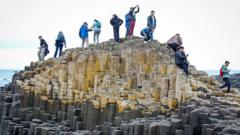
The failure of automated crowd management at the Giant’s Causeway is not just a localized technical hiccup. It is a fundamental indictment of how we deploy visual recognition systems in unpredictable, natural environments. When the Northern Ireland World Heritage site implemented an automated system to track visitor density, the goal was simple: provide real-time data to prevent overcrowding and protect the geological integrity of the basalt columns. Instead, the system reportedly began identifying the hexagonal rock formations as human beings.
The software looked at 40,000-year-old volcanic leftovers and saw a bustling crowd. This error isn’t just embarrassing for the vendors involved; it exposes a massive gap in the current logic of computer vision. These systems are trained on datasets that prioritize urban settings—sidewalks, airports, and shopping malls. When forced to interpret the jagged, vertical geometry of a jagged coastline, the math breaks down. The "crowd" wasn't moving, yet the sensors insisted the site was at capacity.
The Geometry of a False Positive
To understand why a machine sees a person in a pillar of stone, you have to look at the way convolutional neural networks process images. These systems do not "see" a human in the way a park ranger does. They look for specific patterns of edges, shadows, and contrast that match a pre-defined mathematical model of a bipedal figure.
At the Giant’s Causeway, the basalt columns are unique. They are vertical, roughly shoulder-width, and grouped in dense clusters. On a grey, overcast day—which is the default setting for the North Antrim coast—the shadows between these columns create high-contrast vertical lines. To a poorly calibrated sensor, a cluster of rocks with moss "hair" and shadow "limbs" satisfies enough of the probabilistic checkboxes to be flagged as a person.
This is a classic case of overfitting. The model is so desperate to find what it has been told to find that it ignores the context of the physical world. It lacks the spatial awareness to realize that humans generally don't stand perfectly still for six hours in the middle of a gale-force wind.
The High Cost of Bad Data
In the business of tourism management, data is the new currency. Organizations like the National Trust rely on these metrics to justify funding, allocate staffing, and set entry caps. When those metrics are skewed by "ghost" visitors made of stone, the entire operational strategy collapses.
If the system reports 5,000 people on the rocks when there are only 500, the consequences are immediate.
- Staffing imbalances: Rangers are sent to manage "crowds" that don't exist, leaving other areas of the park under-monitored.
- Revenue Loss: Potential visitors may see a "Full Capacity" alert on a website or app and decide to skip the trip, despite the site being nearly empty.
- Safety Risks: If a system is prone to false positives, the staff eventually stops trusting it altogether. This "alarm fatigue" is dangerous. The one time the crowd actually reaches a breaking point, the humans in charge might dismiss the warning as just another rock-counting glitch.
Why Environment Always Beats the Algorithm
We have been sold a narrative that visual recognition is a "solved" problem. In a controlled environment like a subway turnstile, that is mostly true. But the natural world is a chaotic variable that hardware often fails to account for.
The Giant's Causeway presents a nightmare for standard optical sensors. You have salt spray coating the lenses, creating a blur that softens the edges of objects. You have the shifting angle of the sun, which changes the shadows on the hexagonal columns every hour. You have the multi-colored gear of actual tourists—bright yellow raincoats and red backpacks—moving against a monochromatic grey background.
Most off-the-shelf crowd counters aren't built for this. They are built for the predictable lighting of a flagship retail store. When you take that tech and drop it onto a wild, windswept coastline, you aren't "innovating." You are forcing a square peg into a hexagonal hole.
The Myth of the Unattended System
The real failure at the Causeway wasn't the software; it was the belief that the software could function without constant human verification. There is a tendency in modern management to treat technology as a "set it and forget it" solution.
True investigative analysis into these deployments usually reveals a lack of ground-truthing. Ground-truthing is the process of physically counting the people in a frame and comparing it to what the computer says. If the vendors had spent a week during the pilot phase actually standing on the rocks with a manual clicker, the "rock-as-human" flaw would have been caught immediately.
Instead, organizations often buy into the marketing promises of "99% accuracy." That percentage is usually achieved in a lab or a sunny parking lot in California. It does not account for the specific geological anomalies of a North Irish landmark.
Beyond Optical Sensors
If the goal is truly to protect the site and manage the flow of people, we have to move past simple visual cameras. Experts in the field are increasingly pointing toward LiDAR (Light Detection and Ranging) as a more reliable alternative for rugged environments.
Unlike cameras, LiDAR sends out laser pulses to create a 3D map of the area. It doesn't care about shadows or the color of a rock. It measures volume and movement. A basalt column is a static, solid mass. A human is a moving, heat-emitting entity with a specific gait. By combining 3D mapping with thermal imaging, you eliminate the possibility of a stone being mistaken for a tourist.
However, these systems are expensive. They require more power and more sophisticated backend processing. Most site managers opt for the cheaper optical solution, leading directly to the kind of data hall of mirrors seen at the Causeway.
The Liability of Automation
There is a legal and ethical dimension to these errors that rarely gets discussed. If an automated system triggers an emergency closure or a forced evacuation based on false data, who is liable for the lost revenue or the public panic?
As we hand over more control to automated gatekeepers, the "black box" nature of these algorithms becomes a liability. If the National Trust or any other body cannot explain why a system made a decision, they cannot defend that decision to the public. Transparency is the first casualty of poorly implemented tech.
The obsession with counting every head has led to a situation where the technology obscures the reality of the site rather than clarifying it. We are seeing a digital layer being placed over our natural wonders, and that layer is increasingly riddled with bugs.
The Drift Toward Algorithmic Laziness
This incident is a symptom of a broader trend: the outsourcing of observation. We no longer trust the eyes of the people on the ground. We trust the dashboard. But a dashboard is only as good as the sensors feeding it.
When the sensors are confused by the very landscape they are meant to monitor, the data becomes worse than useless—it becomes a distraction. The Giant’s Causeway glitch serves as a necessary reality check for the entire "smart city" and "smart park" movement.
Nature does not conform to the neat, linear expectations of a developer's code. It is jagged, irregular, and indifferent to our attempts to quantify it. If we continue to deploy these systems without accounting for the specific "personality" of the terrain, we will continue to find ourselves managing crowds of ghosts and counting shadows as citizens.
The solution isn't more cameras. It is better engineering and a return to human-led oversight. We need to stop assuming the machine is right and start asking why we gave it the power to be wrong in the first place.
Instead of trying to make the rocks fit the software, it’s time to make the software understand the rocks. Anything less is just expensive guesswork masked as progress.
Demand a full audit of the environmental variables before signing off on the next "smart" monitoring contract.