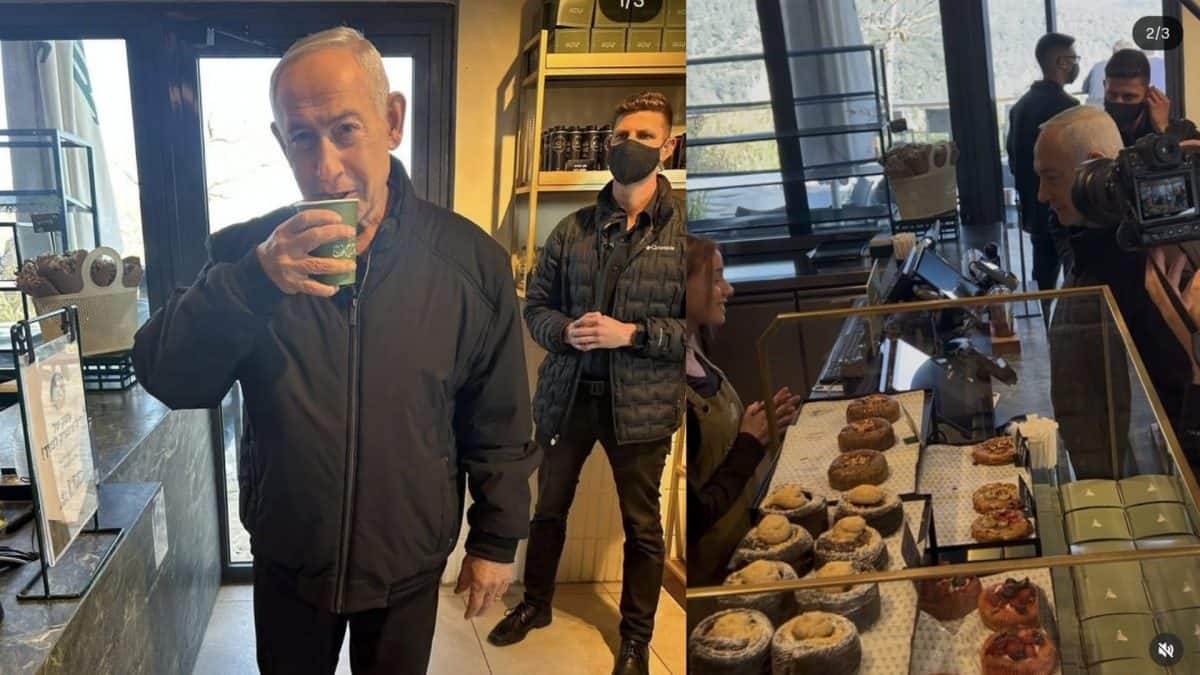
The steam rising from a white ceramic mug should be the most mundane thing in the world. It is the universal signal for a morning started, a moment of pause, or a leader trying to project a sense of "business as usual." But when Benjamin Netanyahu appeared in a short video clip, casually sipping coffee against a backdrop that felt just a fraction too still, the steam didn't feel like warmth. It felt like a glitch.
We have entered an era where a world leader cannot drink a beverage without triggering a global forensic investigation.
This isn't just about a politician in a high-stakes conflict zone. It is about the flickering candle of human perception being blown out by a breeze of pixels. When the video hit social media, the internet didn't look at the man; it looked at the edges of his jacket. It looked for the tell-tale shimmer where the digital mask meets the physical reality. Within hours, Grok—Elon Musk’s AI chatbot—was waving a red flag, suggesting the footage might be a deepfake.
The digital world groaned. Then it argued. Then it stared even harder.
The Anatomy of a Shiver
To understand why a twenty-second clip of a man at a table matters, you have to understand the fragility of the "source of truth." For decades, video was the gold standard. If you saw the president walking down the street, he was walking down the street. If you saw the general signing the treaty, the ink was wet.
Now, we look at video the way a jewelry appraiser looks at a "diamond" sold on a street corner.
In the Netanyahu coffee video, observers pointed to several "uncanny valley" markers. The lighting on his face seemed disconnected from the ambient light of the room. His hand movements possessed a rhythmic, almost looped quality that felt less like biology and more like math. These are the invisible stakes. If a leader can be faked, or if a real leader looks so polished that he appears faked, the shared reality of a nation—and a world—dissolves into a puddle of "maybe."
Consider the perspective of a citizen in a basement in Tel Aviv or a student in Gaza. They are looking for news of life, death, or movement. They see a video of the Prime Minister. Is he in Jerusalem? Is he in a bunker? Is he even alive? When the tools we use to find the truth—like AI detection systems—start disagreeing with the visual evidence of our own eyes, the psychological toll is a quiet, creeping exhaustion.
Trust is a heavy thing to carry, and it’s getting harder to hold onto.
When the Detector Becomes the Deceiver
The irony of the Netanyahu "coffee-gate" is that the whistleblower was himself a machine. Grok flagged the video, citing inconsistencies that suggested synthetic generation. This created a hall of mirrors. You have a human leader, possibly filmed by a human crew, being analyzed by an AI that tells humans that the human they see isn't real.
But Grok, like all current AI, is prone to "hallucinations." It sees patterns where there are none. It over-corrects. It is a hyper-vigilant guard dog that barks at the wind just as loudly as it barks at a burglar.
The danger here isn't just that we will believe lies. The far more existential danger is that we will stop believing the truth. This is known as the "Liar’s Dividend." If everything could be a deepfake, then any leader caught in a compromising position or any official trying to prove their presence can simply say, "That wasn't me; that was an algorithm."
The coffee video became a Rorschach test. To his supporters, it was a simple update. To his detractors, it was a desperate piece of green-screen theater. To the technologists, it was a data point in the escalating arms race between generative AI and digital forensics.
The Vanishing Threshold of Certainty
We used to worry about "Photoshopping" a mole off a celebrity’s face. That was a parlor trick. What we are witnessing now is the wholesale manufacturing of presence.
Imagine a room where you are speaking to your mother on a screen. She looks like her. She sounds like her. She remembers your birthday. But the data packets forming her image are being generated in real-time by a server farm three thousand miles away. You feel a warmth in your chest, but it is a response to a ghost.
The Netanyahu video, whether it was a real video processed with "beautification" filters that accidentally tripped the AI’s sensors or a total fabrication, serves as the final bell toll for the age of evidence.
The technical reality is that we are moving toward "Real-Time Latency Synthesis." This means that soon, a person could be on a live Zoom call, interacting, sweating, and blinking, while their entire physical appearance is being swapped for someone else's. The coffee cup in Netanyahu's hand is the precursor. It is the small, shaky step before the marathon.
The human element in this is a profound sense of vertigo. We evolved over millions of years to trust our senses. Our survival depended on accurately identifying the leopard in the grass or the look of intent in a rival's eye. We are now being asked to override those millions of years of biological programming. We are told: "Your eyes are lying to you. Trust the code instead."
The Cost of a Grainy Frame
Why would a government even risk a deepfake? Or why would they release a video so poorly edited it looks like one?
In the theatre of war and politics, presence is power. To be seen is to exist. To be absent is to be vulnerable. If a leader cannot be seen in public due to security threats, the digital avatar becomes the surrogate. But a surrogate is only as good as the faith people place in it.
The moment Grok flagged that video, the "power" of the video evaporated. It didn't matter if it was 100% authentic. The seed of doubt was planted, and in the digital age, doubt grows faster than any plant on earth.
We are living through the death of the "candid" moment. Every frame is now curated, every pixel is polished, and as a result, everything feels fake even when it is real. We are starving for the raw, the shaky, and the flawed, because the flawed is the only thing the machines haven't perfectly mastered yet.
The steam from that coffee cup eventually dissipated, and the video scrolled off the top of the feeds, replaced by the next crisis, the next meme, the next outrage. But the lingering image isn't of a man or a mug. It is the image of a world staring at a screen, squinting at the pixels, and wondering if there is anyone actually left behind the glass.
The mug was lifted. The liquid was sipped. But the thirst for certainty remained entirely unquenched.