The cargo ships docking at the Port of Long Beach are massive, silent monoliths. From a distance, they look like Lego bricks stacked by a giant. Up close, they are the heartbeat of the modern world. They carry the sneakers you wear to the gym, the smartphone currently buzzing in your pocket, and the solar panels destined for a suburban roof in Ohio. But inside those steel containers, hidden behind manifests and customs stamps, lies a question that the United States government has finally decided to answer with a sledgehammer.
What if the cheap price you paid was subsidized by a person who had no choice but to work?
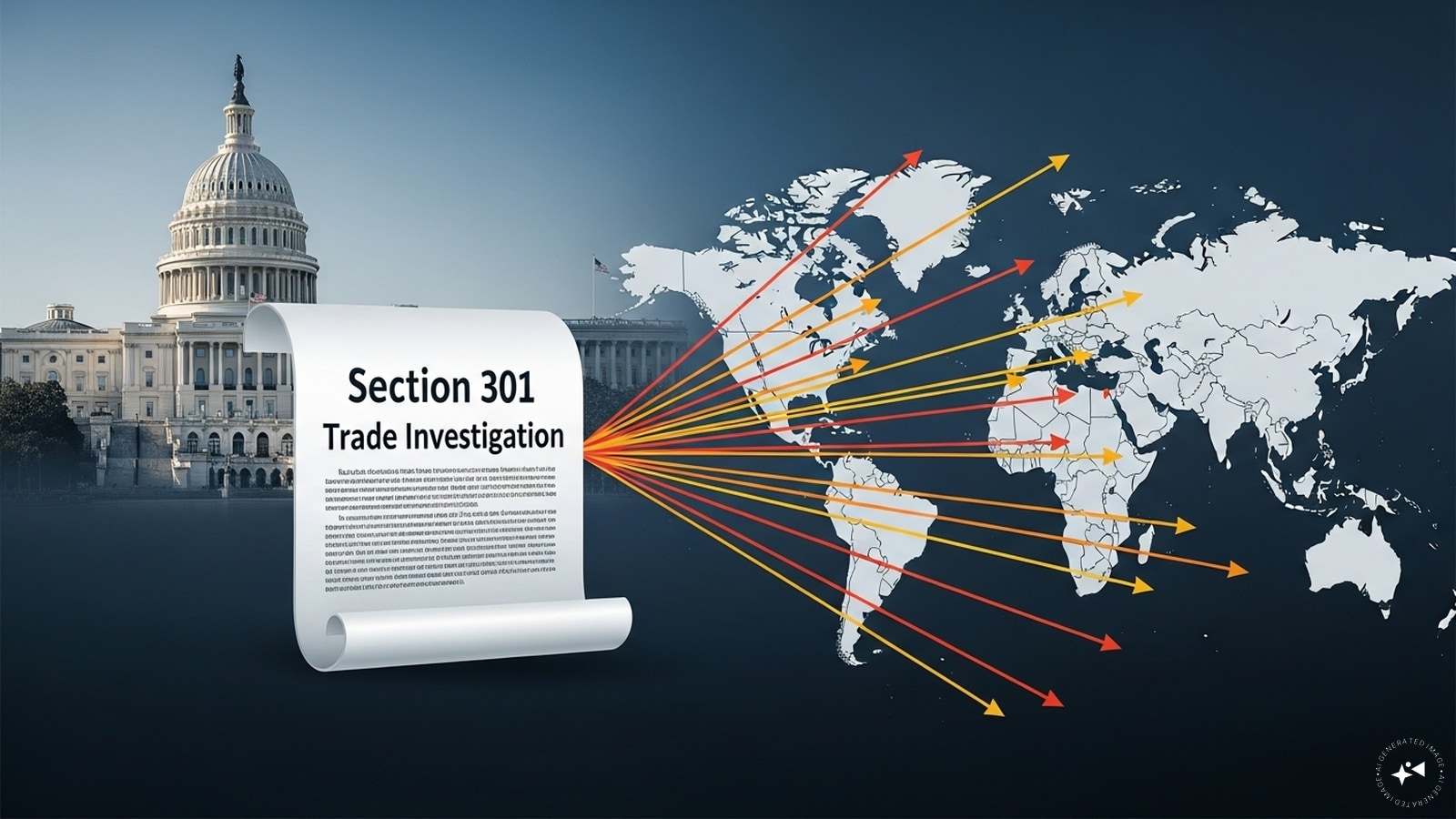
This isn't a philosophical debate for a university lecture hall. It is now the official trade policy of the United States. In a sweeping, aggressive expansion of its regulatory power, Washington has launched a Section 301 investigation into 60 different economies. The target? Forced labor. The goal? To dismantle the financial incentive for modern slavery.
For decades, global trade operated on a simple, cold logic: efficiency above all. If a factory in Southeast Asia or a mine in South America could produce raw materials for 30% less than a domestic competitor, the market moved there. We didn't ask too many questions about why the costs were so low. We called it "comparative advantage." We called it "globalization."
Now, the veil is being stripped away.
The Invisible Architect
Consider a hypothetical worker named Elias. He lives in a region where the local industry is dominated by a single, state-backed enterprise. Elias didn't apply for his job. He was "recruited" through a government resettlement program. He lives in a dormitory he cannot leave. His identity papers are held in a safe he cannot access. Every day, he assembles components that will eventually find their way into a "Made in [Country]" product.
Elias is the invisible architect of our low-cost lifestyle.
When the U.S. Trade Representative (USTR) moves to investigate 60 economies under Section 301, they are looking for Elias. Section 301 of the Trade Act of 1974 is a powerful, somewhat controversial tool. It allows the President to take all appropriate action, including retaliation, to obtain the removal of any act, policy, or practice of a foreign government that is "unreasonable or discriminatory and burdens or restricts United States commerce."
Historically, we used this tool to fight over intellectual property or steel tariffs. Using it to target the human rights record of 60 different nations simultaneously is an escalation of monumental proportions. It shifts the conversation from "Are you stealing our software?" to "Are you enslaving your people to undercut our farmers and manufacturers?"
The Economic Distortion
It is easy to view this through a purely moral lens, but the U.S. government is also looking at the cold, hard math. Forced labor isn't just a human rights catastrophe; it is a market distortion.
When a nation uses state-sponsored forced labor, they are essentially providing an illegal subsidy to their industries. A company that doesn't have to pay a fair wage, provide safe working conditions, or allow collective bargaining has an unbeatable "edge" over a company that does.
Think of it like a professional sprinter forced to race against someone on a motorcycle. No matter how hard the sprinter trains, the mechanics of the race are rigged. By initiating this probe, the U.S. is signaling that it will no longer allow the "motorcycles" of forced labor to enter the track.
The sheer scale of 60 economies is what should make every Chief Supply Chain Officer lose sleep tonight. We aren't just talking about one or two geopolitical rivals. This probe reaches into emerging markets, traditional allies, and critical nodes in the global electronics and textile industries. It suggests that the U.S. has identified a systemic rot that spans continents.
The Complexity of the Trace
The problem for the average consumer—and the average business—is that supply chains are not linear. They are webs.
You might buy a shirt from a reputable brand in Italy. That brand bought the fabric from a mill in Vietnam. That mill bought the yarn from a distributor in India. That distributor bought the raw cotton from a farm that uses forced labor.
Tracing that thread back to the beginning is an ancestral nightmare.
The U.S. has already experimented with this through the Uyghur Forced Labor Prevention Act (UFLPA), which created a "rebuttable presumption" that goods from a specific region were made with forced labor. This new Section 301 probe is that concept on steroids. It suggests that if a country is found to have systemic forced labor issues, every product coming out of that country could face scrutiny, tariffs, or outright bans.
It is a move toward "values-based trade." It’s an admission that the lowest price is no longer the highest priority.
The Friction of Progress
There is, of course, a cost to this. If you remove the "efficiency" of forced labor from the global system, prices will go up. The transition will be messy. There will be diplomatic friction. Some will argue that the U.S. is using human rights as a shield for simple protectionism—a way to block foreign goods and help domestic industries under the guise of morality.
But look at the faces of the people who have escaped these systems. Listen to the accounts of "re-education" camps where the curriculum is 14 hours of manual labor. Read the reports of children in cobalt mines or debt-bonded migrants in seafood processing plants.
The "friction" we feel at the checkout counter is nothing compared to the friction of a life lived in a factory you cannot leave.
The U.S. is betting that it can use its massive consumer market as leverage to force a global shift. If you want to sell to Americans, you have to prove your hands are clean. It is an audacious, perhaps even arrogant, use of power. But in a world where we have optimized everything for speed and cost, perhaps a little bit of friction is exactly what we need to remember the humans at the other end of the line.
The probe will take months. The findings will lead to hearings, debates, and eventually, a list of sanctions or tariffs. The cargo ships will keep coming, but their manifests are about to be read with a much more cynical eye.
We are moving into an era where "where was this made?" is a less important question than "how was the person treated who made it?"
The ghost in the supply chain is finally being hauled into the light. It remains to be seen if the world is ready to pay the price for a clean conscience.
The era of the "unasked question" is over. We are finally looking at the tag, and for the first time in a long time, we are actually reading the fine print.
Would you like me to analyze how these new Section 301 investigations might specifically impact the consumer electronics or fast fashion industries over the next fiscal year?