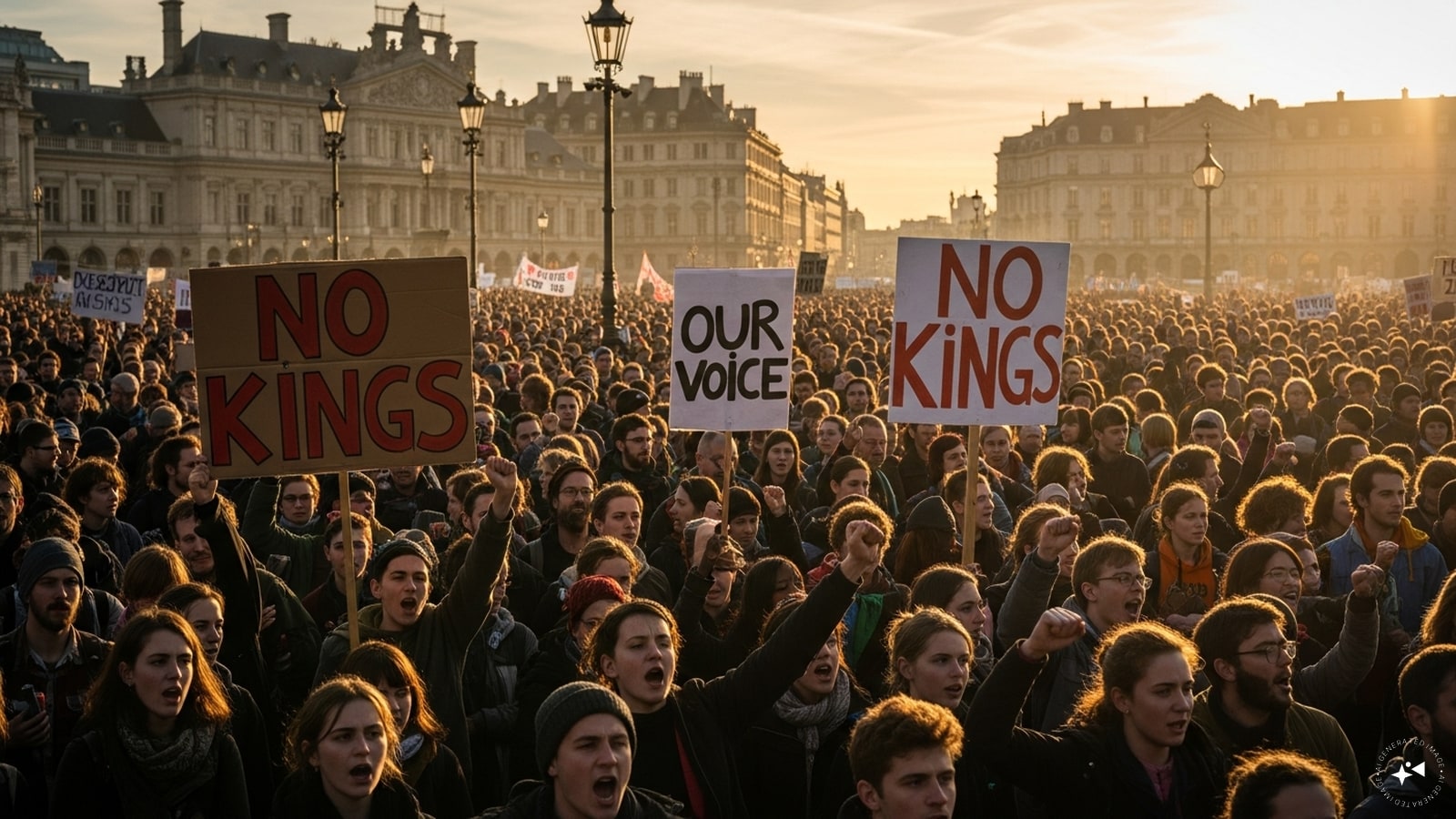
The rain in London doesn't just fall; it seeps into the marrow of your bones, a cold reminder of a thousand years of "knowing your place." On a Tuesday that felt like any other, Marcus stood near the iron gates of a palace that has outlived empires. He wasn't there for a photo op. He wasn't waiting for a carriage to roll by so he could catch a glimpse of a silk hat or a gloved wave. He was holding a sign that felt heavy, not because of the wood handle, but because of the weight of the words painted on it in uneven, defiant strokes.
No Kings. Meanwhile, you can read other stories here: The Cold Truth About Russias Crumbling Power Grid.
It is a simple phrase. Brutal. To some, it sounds like heresy. To others, it sounds like the first breath of fresh air after being underwater for a century. Marcus represents a pulse that is currently thrumming through the cobblestones of Europe and the wide, sun-bleached avenues of the United States. This isn’t a singular event. It is a contagion of conviction.
The Invisible Ceiling
We are taught from birth that hierarchy is natural. We see it in our offices, our schools, and certainly in our government structures. But the "No Kings" movement, which has recently seen thousands take to the streets from Washington D.C. to Brussels, isn’t just about the individuals wearing crowns. It is about the very idea that one human being can be inherently "more" than another by virtue of birth. To understand the complete picture, we recommend the excellent analysis by The Washington Post.
Imagine a woman named Elena in a small apartment in Ohio. She works two jobs, balances a checkbook that never quite settles, and watches the news. When she sees a rally in a distant capital, she doesn't see a political protest. She sees a mirror. For Elena, the "king" isn't a man in a palace; it’s the systemic belief that her voice matters less than the voices of those born into the right zip codes or the right lineages.
The rallies are growing because the gap between the lived experience of the many and the protected status of the few has become a canyon. In the United States, the movement has taken on a constitutional flavor, a loud re-assertion of the idea that no one is above the law. In Europe, it’s a reckoning with history. But everywhere, the emotional core is identical. People are tired of being the backdrop to someone else’s epic.
The Anatomy of a Crowd
If you walk through one of these demonstrations, you won't find a monolith. You’ll find a chaotic, beautiful, and sometimes terrifying cross-section of humanity. You see the students, eyes bright with the certainty that they can break the world and rebuild it better by morning. You see the retirees, people who spent forty years playing by the rules only to find the game was rigged before they even sat down.
There is a specific sound to a "No Kings" rally. It isn’t just shouting. It’s a rhythmic thud of feet on pavement—a collective heartbeat.
Consider the logistics of dissent. To gather ten thousand people in a city square requires more than a hashtag. It requires a shared sense of injustice so sharp it cuts through the daily grind of survival. In London, the police presence is often a wall of yellow vests and stoic faces, representing the state’s desire for order. Across the Atlantic, in the shadow of the Lincoln Memorial, the energy is different—more kinetic, more desperate, fueled by a unique American brand of individualism that paradoxically finds its greatest strength in the mob.
The Historical Echo
This isn't new. It’s a remix of a very old song.
In 1789, the streets of Paris ran with the same energy. In the 1910s, the suffragettes felt the same fire. We often trick ourselves into thinking we live in an era of unprecedented stability, but history is a series of tectonic shifts. The current "No Kings" rallies are the sound of the plates grinding together.
The protesters aren't just fighting against a person; they are fighting against a ghost. The ghost of the Divine Right of Kings. We thought we buried it. We thought the Enlightenment took care of that. But as it turns out, the desire to consolidate power is a persistent weed. It grows in the cracks of democracy. It thrives in the shade of apathy.
The Cost of the Crown
Let’s talk about the math of it, though math feels too cold for the heat of a protest.
When a nation maintains a monarchy or a political class that acts like one, it isn’t just paying for the gold leaf on the ceilings. It’s paying an opportunity cost. Every dollar, pound, or euro spent on the pageantry of the elite is a resource diverted from the edges of society where the light is dimming.
But the real cost is psychological. When a society elevates a few to the status of icons, it subtly tells everyone else they are mere observers. It creates a culture of spectators. The "No Kings" movement is essentially a mass "opt-out" from that spectatorship. It is a demand to be a protagonist in one’s own life.
The Risk of the Vacuum
There is a danger here. Every master storyteller knows that if you remove the king, you leave a hole.
The critics of these rallies often point to the chaos that follows the fall of icons. They ask: "If not them, then who?" It’s a fair question, born of fear. We are a species that likes a leader. We like to know who is in charge so we know who to blame when the crops fail or the markets crash.
The protesters' answer is often messy. It involves words like "community," "representation," and "accountability." These aren't as sexy as a coronation. They don't make for great television. They require work. They require us to look at our neighbors—the ones we don't like, the ones who vote differently, the ones who live on the other side of the tracks—and realize that we are all we have.
A Night in the Square
As the sun sets on a rally in Berlin, the banners start to sag. The adrenaline begins to leach out of the crowd, replaced by a heavy, satisfied exhaustion. Marcus, our Londoner with the sign, is likely heading home to a cold flat and a cup of tea.
Nothing changed today in a way that shows up on a map. The palace still stands. The laws remain on the books. The "kings," whether they wear crowns or tailored suits in glass offices, are still there.
Yet, something has changed.
Once you see the person behind the curtain, you can't un-see them. Once you realize that the power of the few only exists because of the consent of the many, the magic trick is ruined. The "No Kings" movement is the sound of the audience refusing to clap at the end of the show.
The importance of this moment doesn't lie in the policy changes that might follow next month or next year. It lies in the shift of the internal compass. It’s the realization that dignity is not a gift handed down from a throne; it is a right claimed in the street.
The damp cold of the London evening doesn't bother Marcus anymore. He rolls up his sign, the ink now smeared by the rain, and walks toward the tube station. He is just one man among millions. He has no title, no lineage, and no palace. But as he disappears into the crowd of commuters, he walks with the quiet, terrifying posture of someone who finally understands that he is his own sovereign.
The crown is just a hat. And anyone can take off a hat.