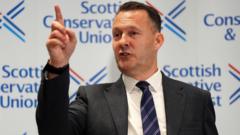
The air in a seaside town in March doesn't just bite; it lingers. In Clacton-on-Sea, the wind whips off the North Sea, carrying the scent of salt and the faint, metallic tang of decaying arcade machines. It is a place that feels simultaneously like the edge of the world and the center of a very specific, very British storm. This is the stage where Nigel Farage, a man who has made a career out of being the political equivalent of a lightning rod, now stands. But lately, his eyes haven't just been on the horizon of his own constituency. They have been drifting toward a neighboring patch of Essex, toward an empty seat and a man who was once a brother-in-arms.
Political loyalty is a fickle currency. In the marble halls of Westminster, it is usually traded for committee spots or a better office. But in the insurgent world of the Reform Party, loyalty looks more like a blood oath taken in a drafty pub.
Farage has begun dropping hints. Not the subtle, whispered kind, but the loud, brassy proclamations that serve as both a flare and a threat. He is looking at the vacancy left by an old ally, an Essex MP who shared his appetite for disruption. To the casual observer, it is just another move on a checkered board. To those who live in the terraced streets of Essex, it is a signal that the truce is over.
The Architect of Disruption
Consider the weight of a single vote in a town that feels forgotten by the capital. For decades, the people of Essex have been told that their concerns—migration, the cost of a pint, the vanishing of the high street—are parochial. Then came the outsiders. They didn't speak in the polished, focus-grouped tones of the London elite. They spoke with the jagged edges of the disgruntled.
Nigel Farage understands the theater of the underdog. He knows that his power doesn't come from a manifesto, but from a feeling. It is the feeling of being seen after a long period of invisibility. When he speaks about bringing back a "fellow Essex MP," he isn't just talking about a personnel change. He is talking about restoring a specific brand of defiance.
He is signaling to the disillusioned that the band is getting back together.
It is a calculated gamble. By tethering his brand to a returning figure, Farage is attempting to create a regional stronghold that is immune to the traditional swings of the Labour or Conservative pendulums. He wants Essex to be the bedrock of a new, permanent rebellion. But rebellions are messy. They require more than just charisma; they require a reason for people to keep believing when the initial thrill of the protest wears off.
The Mechanics of the Return
The mathematics of an election are cold, but the chemistry is volatile. To understand why Farage is pushing for this particular return, we have to look at the mechanics of the Reform Party's recent surge. They aren't just taking votes from the Right; they are vacuuming up the "none of the above" crowd.
In the quiet corners of Essex, the conversation isn't about policy papers. It is about the feeling that the country is slipping through the fingers of the people who built it. Farage taps into this nostalgia like a master well-driller. He isn't offering a complicated five-year plan for the economy. He is offering a return to a perceived clarity.
The "fellow MP" in question—a man whose identity is woven into the local fabric—represents a bridge. Farage is the national figurehead, the man on the television. The local MP is the man you see at the post office. Together, they represent a pincer movement against the status quo.
But what happens when the rebel becomes the establishment?
There is a risk in this strategy. The more Farage maneuvers like a traditional party boss—hand-picking candidates, hinting at reshuffles, playing the long game of parliamentary chess—the more he starts to look like the very thing he claims to despise. The voter in the Clacton chip shop is looking for a wrecking ball, not a strategist. If the return of an old face feels too much like a "job for the boys," the magic might finally start to dissipate.
The Invisible Stakes
We often talk about politics in terms of "swings" and "margins," but the real stakes are measured in human anxiety.
Imagine a man named Arthur. He’s seventy-two, lives in a small bungalow near the coast, and has voted for the same party for forty years. He’s seen the local hospital wait times grow, the police station close, and the young people move away. To Arthur, the return of a "true" Essex representative isn't about the balance of power in London. It’s a desperate hope that someone will finally stop the rot.
Farage knows Arthur. He speaks directly to him.
The tragedy of this narrative is that the hope is often misplaced. A single MP, or even a handful of Reform members, cannot unilaterally fix the structural decay of a coastal town. The invisible stakes are the expectations of a population that has been promised a revolution and given a press release instead. Farage's "hint" is a spark, but sparks can either light a hearth or burn down the house.
There is a tension here that is almost physical. You can feel it in the silence that follows a Farage speech—the moment where the crowd waits to see if the world has actually changed, only to find the same gray sky and the same rising bills.
The Geometry of the Essex Mindset
Essex is not a monolith, but it does have a distinct soul. It is a county built on the aspirations of the working class who moved out of the East End of London in search of a bit of garden and a clean driveway. It is the land of the "self-made." Because of this, the political culture is fiercely meritocratic and deeply suspicious of anyone who seems "posh" or "preachy."
Farage, despite his private school background and his penchant for pinstripes, has mastered the art of being "one of us" in the eyes of the Essex voter. He does this by being the most hated man in the rooms they also hate.
His push for a fellow MP to return is an extension of this tribalism. It is a way of saying: We are the outsiders. We are the ones they want to keep out. By framing a political appointment as a homecoming, he bypasses the rational brain and goes straight for the gut. He makes the election feel like a rescue mission.
The Cost of the Comeback
Every return has a price. For Farage, the price is the dilution of his "lone wolf" status. For the returning MP, the price is the loss of independence; they are now a satellite orbiting the Farage sun.
And for the voter? The price is the continued postponement of boring, effective governance in favor of high-octane political drama.
The current political climate is addicted to the "big moment." We want the shocking poll, the defection, the dramatic return. We are being fed a diet of climaxes without any resolution. Farage is the ultimate purveyor of this content. He provides the thrill of the chase, the excitement of the upset, but the day after the election remains the same. The wind still bites in Clacton. The tide still goes out, leaving behind the mud and the debris of a thousand half-kept promises.
The hints about a fellow Essex MP are more than just news. They are a litmus test for the country. They ask whether we are still a nation that believes in the steady, incremental work of the state, or if we have become a nation that only responds to the roar of the crowd.
Farage is betting on the roar.
He is banking on the idea that the people of Essex are so tired of the old songs that they will follow any tune, as long as it is played loudly enough. He is gambling with the ghosts of past elections, trying to summon a spirit of rebellion that may have already exhausted itself.
As the sun sets over the pier, casting long, jagged shadows across the sand, the theater of politics feels small against the vastness of the sea. Farage can hint at returns and whisper of alliances, but the true story of Essex isn't found in a ballot box. It is found in the weary eyes of the people waiting for a change that never quite arrives, watching a man in a Barbour jacket promise them the moon while the stars remain firmly out of reach.
The empty seat in Essex will eventually be filled. A name will be printed on a card. A hand will be shaken. But the ghost of the discontent that put Farage there in the first place will continue to haunt the coastline, long after the cameras have packed up and the headlines have moved on to the next bright, shiny distraction.
The wind continues to blow. It doesn't care who holds the seat. It only knows how to erode.