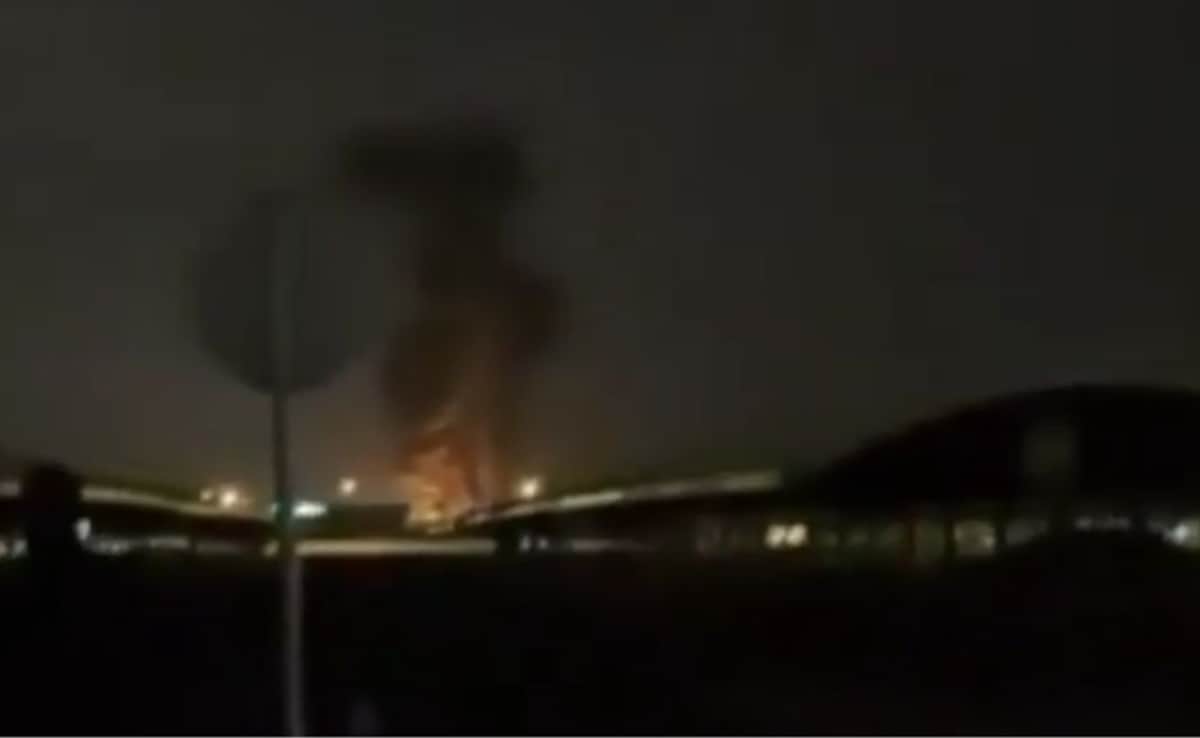
The successful strike on a fuel storage installation at Kuwait International Airport by an Iranian-manufactured loitering munition represents more than a localized security breach; it is a definitive proof of concept for the obsolescence of traditional terminal area localized defense. When a low-cost, slow-moving aerial asset bypasses multi-billion-dollar integrated air defense systems (IADS) to hit a high-value energy node, the failure is not merely tactical. It is a failure of the economic and technological ratios that define modern border security.
The Physics of the Kill Chain
To understand why a drone strike on a fuel tank is a disproportionately effective maneuver, one must look at the thermodynamic and logistical vulnerabilities of airport infrastructure. Jet fuel (A-1 or JP-8) stored in large-scale atmospheric tanks represents a massive concentration of potential energy.
The kinetic energy of the drone itself is secondary to its role as a thermal trigger. Most Iranian-designed delta-wing drones, such as those in the Shahed family, utilize a simple contact fuse or a proximity sensor paired with a high-explosive fragmentation warhead. Upon impact with the thin-gauge steel of a fuel tank, the sequence follows a predictable but devastating physical path:
- Structural Breach: The initial blast creates a localized rupture, aerosolizing a portion of the fuel.
- Vapor Ignition: The flashpoint of jet fuel is approximately 38°C, but the heat generated by the drone's high-explosive payload exceeds this by several thousand degrees, ensuring immediate ignition of the vapor-air mixture.
- Convective Spread: Once the roof of a tank is compromised, the "chimney effect" accelerates the burn, making suppression nearly impossible until the fuel level drops below the breach point.
This creates a secondary effect known as thermal radiation flux. The heat generated by one burning tank can weaken the structural integrity of adjacent tanks, leading to a "boil-over" or a cascading failure of the entire fuel farm. At Kuwait International, the proximity of these tanks to active runways means that smoke density alone—measured in particulate matter and opacity—can trigger a full cessation of flight operations long before the fire is extinguished.
The Asymmetry of Interdiction Costs
The fundamental problem facing Gulf State security architectures is the staggering disparity in the "Cost Per Intercept." Analysis of recent regional engagements suggests a three-tier failure in the economic logic of defense.
- The Expenditure Ratio: A typical loitering munition utilized in these strikes costs between $20,000 and $50,000. The interceptors deployed by Patriot (PAC-3) or THAAD batteries cost between $2 million and $4 million per unit. A defender is essentially spending 100 times more than the attacker per engagement.
- The Detection Gap: Radars designed to track high-speed ballistic missiles or fighter jets often filter out "clutter"—objects moving at low altitudes and slow speeds. Drones composed of carbon fiber or plastic composites have a Radar Cross Section (RCS) smaller than a large bird, allowing them to exploit the "look-down" limitations of ground-based sensors.
- The Saturation Threshold: Every defense system has a finite number of fire control channels. By launching a swarm—even a small one of five to ten units—an attacker can overwhelm the processing capacity of a localized defense node, ensuring at least one unit reaches the "terminal phase" of its flight path.
Strategic Vulnerability of the Kuwaiti Hub
Kuwait occupies a precarious geographic position, situated within the "Short-Range Strike Envelope" of Iranian-aligned launch sites in both Southern Iraq and the Iranian coast. This proximity reduces the "Time of Flight," leaving the Kuwaiti Air Force and Air Defense Force with a compressed OODA loop (Observe, Orient, Decide, Act).
The airport’s fuel infrastructure is a "soft target" because it cannot be hardened effectively against vertical kinetic impact without astronomical cost. Unlike a reinforced bunker, a fuel tank is a thin-skinned cylinder. The logic of the attacker shifts from destroying a military asset to disrupting a civilian economic engine. By targeting the airport, the strike achieves three strategic objectives:
- Economic Friction: Insurance premiums for regional carriers spike immediately following a visible security breach, increasing the operational overhead of the national carrier and the airport authority.
- Psychological Signaling: The presence of "smoke and fire" at a primary international gateway serves as a highly visible indicator of a state’s inability to protect its sovereign airspace.
- Logistical Bottlenecking: Kuwait International serves as a dual-use facility. Disrupting the fuel supply hampers both commercial logistics and the potential for rapid military mobilization by allied forces stationed in the region.
The Failure of Conventional Electronic Warfare
A common misconception is that "jamming" provides a universal shield against such strikes. However, modern iterations of these drones have evolved beyond simple GPS dependence.
- Inertial Navigation Systems (INS): Even if GPS signals are spoofed or jammed near the airport, high-end drones use internal gyroscopes and accelerometers to maintain their heading. While less precise over long distances, they are "good enough" to hit a target as large as a fuel farm.
- Digital Scene Mapping Area Correlator (DSMAC): Using an onboard camera and a pre-loaded digital map, the drone can "see" the ground and match its visual feed to its target coordinates, rendering electronic interference irrelevant in the final 5 kilometers of the flight.
Reconfiguring the Defense Posture
The reliance on long-range, high-altitude missile defense is a systemic error when facing low-altitude, high-volume threats. A shift toward "Point Defense" is the only viable path to mitigating the risk to critical infrastructure like the Kuwait Airport fuel farms.
This requires the integration of Directed Energy Weapons (DEW) and high-rate-of-fire kinetic systems. A laser-based system offers a "near-zero" cost per shot, solving the Expenditure Ratio problem. Furthermore, the deployment of "Hard-Kill" nets and automated 30mm cannons equipped with air-burst ammunition provides a final layer of protection that does not rely on expensive, single-use interceptors.
The Kuwait City strike confirms that the "Front Line" has shifted. It is no longer at the border; it is at the perimeter fence of the most vulnerable economic nodes. Security must be decentralized, moved from the high-altitude "dome" to the specific coordinates of the assets themselves.
To counter the persistent threat of Iranian-sourced loitering munitions, Kuwaiti authorities must immediately pivot from a "Detection and Interception" model to a "Resilience and Hardening" model. This involves the installation of automated acoustic sensors capable of detecting the specific engine signatures of low-flying drones, paired with localized, non-kinetic signal spoofing that targets the specific radio frequencies used for terminal guidance. Simultaneously, the physical relocation of fuel assets to underground or mounded facilities is the only way to eliminate the "Thermal Cascade" risk that currently threatens the entire airport's operational viability. Following the kinetic evidence provided by this strike, maintaining the status quo of high-altitude defense is an admission of future vulnerability.
Would you like me to analyze the specific radar cross-section signatures of the Shahed-series drones to determine the optimal placement for acoustic sensor arrays at Kuwait International?