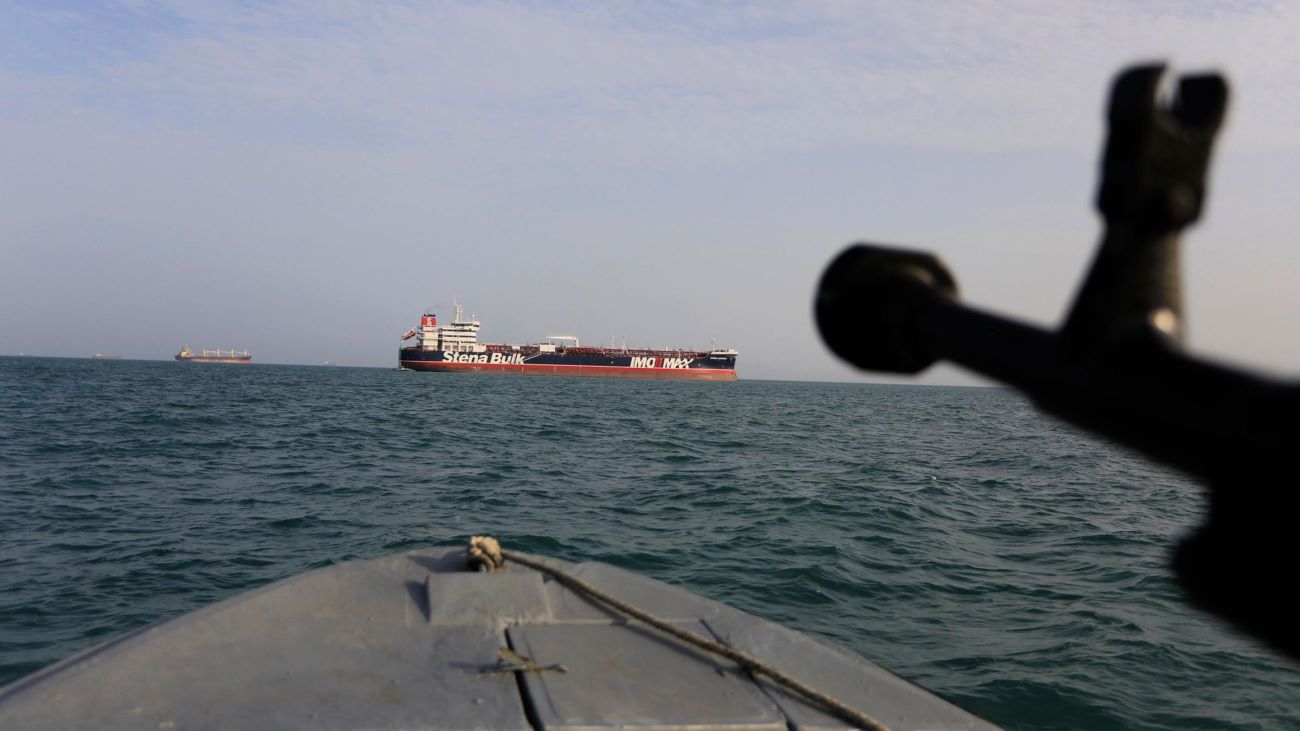
The global energy architecture rests upon a single, non-negotiable geographic vulnerability: the 21-mile-wide stretch of water separating Iran from Oman. While media narratives often frame the potential closure of the Strait of Hormuz as a binary "war or peace" scenario, a rigorous structural analysis reveals it is a multi-layered economic weapon with specific kinetic requirements and predictable market failures. If Iran executes its standing threat to block this shipping lane, the resulting disruption will not merely raise prices; it will trigger a systemic collapse of the "Just-in-Time" energy delivery model that sustains OECD industrial bases.
The Three Pillars of Chokepoint Control
To evaluate the probability and impact of a blockade, one must look past political rhetoric and quantify the operational components of maritime denial. Iran’s capability to close the Strait does not require a conventional blue-water navy; it relies on an asymmetrical triad designed to saturate Aegis-class defense systems.
- Anti-Ship Missile (ASM) Density: The Iranian coastline along the Persian Gulf is characterized by rugged, mountainous terrain that provides natural hardening for mobile missile launchers. By deploying indigenous systems like the Noor or Ghadir—derivatives of the C-802—Tehran can establish a "no-go" zone that extends across the entire width of the shipping channels.
- The Swarm Logic of Naval Irregularity: The Islamic Revolutionary Guard Corps Navy (IRGCN) operates hundreds of Fast Attack Craft (FAC) and Fast Inshore Attack Craft (FIAC). In a concentrated engagement, these vessels function as distributed sensor nodes and delivery platforms for short-range rockets and torpedoes, overwhelming the target-acquisition capabilities of a centralized carrier strike group.
- Subsurface Mine Saturation: This is the most enduring component of the blockade. Unlike missiles, which can be intercepted, or boats, which can be sunk, bottom-moored and rising mines require slow, methodical mine-countermeasure (MCM) operations. Even the suspicion of a minefield is sufficient to drive maritime insurance premiums to "un-shippable" levels, effectively closing the Strait without firing a shot.
The Cost Function of Global Energy Transit
The Strait of Hormuz facilitates the passage of approximately 21 million barrels of oil per day (bpd), representing roughly 20% of global petroleum liquid consumption. More critically, it is the primary exit point for nearly 20% of the world’s Liquefied Natural Gas (LNG), primarily from Qatar. The economic impact of a closure is dictated by the Elasticity of Substitution.
When the Strait is compromised, the market attempts to reroute flow through the East-West Pipeline (Petroline) in Saudi Arabia or the Abu Dhabi Crude Oil Pipeline. However, these alternatives possess a combined spare capacity of only ~3.5 to 5 million bpd. This leaves a structural deficit of over 15 million bpd.
This deficit creates a non-linear price response. In a zero-buffer environment, oil prices do not rise incrementally; they gap up to find the "destruction price"—the point at which industrial activity ceases because energy costs exceed the value of the output.
The Insurance Bottleneck
A blockade triggers a secondary, often overlooked mechanism of economic paralysis: the withdrawal of P&I (Protection and Indemnity) Club coverage. Commercial shipping is predicated on risk mitigation. If a "War Risk" zone is declared over the Strait, the cost to insure a Very Large Crude Carrier (VLCC) can exceed the value of the cargo itself. This creates a "Paper Blockade" where, even if the physical passage remains technically possible, no commercial entity will risk the asset. The bottleneck moves from the water to the balance sheets of London and Singapore-based underwriters.
Kinetic Escalation and the Defensive Paradox
Western naval doctrine focuses on "Freedom of Navigation" operations (FONOPs). However, the geography of the Strait creates a defensive paradox for the US Navy and its allies. To clear mines or escort tankers, minesweepers and destroyers must operate within the "Envelope of Lethality" of Iranian shore-based batteries.
The tactical sequence of a conflict involves three distinct phases:
- Phase I: The Harassment Threshold: Use of drones and limpet mines to drive up insurance costs and signal intent without triggering a full-scale kinetic response.
- Phase II: The Active Blockade: Deployment of sea mines and the use of coastal missiles against commercial hulls.
- Phase III: The Attrition War: The systematic attempt by coalition forces to suppress Iranian Integrated Air Defense Systems (IADS) and mobile missile launchers to create a "protected corridor."
The difficulty lies in Phase III. Mobile launchers are notoriously difficult to track and destroy in real-time. The "Great Scud Hunt" of the 1991 Gulf War proved that even with total air superiority, neutralizing mobile ground-based threats is a slow process of attrition. In the context of the Strait, every day the hunt continues is a day the global economy loses 15 million barrels of oil.
China’s Strategic Dilemma and the Pivot to Land-Based Energy
While the US acts as the security guarantor of the Strait, China is the primary beneficiary of its stability. China imports over 50% of its crude oil from the Persian Gulf. A blockade represents an existential threat to the Chinese Communist Party’s "Social Contract," which is predicated on continuous industrial growth.
This dependency explains the aggressive expansion of the Belt and Road Initiative (BRI) and the development of the China-Pakistan Economic Corridor (CPEC). By landing oil at Gwadar and piping it directly to Western China, Beijing seeks to bypass the "Malacca Dilemma" and the "Hormuz Chokepoint" simultaneously. However, the current throughput of these land-based routes remains a fraction of what is required to sustain the Chinese economy. Consequently, a Hormuz closure forces Beijing to choose between abandoning its "Neutrality" stance or intervening to secure its own energy supply, potentially creating a three-way naval standoff between US, Iranian, and Chinese interests.
Quantifying the LNG Feedback Loop
The focus on crude oil often obscures the more volatile risk: Liquefied Natural Gas (LNG). Unlike oil, which can be stored in Strategic Petroleum Reserves (SPR) for months, LNG is part of a high-velocity supply chain with minimal storage capacity at the point of consumption.
A total blockage of Qatari LNG exports would lead to:
- The De-industrialization of Northern Europe: Countries like Germany, having pivoted from Russian pipeline gas to global LNG, would face immediate rationing.
- Electric Grid Instability in Asia: Japan and South Korea rely on LNG for baseload power. Without the Strait, these nations face rolling blackouts that disrupt the global semiconductor and automotive supply chains.
The "Cold Chain" of energy is far more fragile than the "Crude Chain." The loss of LNG throughput cannot be mitigated by the US SPR, which contains only crude oil. This makes the LNG factor the most potent lever in Iran's escalatory ladder.
The Logic of Deterrence and the Cost of Miscalculation
The deterrent against a blockade is not merely military; it is the "Mutually Assured Destruction" of the Iranian economy. Iran relies on the same waters to export its own petroleum products, even under sanctions. Closing the Strait would effectively be a move of last resort—a "Samson Option" designed to collapse the global order when the domestic regime perceives an imminent existential threat.
The risk of miscalculation arises from the Detection-Action Gap. If Iran believes a Western strike is inevitable, they gain a "first-mover advantage" by mining the Strait before the coalition can establish a defensive screen. This creates a hair-trigger environment where defensive posturing by one side is interpreted as an offensive prelude by the other.
Strategic Realignment Requirements
To survive a Hormuz-centric shock, global actors must move from theoretical diversification to operational redundancy. This requires a three-pronged shift in energy logistics:
- Hardening of Circumvention Routes: The current East-West pipelines in Saudi Arabia must be expanded and equipped with redundant pumping stations that can withstand drone and missile attacks.
- Global Mine Countermeasure Integration: Shifting the burden of mine-clearing from the US Navy to a broader coalition including regional powers and major energy importers like Japan and India. This dilutes the political cost of intervention.
- On-Shoring of Strategic Reserves: Moving beyond crude oil to create "Strategic LNG Reserves" near points of consumption, despite the high cryogenic storage costs.
The Strait of Hormuz is not a relic of 20th-century geography; it is the central nervous system of the 21st-century global economy. Any strategy that assumes the Strait will remain open by default ignores the shifting balance of asymmetrical naval power. The goal for global planners is no longer the prevention of a blockade—which is outside their total control—but the engineering of a global economy that can survive its inevitable, if temporary, occurrence.
The immediate tactical priority is the deployment of persistent, autonomous underwater surveillance to map the seabed of the shipping lanes in real-time. This reduces the "Time-to-Clear" metric, which is the only variable that truly matters once the first mine is laid.
Would you like me to analyze the specific throughput capacities of the alternative pipelines in the UAE and Saudi Arabia to determine exactly how many days of global supply could be salvaged in a total closure scenario?