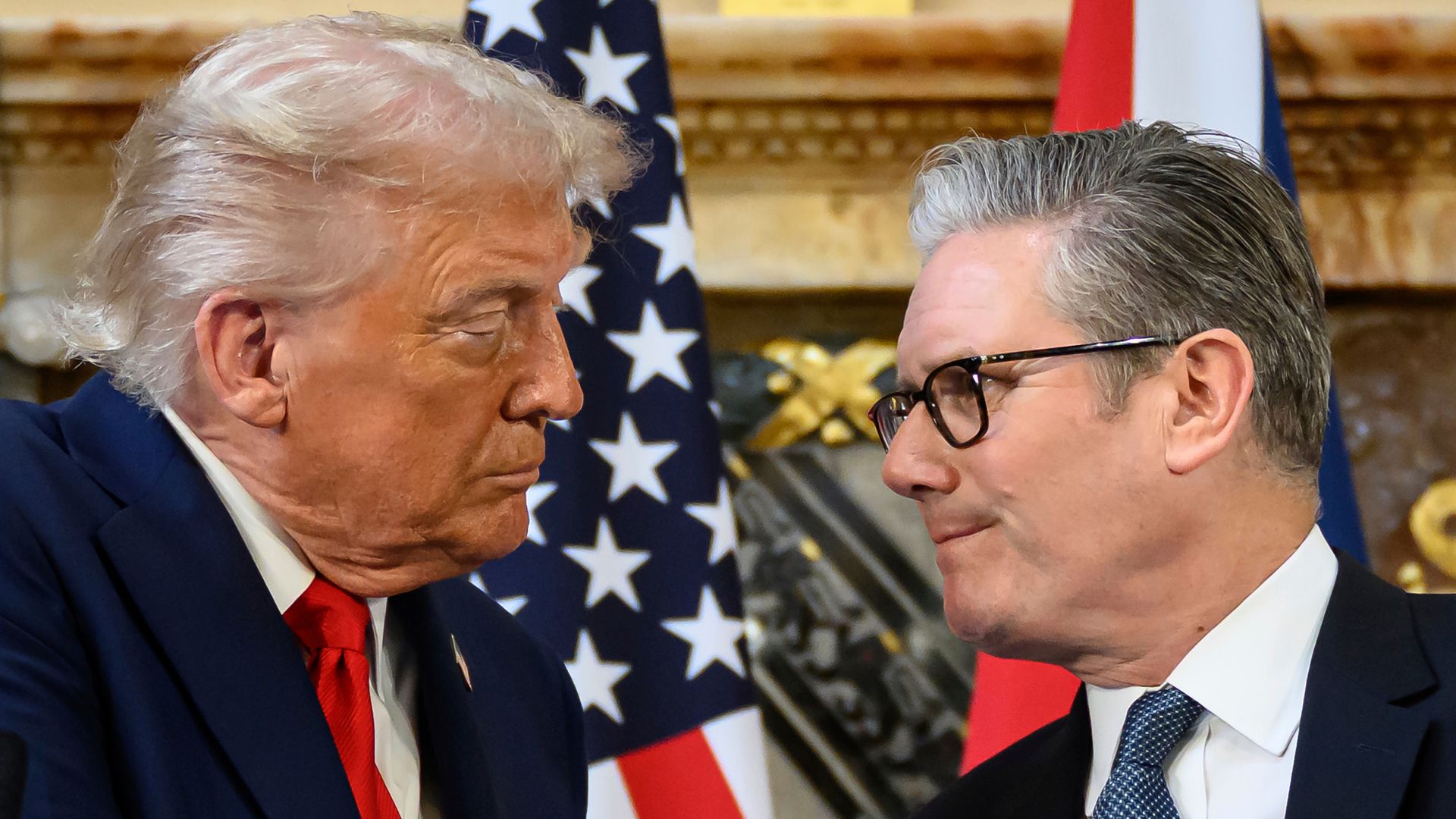
The diplomatic tension between the Keir Starmer administration and the incoming Trump executive regarding the Iranian conflict is not a mere personality clash; it is a structural misalignment of "Strategic Autonomy" versus "Maximum Pressure 2.0." While British Prime Minister Keir Starmer has signaled a refusal to "back down" from a stance that emphasizes international law and regional containment through diplomacy, the Trump transition team operates on a doctrine of total economic and military deterrence. This friction creates a specific systemic risk for the "Special Relationship," potentially devaluing the UK’s role as a bridge between the European Union and the United States.
To understand the mechanics of this dispute, one must look at the three distinct variables currently driving the friction: the legalistic constraints of UK foreign policy, the transactional nature of the Trumpian "America First" strategy, and the diverging definitions of "escalation dominance" in the Middle East.
The Triad of Conflict: Why the UK and US Models Are Decoupling
The current disagreement is rooted in three foundational pillars that govern how both nations perceive the Iranian threat.
1. The Institutional Constraint vs. Executive Volatility
The UK government operates under a framework of "Liberal Internationalism." Starmer, a former Director of Public Prosecutions, views foreign policy through the lens of international treaties and legal justifications. For the UK, backing down to Trump’s rhetoric would mean undermining the Foreign, Commonwealth & Development Office (FCDO) commitment to the Joint Comprehensive Plan of Action (JCPOA) frameworks—or what remains of them.
Conversely, the Trump approach treats international agreements as "sunk costs." The logic is purely transactional. If a treaty does not yield immediate, measurable gains in US security or economic dominance, it is discarded. This creates a bottleneck in joint military planning; the UK requires a clear legal mandate for kinetic action, whereas the Trump administration prioritizes "Tactical Unpredictability" to keep Tehran off-balance.
2. The Economic Sanctions Asymmetry
The US and UK have vastly different "Sanction Elasticities."
- The US Position: As the controller of the global reserve currency, the US can enforce secondary sanctions that effectively decapitate Iranian trade with third parties. For Trump, sanctions are a blunt force instrument used to trigger internal regime collapse.
- The UK Position: The UK is more exposed to European energy markets and regional trade stability. Starmer’s government fears that a total economic blockade—without a diplomatic off-ramp—forces Iran into a "Nuclear Breakout" scenario. The UK’s strategy is "Calibrated Containment," whereas Trump’s is "Systemic Asphyxiation."
3. Escalation Dominance Models
The core of the "Starmer won't back down" narrative lies in the definition of safety. The UK military establishment operates on the principle that any direct strike on Iranian soil or proxy leadership must have a "De-escalation Pathway." Without this, the UK risks being dragged into a protracted regional war for which its current carrier strike groups and land forces are under-resourced.
The Trump doctrine assumes that "Escalation Dominance" is achieved by being the most willing to escalate. By attacking Starmer’s perceived "weakness," Trump is signaling to Tehran that the Western alliance is fractured, which, paradoxically, he believes increases US leverage by making the US appear as a "lone wolf" actor that is harder to predict or restrain.
The Cost Function of Diplomatic Defiance
Starmer’s refusal to align with Trump carries measurable costs across the UK’s strategic portfolio. The "Cost of Defiance" can be calculated through three primary channels:
Intelligence Sharing and Five Eyes Integrity
The UK’s greatest asset in the Anglo-American relationship is its high-tier intelligence contribution (GCHQ). If the Trump administration perceives Starmer as an obstructionist regarding Iran, the flow of "Tier 1" actionable intelligence may be throttled. This is not a hypothetical risk; it is a standard leverage tactic used to force alignment on security issues.
The Trade Agreement Paradox
The UK has long sought a comprehensive Free Trade Agreement (FTA) with the US. Trump has explicitly linked trade concessions to security cooperation. By holding a firm line on Iran, Starmer is effectively placing a "Geopolitical Risk Premium" on any future trade negotiations. The logic is simple: if the UK will not support the US in its primary theater of concern (Iran/China), the US sees no reason to grant the UK preferential market access.
European Leadership vs. Atlanticist Loyalty
Starmer is attempting to "rebuild bridges" with Brussels. Aligning with Trump on a hardline Iran policy would alienate France and Germany, who remain committed to the security architecture of the JCPOA. However, by siding with Europe, Starmer risks becoming a "junior partner" in a European bloc that lacks the military hardware to actually enforce its diplomatic will.
Mapping the Iranian Response to Western Disunity
Tehran views the Starmer-Trump friction as a "Strategic Window." When the two most powerful members of the Western security apparatus disagree on the "Rules of Engagement," Iran gains room to maneuver in three areas:
- Proxy Acceleration: Groups like Hezbollah and the Houthis can exploit the lack of a unified Western response. If the UK refuses to back US-led maritime strikes in the Red Sea, the operational cost for proxies drops.
- Nuclear Latency: Iran can use the "good cop/bad cop" dynamic to delay inspections. They may offer minor concessions to Starmer to prevent the UK from triggering "snapback" sanctions, while simultaneously hardening their nuclear facilities against a potential Trump-led strike.
- Sanctions Evasion: Disunity in the West makes it easier for Iran to find "Grey Market" partners. If the UK does not mirror US "Maximum Pressure," London’s financial markets remain a theoretical (though heavily guarded) point of interest for Iranian-linked entities seeking to bypass dollar-denominated restrictions.
The Mechanics of "Not Backing Down": Starmer’s Internal Logic
To an analyst, Starmer’s "vow to not back down" is more than rhetoric; it is a necessity for domestic political stability. The Labour Party’s base is historically skeptical of US-led interventions (the "Iraq Shadow"). A total capitulation to Trump’s Iran policy would trigger a backbench revolt and undermine Starmer’s "Country First" branding.
However, "not backing down" does not mean "active opposition." The UK’s likely path is "Passive Non-Alignment." This involves:
- Maintaining the rhetoric of the "Special Relationship."
- Participating in "Freedom of Navigation" exercises but refusing to participate in "Regime Change" or "Deep Strike" operations.
- Focusing on "Humanitarian Corridors" and "Regional Stability" to frame their dissent as a moral and legal high ground rather than a strategic betrayal.
The Breakdown of the Deterrence Equation
The fundamental problem with the current UK-US split is the erosion of the "Credible Threat." Deterrence is a function of (Capability × Will).
$$D = C \times W$$
If Trump provides the Capability but Starmer’s dissent signals a lack of collective Will, the value of $D$ decreases. Iran calculates that it can survive a US strike if the rest of the G7 (led by the UK and EU) does not follow up with a total diplomatic and economic blockade. This "Decoupling of Will" is the primary reason why Trump has attacked Starmer’s position so aggressively. He views the UK’s nuance as a "Force Multiplier" for the enemy.
Strategic Recommendation for the UK Executive
The Starmer administration must transition from a posture of "Defiance" to one of "Functional Specialization." To mitigate the risks of a Trump backlash while maintaining strategic autonomy, the UK should:
- Redefine the "Red Lines": Instead of broad disagreement on "Iran policy," the UK should identify specific, non-negotiable triggers (e.g., Iran transferring ballistic missiles to Russia) where it will align 100% with the US. This creates "Predictable Alignment" rather than "Blanket Opposition."
- Leverage the "European Bridge": The UK should position itself as the only actor capable of bringing the EU into a "Modified Maximum Pressure" framework. Trump values results over process; if Starmer can deliver European participation in limited sanctions, the "back down" narrative disappears.
- Audit the "Defense-Diplomacy Gap": The UK cannot afford a hawkish diplomatic stance without the military budget to back it up. If Starmer intends to maintain an independent Iran policy, he must accelerate the "2.5% of GDP" defense spending target to ensure the UK is not entirely dependent on US logistics and "Search and Rescue" capabilities in the Persian Gulf.
The friction is not a bug in the relationship; it is a feature of a multi-polar world where the UK is no longer the "Sub-Headquarters" of US foreign policy. The path forward requires a cold, data-driven assessment of where UK interests overlap with US power, and where they are structurally destined to diverge.
Would you like me to generate a quantitative risk assessment of how specific US secondary sanctions might impact the UK’s current trade volume with the Middle East?