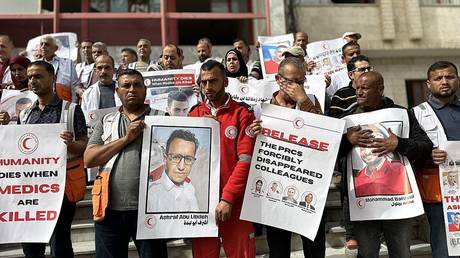
The red crescent on the side of an ambulance is not supposed to be a bullseye. In the frantic, dust-choked theater of a conflict zone, that symbol is meant to function as a visual ceasefire—a silent, universal plea that says, "We are only here to keep people from dying." But on a stretch of road in Gaza, that symbol became a witness to something else entirely.
It wasn't a stray bullet. It wasn't a tragic misunderstanding of coordinates in the fog of war. It was a sustained, methodical application of force that lasted for nearly forty minutes. When the forensic investigators finally laid out the map of what happened, they didn't just find a tragedy. They found nine hundred and fifty-four pieces of lead.
Nine hundred and fifty-four.
If you say the number quickly, it sounds like a statistic. If you count it out, heartbeat by heartbeat, it becomes a marathon of intent. To fire that many rounds, you have to mean it. You have to reload. You have to adjust your aim. You have to watch the sparks fly off the metal of the vehicle again and again, and you have to decide, over and over, to pull the trigger once more.
The Anatomy of the Standoff
The investigators from Forensic Architecture and various human rights organizations didn't just look at the wreckage; they reconstructed the physics of the moment. Imagine a residential street turned into a wind tunnel of debris. On one side, a medical crew is trying to reach a six-year-old girl named Hind Rajab, who is trapped in a car filled with her dead relatives. On the other, the heavy iron of an armored presence.
The medics, Yusuf and Ahmed, weren't charging. They were moving through a pre-coordinated corridor. In the world of international law, "coordination" is a holy word. It is the process where aid workers tell the military exactly where they are going, and the military says, "We see you. Proceed."
The ambulance moved. The agreement was supposedly in place. Then, the air shattered.
The ballistic analysis tells a story that the official reports tend to skip. The rounds weren't coming from a distance of miles. This wasn't a blind artillery strike from over the horizon. The shooters were close—close enough to see the white of the van, close enough to see the flashing lights, close enough to know exactly what they were dismantling.
The Physics of Nine Hundred Rounds
To understand the scale of nine hundred and fifty-four bullets, you have to look at the metal. An ambulance is a shell of thin steel, glass, and oxygen tanks. It is built for speed and life-saving, not for combat.
When a heavy machine gun opens up on a vehicle like that, the sound is not a bang. It is a rhythmic, industrial tearing. It sounds like a giant zipper being ripped through the sky. The first few dozen rounds shatter the glass. The next hundred shred the tires and the engine block. After that, the bullets aren't seeking to disable a vehicle; they are searching for the soft tissue inside.
The forensic report utilized "earwitness" testimony—the recorded audio from a phone call Hind Rajab was making to the Red Crescent while she was still alive. In the background of that call, you can hear the mechanical cadence of the firing. It isn't the panicked, sporadic popping of a soldier who is scared. It is the steady, controlled burst of a professional system.
The sheer volume of fire suggests a terrifying lack of restraint. In many modern militaries, there is a concept called "fire discipline." You use what is necessary to neutralize a threat. But what is the threat posed by a stationary ambulance? What is the threat posed by two men in fluorescent vests?
The numbers suggest that the goal wasn't just to stop the ambulance. The goal was to erase it.
The Invisible Stakes of a Broken Promise
This isn't just about one afternoon in Gaza. If it were, we could perhaps write it off as the horrific, singular error of a broken unit. But the data shows a different pattern. When medical personnel are targeted with this level of intensity, the "Red Cross" or "Red Crescent" ceases to be a shield and becomes a liability.
Think about the psychological toll on the next crew. Think about the driver who has to start the engine tomorrow morning. He knows that his coordination papers might be nothing more than a list of his own coordinates for a targeting computer.
When the sanctity of the medic is destroyed, the entire structure of human rights in warfare collapses. We are left with a vacuum where the only rule is the capacity to kill. The "protected status" of a hospital or an ambulance is a collective hallucination that we all agree to believe in so that humanity can survive its own worst impulses. When nine hundred bullets rip through that hallucination, the world becomes a much darker place for everyone, not just those in the line of fire.
The Silence of the Aftermath
The investigation into the shooting of Hind Rajab and the Red Crescent medics reveals a discrepancy that is hard to stomach. The military's initial claims often revolve around "crossfire" or "unidentified threats." But the forensic reconstruction—the literal geometry of the bullet holes—shows that the fire came from a single direction, from elevated positions, and with a clear line of sight.
There was no "other" side firing back. There was no battle. There was a car with a child, an ambulance with two men, and a relentless stream of lead.
The debris was eventually cleared. The bodies were recovered twelve days later, once the tanks had pulled back and the area was "safe" for the recovery teams. What they found was a car that looked like lace and an ambulance that had been incinerated.
The weight of nine hundred rounds is heavy. It weighs down the soul of a civilization. It asks us what we are willing to tolerate in the name of security. It asks if a child’s plea for help is worth the price of a thousand shells.
We often talk about the "fog of war" as if it’s an atmospheric condition that justifies every mistake. But fog eventually clears. When it did in this instance, it revealed a surgical, prolonged destruction of the very people sent to help. It wasn't an accident of geography; it was a failure of humanity.
The final image isn't the flashes of the muzzles or the sound of the glass. It is the silence of the phone line after the 954th bullet found its mark, leaving nothing behind but the cold, indifferent wind of a street that used to be a neighborhood.


