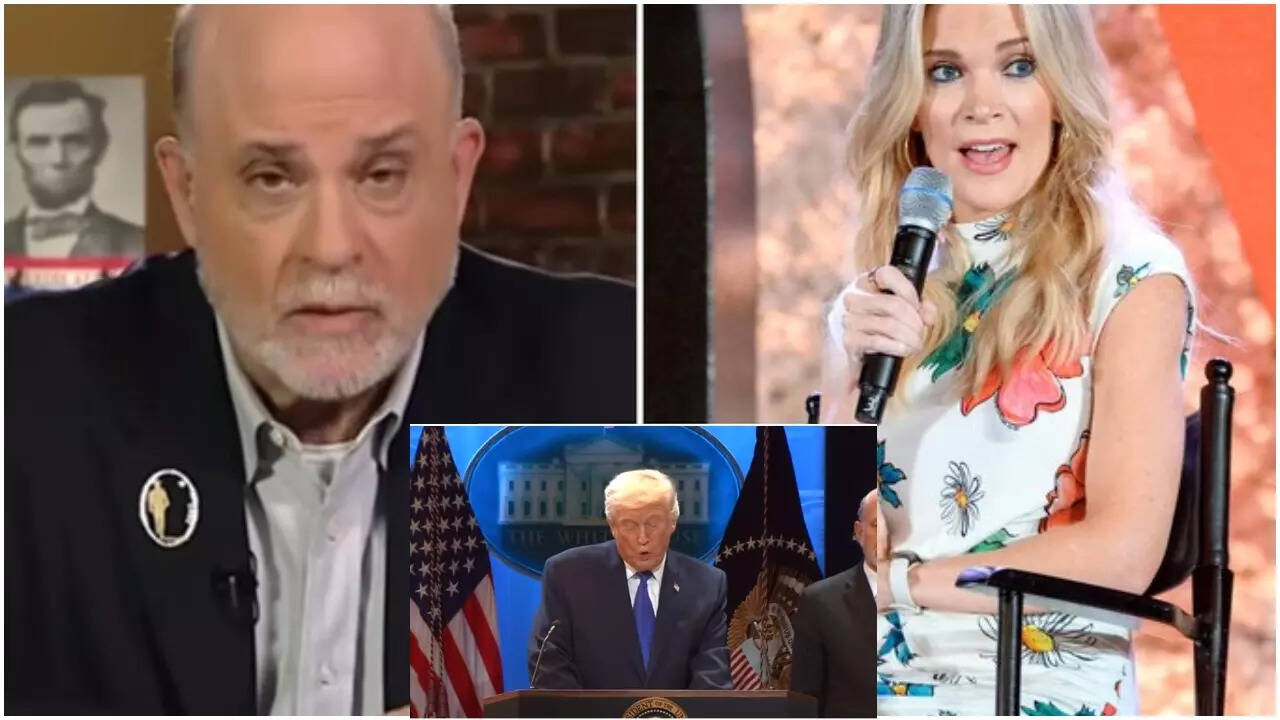
The air in the American living room is getting thinner. It is a strange, pressurized environment where the hum of the television doesn’t just provide background noise—it sets the temperature of the household. For years, the Republican movement felt like a massive, rowdy, but ultimately united family reunion. Now, the china is smashing against the walls.
At the center of this domestic explosion is a question of life and death, of missiles and borders, and of a man who once sat at the head of the table. Donald Trump is no longer just a candidate; he is the gravity around which two of the most powerful voices in conservative media are currently spinning out of control. Mark Levin and Megyn Kelly are not just talking heads. They are the architects of opinion for millions. And they are currently at each other's throats over the prospect of a war with Iran.
The Architect and the Outsider
Mark Levin speaks with the urgency of a man who believes the barbarians are not just at the gate, but already swinging the battering ram. To him, the threat from Tehran is existential. It is a theological and military shadow that must be confronted with the full, righteous might of the American war machine. He views the world through the lens of historical precedents, seeing 1938 in every diplomatic overture and a potential Churchill in every hardliner.
Then there is Megyn Kelly. She represents a different, growing skepticism within the movement—a "Main Street" weariness born from two decades of desert sands and flag-draped coffins. Her audience isn't necessarily isolationist, but they are tired. They are the people who sent their sons to Fallujah and their daughters to Bagram, only to watch the geopolitical needle barely move. When she questions the wisdom of a direct kinetic conflict with Iran, she isn't just asking a policy question. She is voicing the collective exhaustion of a base that feels it has given enough.
The friction between them would be a standard media spat if not for the intervention of the former President. Trump’s decision to side with Levin isn't just a tweet or a Truth Social post. It is a seismic shift in the internal tectonic plates of the MAGA universe.
The Ghost of 2003
To understand why this hurts so much, you have to look at the scars. Imagine a father in Ohio. Let’s call him Jim. In 2003, Jim sat in his recliner and listened to experts explain why Iraq was a necessity. He believed in the mission. He believed in the moral clarity. Twenty years later, Jim’s son has a prosthetic leg and a prescription for PTSD medication, and the map of the Middle East looks more volatile than ever.
When Megyn Kelly speaks, she is speaking to Jim. She is tapping into the "America First" instinct that Trump himself cultivated—the idea that our blood and treasure are too precious to be spent on the whims of the military-industrial complex.
But when Trump backs Levin, he is reintroducing a paradox. Levin represents the "Peace Through Strength" wing that occasionally looks a lot like "Strength Through Intervention." By throwing his weight behind Levin’s fiery rhetoric regarding Iran, Trump is signaling a return to a more traditional, hawkish posture. This creates a dizzying cognitive dissonance for the voter. If the movement is about ending "forever wars," how does a confrontation with a sophisticated regional power like Iran fit into the narrative?
The Digital Trenches
The battle isn't happening in hallowed halls. It’s happening in the comments sections and on X. It’s a civil war of the airwaves. Levin has called out those he deems "pseudo-conservatives" or "isolationists," using his platform to hammer home the necessity of supporting Israel and neutralizing the Iranian threat. He sees the hesitation of people like Kelly not as caution, but as a dereliction of moral duty.
Kelly, meanwhile, isn't backing down. She has navigated the storms of public life long enough to know when she’s hit a nerve. Her stance is a reflection of a populist shift that Trump helped start but may no longer fully control. The "America First" genie is out of the bottle. It is skeptical. It is guarded. It is deeply suspicious of any rhetoric that sounds like the prelude to a new theater of operations.
The internal strife isn't just about ego. It’s about the soul of a political identity. Are they the party of Reagan’s "Evil Empire" speech, or are they the party of the 2016 campaign trail that decried the stupidity of the Iraq invasion?
The Invisible Stakes
When these titans clash, the ripple effect reaches far beyond a television studio in New York or a radio booth in Virginia. It affects how the rest of the world views American resolve. Tehran is watching. Moscow is watching. They see a movement divided between its visceral impulse to strike back and its profound weariness of the cost of leadership.
The tragedy of the Levin-Kelly feud is that both are right in their own fears. Levin is right that a nuclear-armed Iran is a nightmare scenario that could destabilize the globe for a century. Kelly is right that the American public is hollowed out, skeptical of "intelligence" reports, and wary of being led into another quagmire by leaders who won't have to fight the battles themselves.
Trump’s endorsement of Levin’s worldview suggests that, in the heat of a crisis, the former President may favor the old-school displays of dominance over the restrained populism his followers often champion. It is a reminder that "America First" is not a static doctrine; it is a tug-of-war.
Consider the reality of a direct conflict. We aren't talking about a quick strike. We are talking about the Strait of Hormuz, global oil prices spiking to $200 a barrel overnight, and the potential for asymmetric warfare reaching into the West. This isn't a game of checkers on a cable news set. It is a high-stakes gamble with the global economy and thousands of lives on the line.
The Cracked Mirror
The movement now looks in the mirror and sees two different versions of itself. One version is wearing a flight suit, ready to defend its allies and project power across the globe. The other is wearing a work jacket, looking at the crumbling infrastructure of its own hometown and wondering why the money is always there for a bomb but never for a bridge.
Levin and Kelly are the voices of these two identities. Trump, by choosing a side, hasn't ended the debate; he has simply increased the volume. The "internal strife" isn't a distraction. It is the main event. It is the process of a political movement trying to decide if it still believes in the global order it helped build, or if it is ready to walk away from the table entirely.
The dinner table is quiet now, but the air is still heavy. The plates are broken, and the guests are staring at each other across the wreckage. The question of Iran is merely the catalyst. The real fight is about what it means to be an American in an era where the old rules have been burned, and the new ones are being written in the heat of a fratricidal rage.
Tonight, the screens will flicker again. Levin will shout his warnings. Kelly will offer her cold, hard questions. And somewhere in Ohio, Jim will sit in his recliner, looking at his son, wondering which of those voices will ultimately decide the future of the family he has left.
The television stays on, but the light it casts is no longer steady. It is the flickering, uncertain glow of a house divided against itself, waiting for a signal that may never be clear.