The cold does more than bite. It hollows you out. In the decimated outskirts of eastern Ukraine, the temperature drops until the air feels like shattered glass in your lungs. You don’t just feel the frost on your skin; you feel it in the way your bolt-action rifle becomes a heat-sink, leeching the warmth from your gloved palms until your fingers lose the nuance required for a three-pound trigger pull.
This is not a movie. There is no swelling orchestral score. There is only the rhythmic, agonizingly slow sound of a human heart beating against the frozen mud of a crawl space.
For a Ukrainian sniper—let’s call him Vyacheslav, a name that carries the weight of many who currently haunt the tree lines—the job is ninety-nine percent waiting and one percent soul-crushing precision. The world thinks of sniping as an act of movement. In reality, it is the art of becoming a stone.
The Engineering of a Ghost
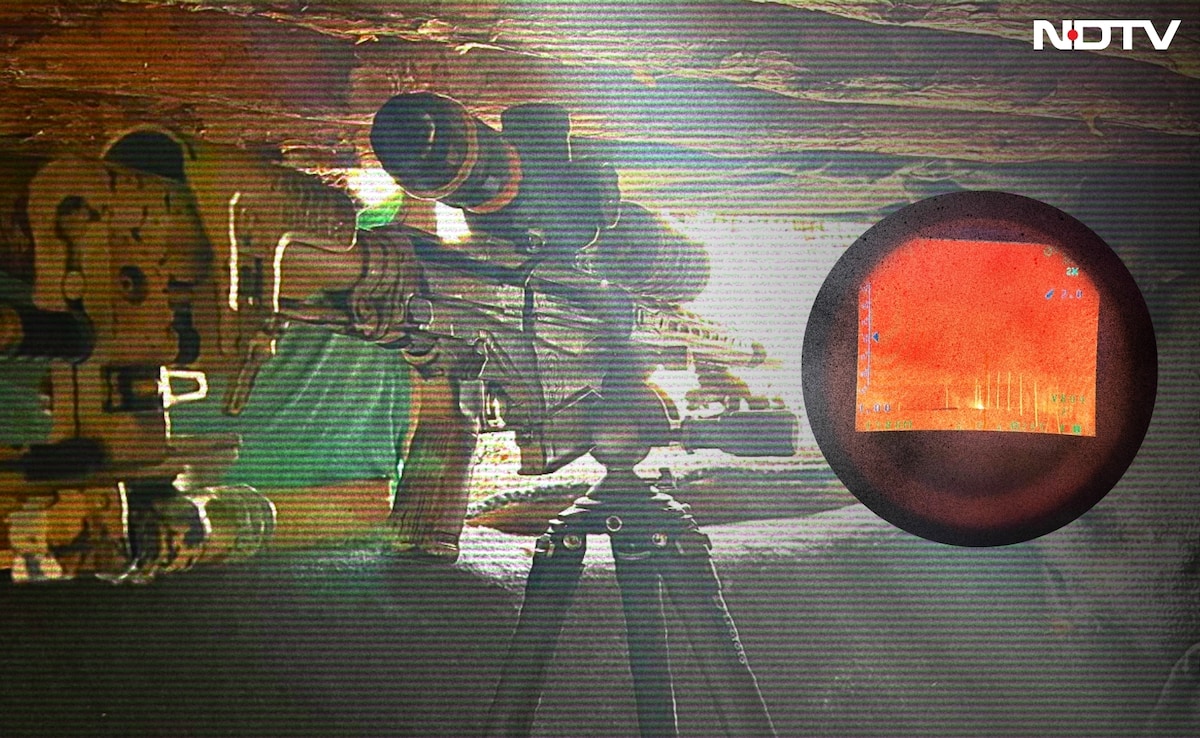
Modern warfare is often portrayed as a digital storm of drones and satellite uplinks. While those elements exist, they eventually funnel down to a single person looking through a piece of glass. Vyacheslav’s primary companion is the "Lord of the Horizon," a locally manufactured behemoth of a rifle designed to reach out and touch targets at distances previously thought impossible.
Weighing nearly 16 kilograms, it is not a weapon you carry so much as one you endure. It fires a massive .50 caliber round, a slug of metal designed to punch through engine blocks and body armor alike. But the rifle is useless without the ballistics computer.
To hit a target at two miles, you aren't aiming at a person. You are aiming at a mathematical probability. You have to account for the Earth's rotation, a phenomenon known as the Coriolis effect. You have to calculate the humidity, which thickens the air and slows the bullet. You have to read the wind, not just where you are sitting, but in the valley three hundred meters ahead, and again at the ridgeline a kilometer beyond that.
The bullet travels for several seconds. In that window of time, the world changes. A man can sneeze. He can bend down to tie a lace. He can cease to exist before the sound of the shot even reaches his ears.
The Tactical Monotony
The "long wait" mentioned in tactical reports is a sterilized term for a grueling physical ordeal. Imagine lying perfectly still for sixteen hours. You cannot stand to stretch. You cannot light a heater. You cannot even shift your weight too suddenly, lest the slight shimmer of a thermal signature betray your position to a Russian Orlan drone hovering overhead.
Vyacheslav describes the sensory deprivation. After ten hours, your eyes begin to play tricks on you. Stumps become soldiers. Shadows begin to crawl. You have to blink slowly, one eye at a time, to keep your vision from blurring. You eat cold protein bars that taste like chalk and sip water that has the consistency of slush.
The gear is a second skin. It consists of multi-layered thermal clothing, a ghillie suit woven with local flora to break up the human silhouette, and a suppressed muzzle to hide the flash of gunpowder. But the most important piece of gear is the spotter.
The spotter is the sniper’s brain. While the sniper focuses on the "fine motor" reality of the shot, the spotter watches the "macro" world. They are a two-man island in a sea of hostility. They whisper in fragments. They share the same cramped space, the same smell of damp earth, and the same looming realization that if they are spotted, the response will not be a return rifle shot, but a rain of 122mm artillery shells.
The Physics of the Record
When news broke of a Ukrainian sniper breaking the world record for a confirmed kill—hitting a target at 3.8 kilometers (roughly 2.36 miles)—the technical community gasped. To put that in perspective, that is the length of nearly 35 football fields.
At that distance, the drop of the bullet is astronomical. The shooter has to aim dozens of feet above the target. The projectile arches through the sky like a small, angry mortar shell.
But the record isn't the point for the men in the mud. They don’t care about the Guinness Book. They care about the psychological shadow they cast. A sniper is a force multiplier. If a platoon knows there is a marksman in the ruins who can pick them off from a different zip code, they stop moving. They stop communicating. They become paralyzed by the invisible.
The Invisible Stakes
Why do it? Why endure the frostbite and the psychic weight of taking a life from such a distance that the victim never even hears the report?
It is about the math of survival. Every high-ranking officer removed from the field, every machine-gun nest silenced, is a hundred Ukrainian infantrymen who get to go home. The sniper carries the guilt so the teenager in the trench doesn’t have to carry a casket.
But the cost is paid in the soul. Vyacheslav speaks of the "hollow space" that grows inside you. When you watch a target through a high-powered optic for hours, you see them as a human. You see them smoke a cigarette. You see them laugh at a joke from a comrade. You see the steam of their breath. And then, you pull the trigger.
The recoil of the .50 caliber is a physical assault. It slams into your shoulder like a sledgehammer, rattling your teeth and blurring your vision for a fraction of a second. By the time you recover, the target is down, and the silence returns—heavier than it was before.
Beyond the Ballistics
We often focus on the hardware—the Lord of the Horizon rifle, the Nightforce optics, the Hornady ammunition. We treat it like a sporting event. But the reality is a story of extreme human endurance. It is a story of men who have learned to lower their heart rates to forty beats per minute to find the stillness between pulses.
As the war enters another grueling phase, the technology will only get sharper. Drones will get smaller. Rifles will shoot further. But the core of the conflict remains a human being lying in the dirt, holding his breath, waiting for a single moment of clarity in a world of chaos.
The sniper’s greatest weapon isn't the rifle. It is the patience to wait for a world that refuses to stop turning.
The sun begins to set over the jagged skyline of a broken city. Vyacheslav packs his gear with the methodical slowness of a man who has nowhere else to be. He leaves no trace. No brass casings, no footprints, no warmth. He disappears back into the grey haze of the front line, a ghost returning to the mist, leaving behind only a record-breaking silence and the cold, indifferent wind.