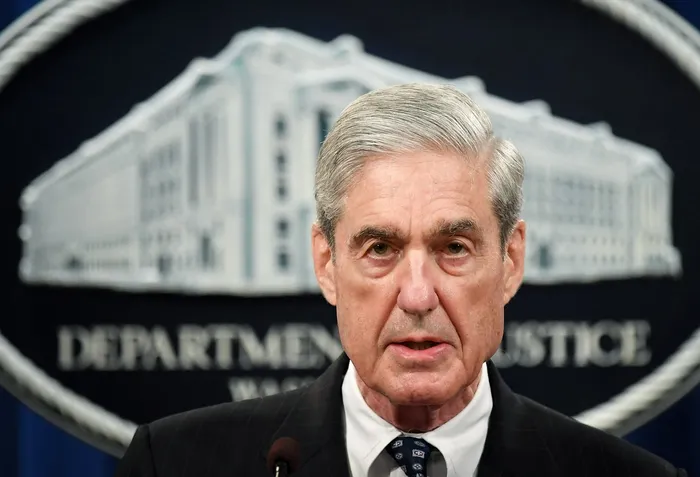
Robert Mueller, the career prosecutor who became the personification of the American establishment's struggle with the Trump era, died Friday night at the age of 81. His family confirmed his passing in Charlottesville, Virginia, noting that the former FBI Director had been living with Parkinson’s disease since 2021. For a man who spent his entire professional life adhering to a rigid, almost monastic code of silence and institutional duty, his death serves as a final, somber bookend to a period of American history defined by noise, tribalism, and the erosion of shared facts.
Mueller’s passing was met immediately by the same polarized energy that defined his final years in the public eye. While former President Barack Obama hailed him as a protector of the rule of law who transformed the FBI after the September 11 attacks, Donald Trump took to social media to celebrate the news, expressing gladness at the death of a man he long branded a "hoax" peddler. This split screen is the definitive legacy of Robert Swan Mueller III. He was a man of the 20th century—a Marine, a "straight arrow," a believer in the sanctity of the Department of Justice—forced to navigate a 21st-century political storm that didn't value the quiet deliberation he offered.
The Transformation of the Bureau
When Mueller took the helm of the FBI on September 4, 2001, he expected to spend his tenure fighting traditional organized crime and white-collar fraud. Seven days later, the world changed. The 9/11 attacks forced an immediate and agonizing pivot. Mueller didn't just manage the bureau; he dismantled and rebuilt it into an intelligence-driven counterterrorism organization. This shift was not without its critics, who argued the FBI was sacrificing its domestic law enforcement roots for a murky role in global surveillance.
Yet, within the halls of the J. Edgar Hoover Building, Mueller was the steady hand. He was famous for his "7:30 a.m. briefings," where he demanded granular detail and tolerated zero fluff. He was the second-longest serving director in the agency's history, requested by Obama to stay beyond his ten-year term because the establishment simply didn't trust anyone else with the keys to the kingdom.
The Special Counsel Gamble
In 2017, when Mueller was pulled out of private practice to lead the investigation into Russian interference in the 2016 election, he was viewed as a secular saint by the American left and a principled veteran by the old-guard right. The belief was that if anyone could find the "truth," it was Bob Mueller.
The 22-month investigation that followed was a masterclass in institutional procedure and a disaster in public relations. Mueller operated in total silence, a strategy that allowed both his supporters and his detractors to project whatever they wanted onto his "black box" investigation. By the time the 448-page report was released in 2019, the country had already moved beyond a desire for a legalistic conclusion.
The report's famous line—"If we had confidence... that the President clearly did not commit obstruction of justice, we would so state"—became a Rorschach test. To some, it was a damning indictment phrased in careful "prosecutorese." To others, it was a weak abdication of duty. Mueller’s refusal to make a definitive "prosecute or don't prosecute" decision on the sitting president remains one of the most debated moments in legal history. It showed a man who was perhaps too committed to the rules of a system that was crumbling around him.
The Parkinson's Years and the Final Subpoena
In the years following the report, Mueller retreated further into the shadows. We now know that as early as 2021, he was grappling with the onset of Parkinson’s disease. This diagnosis likely explains his occasional frailty during his 2019 Congressional testimony, a performance that disappointed those hoping for a fiery "gotcha" moment.
Even in retirement, the political machinery wouldn't let him go. As recently as late 2025, House investigators attempted to subpoena him regarding the Jeffrey Epstein case, a request that was only withdrawn when his deteriorating health became a matter of public record. It was a final attempt to drag a man who valued the "quiet professional" ideal back into the partisan fray.
A Legacy of Institutionalism in a Post-Institutional World
Robert Mueller’s death marks the departure of one of the last true "Institutionalists." He believed that the system, if followed correctly, would provide the answer. He believed that the Department of Justice was a cathedral, and he was its most faithful sexton.
History will likely judge him as a man of immense integrity who was perhaps the wrong tool for the job he was eventually asked to do. You cannot bring a rulebook to a street fight and expect the spectators to cheer for the referee. Mueller never wanted to be a hero or a villain; he just wanted to be a prosecutor.
The fracture in the American psyche regarding his work will not heal with his passing. Instead, the void he leaves behind serves as a reminder that the era of the "unimpeachable civil servant" is likely over.
Would you like me to research the specific legal precedents established by the Mueller report and how they are being cited in current federal cases?