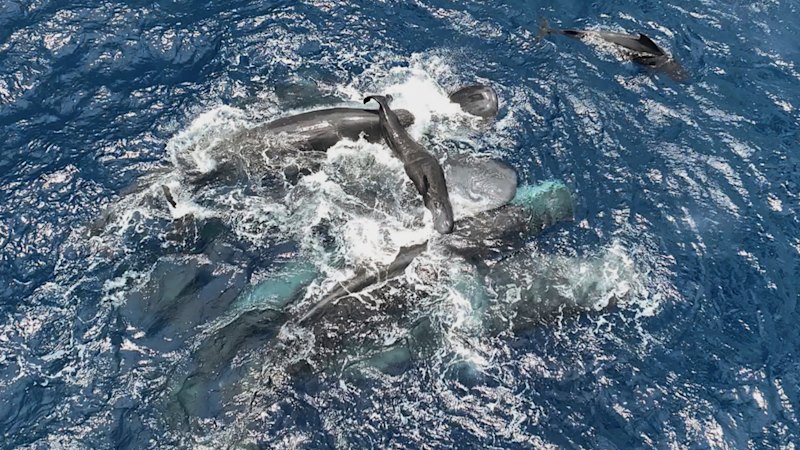
Nature isn't always kind, but it’s often incredibly organized. When a 15-ton sperm whale goes into labor, she isn't just dealing with the physical strain of bringing a calf into the world. She’s ringing a dinner bell for every shark and orca within ten miles. New footage of sperm whales working together during a birth shows us that these marine giants don't leave survival to chance. They use a tactical formation that looks more like a military maneuver than a family gathering.
Most people think of whales as solitary wanderers or simple pods. That's wrong. Sperm whales live in a complex matriarchal society where "it takes a village" isn't a cliché—it’s the law of the deep. Recent observations captured by researchers and drone pilots have provided a rare look at how female sperm whales protect their own during the most vulnerable moment of their lives.
The Marguerite Formation is a Wall of Meat and Bone
When the birthing process begins, the pod doesn't just hang around. They move into what biologists call the Marguerite Formation. Imagine a giant daisy. The whales' heads point inward toward the center, while their massive, powerful tail flukes fan out like petals. In the middle of this circle sits the laboring mother and, eventually, the newborn calf.
This isn't for show. A sperm whale’s tail is its most dangerous weapon. By pointing their flukes outward, the surrounding females create a literal 360-degree shield of muscle. If a shark tries to get close to the blood in the water, it risks a strike that could crush its skeleton instantly. It’s a high-stakes bodyguard service.
You’ve got to realize how rare this footage is. Sperm whales usually dive deep—down to $2,000$ meters or more—to hunt giant squid in the dark. They spend most of their lives where humans can't see them. But birth happens near the surface because the calf needs to take its first breath immediately. This puts them right in the strike zone for predators. The pod knows this. They stay shallow, stay tight, and stay loud.
Why Females Take the Lead
In sperm whale society, males are basically nomads. Once they hit a certain age, they head off to colder waters and live largely solitary lives until it's time to mate. The females, however, stay together for life. These "social units" are built on deep bonds. When you see six or seven whales surrounding a mother, you’re looking at sisters, aunts, and grandmothers.
These females engage in what’s called allomaternal care. That’s a fancy way of saying they babysit. They don't just protect the calf during birth; they take turns watching it while the mother dives deep to feed. A newborn can't dive very far or hold its breath for long. If the mother had to go it alone, the calf would be a sitting duck at the surface.
This cooperative behavior is why sperm whales have survived for millions of years. They aren't just big; they’re smart. They communicate with "codas"—series of clicks that act like a social signature. During a birth, the acoustic activity spikes. They’re talking to each other, coordinating their positions, and likely reassuring the mother. It’s a level of emotional and tactical intelligence that we’re only just beginning to grasp.
The Brutal Reality of Mid-Ocean Labor
Let's be real about the environment. The open ocean is a desert of blue where anything unusual attracts attention. The scent of birth reaches predators fast. Drones have captured moments where sharks circle the perimeter of the Marguerite Formation, testing for a gap. They rarely find one.
The physical act for the whale is grueling. Unlike land mammals, the calf is usually born tail-first. This prevents the blowhole from being exposed to water before the calf is fully out, which would cause it to drown. Once the calf is out, the "aunties" often nudge it toward the surface. They’re making sure it gets that first breath of air.
There’s also the issue of buoyancy. Newborns aren't great swimmers. They’re floppy and uncoordinated. The surrounding females will often use their bodies to buoy the calf up, keeping it sandwiched between them so it doesn't sink or drift away from the group. It’s a physical support system that lasts for days until the calf finds its fins.
What This Means for Conservation
We used to hunt these animals for the oil in their heads. We nearly wiped them out. Now, seeing this level of social cohesion reminds us that we aren't just looking at "oil tanks" or "biomass." We’re looking at a culture. When a ship strike or a plastic net kills one female, it doesn't just kill an individual. It breaks a link in a protective chain that keeps the next generation alive.
If a pod loses its experienced matriarchs, the younger females might not know how to hold the formation as effectively. Experience matters in the ocean. The older whales have seen the sharks before. They know the drill.
The footage being discussed isn't just "cool whale videos." It’s evidence of a sophisticated defense strategy that requires communication, empathy, and collective action. It’s a reminder that the ocean is a place of intense struggle, but also of intense cooperation.
How to Help Protect Sperm Whale Habitats
If you want to ensure these pods keep thriving, you can take direct action. Support organizations like the Whale and Dolphin Conservation (WDC) or Sea Shepherd. These groups work on the front lines to stop commercial whaling and reduce ship strikes in critical birthing grounds. You can also reduce your use of single-use plastics, which often end up in the deep-sea trenches where sperm whales hunt.
Pay attention to marine protected areas (MPAs). These are zones where industrial activity is restricted, giving pods the quiet and safety they need to raise their young. Advocate for the expansion of these zones in the Atlantic and Pacific. The more space these whales have away from human interference, the better their chances of maintaining these incredible social structures.
Keep an eye on the latest research from the Dominica Sperm Whale Project. They’re doing the heavy lifting in understanding these family units. Knowledge is the best tool we have for keeping these "defense squads" patrolling the deep.