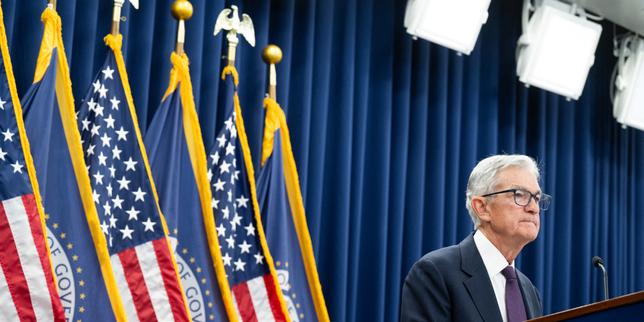
The Federal Reserve is currently trapped in a room where the walls are closing in. On one side, you've got a labor market that refuses to cool down. On the other, there's a sticky inflation problem that won't just "go away" because Jerome Powell says a few stern words at a press conference. If the Fed cuts rates to save jobs, they risk a 1970s-style price spiral. If they keep them high to crush inflation, they might just trigger a recession that wipes out a decade of gains for the middle class. They’re stuck between a rock and a hard place, and honestly, there’s no clean way out.
Most people think the Fed has a magic dial. They turn it up, inflation goes down. They turn it down, the economy grows. In reality, it’s more like trying to steer a massive cargo ship with a broken rudder while a storm is brewing. The lag time between a rate hike and its actual impact on your grocery bill can be eighteen months or longer. That means by the time the Fed realizes they’ve gone too far, the damage is already done.
The myth of the soft landing
Economists love to talk about a "soft landing." It's this idea that the Fed can raise interest rates just enough to slow down the economy without causing a spike in unemployment. It sounds great on paper. In practice, it’s incredibly rare. Look at the history of the last several decades. Every time the Fed has embarked on a series of aggressive rate hikes to combat inflation, a recession has followed.
The problem is that the US economy isn't a machine. It’s a complex web of human psychology and credit. When interest rates rise, the cost of everything goes up—mortgages, car loans, credit card balances, and business investment. Small businesses, which are the backbone of the American economy, feel the squeeze first. They stop hiring. Then they start laying people off. Once that momentum starts, it’s almost impossible to stop.
We are seeing this play out right now in the housing market. High rates have basically frozen the market. Sellers don't want to give up their 3% mortgages, and buyers can't afford a 7% rate. This creates a supply shortage that keeps prices high, even though demand is technically falling. It’s a paradox that defies standard economic textbooks.
Why inflation is stickier than we thought
The Fed spent much of 2021 calling inflation "transitory." They were wrong. While some of the price spikes were due to supply chain issues from the pandemic, a huge chunk was driven by massive fiscal stimulus and a fundamental shift in the labor market.
We’ve seen a "wage-price spiral" start to take root. Workers demand higher pay because their rent and eggs cost more. Businesses then raise prices to cover those higher wages. It’s a feedback loop that’s hard to break once it starts. The Fed knows this. Their goal is to create enough "slack" in the labor market to stop this cycle, which is a polite way of saying they want more people to be unemployed.
- Service inflation is the real beast. While goods prices (like TVs or used cars) have leveled off, the cost of services like healthcare, insurance, and education continues to climb.
- Energy costs remain a wildcard. Geopolitical tensions in the Middle East or Ukraine can send oil prices soaring at any moment, undoing months of Fed progress in a single week.
- Deglobalization is making everything more expensive. Moving factories back to the US or "friendly" nations costs more than manufacturing in China.
The ghost of Paul Volcker
Jerome Powell often references Paul Volcker, the Fed Chair who crushed the double-digit inflation of the late 70s and early 80s. Volcker did it by jacked up rates to 20%. It worked, but it also caused a brutal recession and 10% unemployment.
Powell wants to be seen as a hero who saved the dollar, but he doesn't want the legacy of destroying millions of jobs. This hesitation is exactly what makes the current situation so dangerous. If the Fed is too timid, inflation becomes entrenched. If they’re too aggressive, they break the financial system. We already saw a glimpse of this with the collapse of Silicon Valley Bank and Signature Bank. High rates exposed the cracks in their balance sheets. There are likely more "zombie" companies out there waiting to fail.
The debt trap nobody wants to talk about
Here is the thing most analysts ignore: the US government's own debt. We are sitting on over $34 trillion in debt. When the Fed raises rates, the interest payments on that debt explode. We are quickly reaching a point where the US spends more on interest payments than on its entire defense budget.
If the Fed keeps rates high for too long, the government might actually struggle to find buyers for its bonds. This could lead to a "fiscal dominance" scenario where the Fed is forced to lower rates and print money just to keep the government solvent, regardless of what inflation is doing. It’s a nightmare scenario for the dollar’s purchasing power.
You can’t just ignore the math. The more the Fed fights inflation with high rates, the more they risk a sovereign debt crisis. It’s a circular trap. They are trying to extinguish a fire while the building they're standing in is made of dry wood and gasoline.
Stop waiting for a return to 2% inflation
The 2% inflation target is an arbitrary number. It was popularized by New Zealand in the late 80s and adopted by the rest of the world. There’s no scientific reason why 2% is "perfect." In fact, many experts argue that in a world of shifting demographics and energy transitions, 3% or 4% might be the new normal.
If the Fed insists on hitting 2% at all costs, they are going to cause unnecessary pain. You need to prepare for a world where "higher for longer" isn't just a catchphrase, but a permanent reality. This means:
- Cash is no longer trash. High-yield savings accounts and T-bills are actually paying out now. You don't have to gamble in the stock market to get a return.
- Debt is a liability. If you have variable-interest debt, kill it now. The days of cheap money are over.
- Asset allocation matters. Inflation-protected securities (TIPS), gold, and even certain types of real estate can act as a hedge, but the old "60/40" portfolio is struggling in this environment.
The Fed is trying to project confidence, but they're essentially flying blind. They rely on data that is weeks or months old to make decisions that affect the next several years. Don't bet your financial future on them getting it exactly right. They’ve been wrong before—very wrong—and they'll likely be wrong again.
Keep your liquidity high and your overhead low. The volatility isn't going away anytime soon. Watch the "Core PCE" numbers more than the "Headline CPI" if you want to see what the Fed is actually looking at. Core PCE strips out food and energy, giving a better look at underlying trends. If that number doesn't move down significantly, expect the Fed to keep the pressure on, regardless of how much the stock market screams for a cut.
Move your emergency fund into a high-yield account today if it's still sitting in a big-bank savings account earning 0.01%. Check your exposure to high-growth tech stocks that rely on low rates to survive. Lock in fixed rates on any necessary loans before the next potential spike. Being proactive is the only way to survive the Fed's tug-of-war.