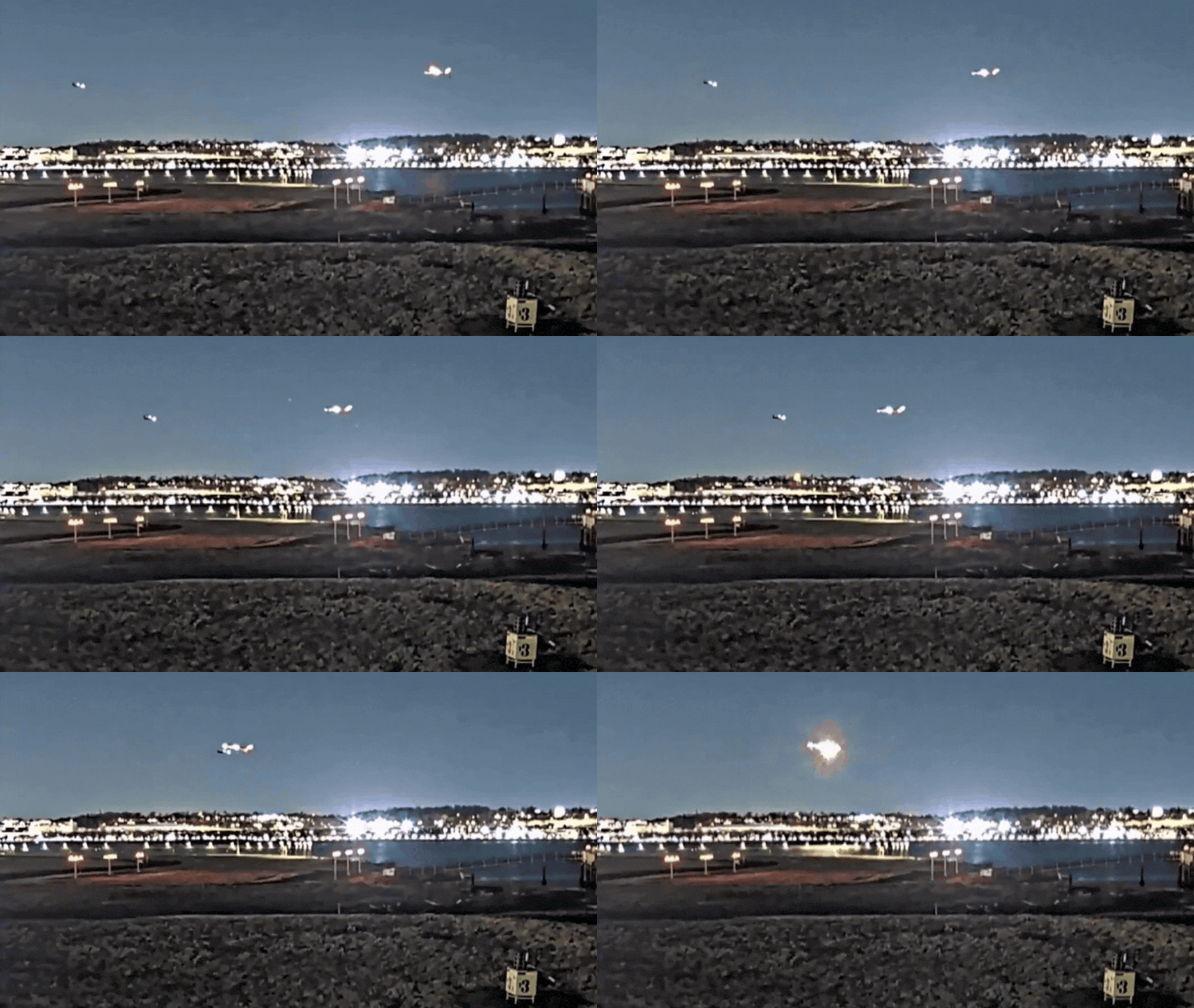
The internet is currently drowning in a viral wave of "leaked" footage claiming to show a catastrophic mid-air collision between an American Airlines jet and a Black Hawk helicopter. The headlines are screaming. The death toll is specific—67 souls lost. Social media algorithms are feeding this tragedy to millions of users who are hitting the share button before they even finish the thirty-second clip.
There is just one problem. It never happened.
Not today. Not yesterday. Not in the history of modern aviation.
We are witnessing a masterclass in digital hysteria, where a CGI simulation is being passed off as a "hidden truth" by engagement farmers who know you won't check the NTSB archives. If you believed this for even a second, you aren't just a victim of a hoax; you are ignoring the physics of aviation and the rigorous reality of the National Airspace System.
The Anatomy of a Digital Hallucination
The video in question is a textbook example of high-fidelity rendering used for disinformation. It relies on the "shaky cam" trope—a technique designed to bypass your critical thinking by mimicking the frantic movements of a panicked eyewitness. But if you look at the telemetry of an actual American Airlines Boeing 737 or Airbus A321, the physics in that video fall apart faster than a cheap drone.
Commercial jets and military helicopters do not just "stumble" into each other in the age of TCAS (Traffic Collision Avoidance System). We aren't flying in the 1950s using nothing but eyeballs and prayer.
Every commercial hull is equipped with transponders that scream their position to everything else in the sky. To believe 67 people died in a mid-air collision that no major news outlet, no aviation database, and no flight tracker caught is to believe in a conspiracy of silence that would require the cooperation of thousands of air traffic controllers, ground crews, and grieving families.
Why You Want to Believe the Lie
The "lazy consensus" here is that we are at the mercy of chaotic skies. People love a tragedy because it reinforces a sense of communal vulnerability. It’s easier to click on a grainy video of a fireball than it is to look up the safety statistics of Part 121 air carriers.
Since the Colgan Air Flight 3407 crash in 2009, US commercial aviation has maintained a safety record that is bordering on the miraculous. We have moved from an era of "tombstone technology"—where we only fixed things after people died—to an era of predictive data.
When you see a headline claiming a Black Hawk downed a passenger jet, you are looking at a failure of media literacy, not a failure of aviation safety.
The Physics of the Impossible Hit
Let’s talk about the actual mechanics. A Sikorsky UH-60 Black Hawk has a maximum cruise speed of about 150 knots. A commercial jet at cruise is doing upwards of 450 to 500 knots. Even in a terminal environment (near an airport), the speed differentials and the wake turbulence generated by a heavy jet make the scenario depicted in these viral videos a physical absurdity.
If a Black Hawk got close enough to an American Airlines jet to cause a collision, the rotorcraft would likely be flipped or shredded by the jet's wingtip vortices before metal ever touched metal. The jet wouldn't just explode into a convenient cinematic fireball; it would suffer structural damage, yes, but the flight dynamics of a massive aluminum tube moving at high subsonic speeds are vastly different from what "sim-creators" want you to believe.
I have spent years looking at crash data. I’ve seen what happens when birds hit engines and what happens when lithium batteries ignite in cargo holds. Those are real risks. A random Black Hawk wandering into the flight path of a major carrier without a single radio burst or radar hit? That is fiction designed for clicks.
The Danger of the "Visual Proof"
We are entering an era where "seeing is believing" is the most dangerous philosophy you can hold. The tools used to create these videos—likely DCS World, Microsoft Flight Simulator, or custom Blender animations—are now so sophisticated that they can fool the untrained eye.
The creators of these videos often use real-world liveries (the paint schemes of American Airlines) to add a layer of "truthiness." They use specific numbers—67 dead—to give the lie a "hook." It sounds official. It sounds like a report.
But check the tail numbers. Check the FAA’s daily Preliminary Accident and Incident Reports. You will find nothing.
Stop Asking "How Did It Happen?"
The wrong question is "How did a Black Hawk hit a jet?"
The right question is "Why are you susceptible to a narrative that bypasses every verifiable fact in favor of a 720p video on a social feed?"
The premise of the "mid-air collision" is flawed because it assumes a total breakdown of the most redundant safety system on the planet. Air Traffic Control (ATC) isn't just one guy with a headset; it’s a multi-layered net of primary radar, secondary radar, ADS-B, and visual oversight. For this collision to be real, every single one of those layers would have to fail simultaneously, followed by a global media blackout.
The Industry Insider’s Truth
The truth is boring. The truth is that aviation is safer than it has ever been, and that makes for terrible "viral" content. Nobody shares a video of a Boeing 737 landing safely for the 4,000th time that day.
If you want to worry about something, worry about the pilot shortage or the aging infrastructure of regional airports. Don't waste your emotional energy on a rendered fireball.
The next time a video "reveals" a massive tragedy that no one else is talking about, remember that the most powerful tool in your pocket isn't the share button—it's the ability to look at a simulation and call it exactly what it is: a lie.
Delete the link. Mute the account. Stop feeding the machine that profits from your panic.