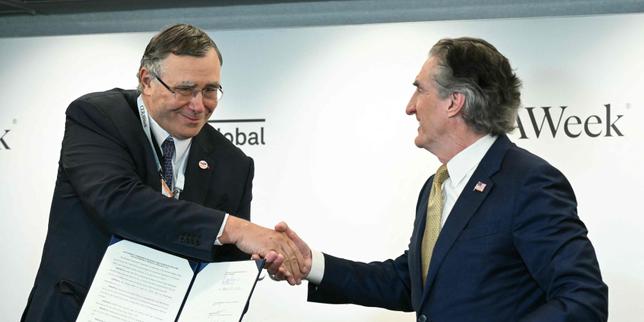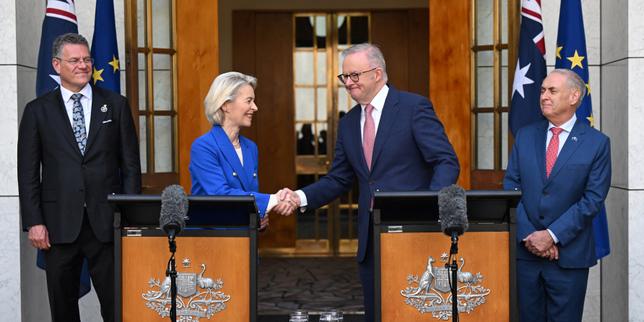
The wait is finally over. After years of bickering over geographic naming rights and agricultural quotas, the European Union and Australia have officially signed a trade agreement that actually changes things. It's not just another dry piece of paper signed in a Brussels boardroom. It's a fundamental shift in how two of the world’s most stable democracies swap goods, services, and green technology. If you’ve been following the stop-and-start nature of these talks since 2018, you know this wasn't guaranteed.
Most people think trade deals are only about cheaper wine or cheaper cars. They're wrong. This specific pact is a strategic move to break dependencies on volatile markets. It’s about securing the minerals needed for the electric vehicle revolution. It’s about setting a standard for "fair trade" that doesn't just look at the bottom line but also at the carbon footprint of every shipment. Meanwhile, you can find similar developments here: The Caracas Divergence: Deconstructing the Micro-Equilibrium of Venezuelan Re-Dollarization.
Breaking the Resource Monopoly
Australia sits on a goldmine. Actually, it's more of a lithium, cobalt, and rare-earth element mine. These materials are the lifeblood of the modern world. Without them, there are no smartphone batteries, no wind turbines, and definitely no Tesla or Volkswagen EVs. For a long time, Europe relied heavily on single-source suppliers for these critical minerals. That was a mistake.
This deal changes the math. By removing export taxes and streamlining regulations, the EU gets direct, stable access to Australian resources. In return, Australia gets a massive infusion of European investment to build up its own processing capabilities. Instead of just digging rocks out of the ground and shipping them elsewhere to be refined, Australia can now start doing the high-value work at home with European tech. To understand the full picture, we recommend the recent report by Bloomberg.
It’s a win-win that actually makes sense. You get more stable prices for tech in Lyon, and you get high-paying industrial jobs in Perth. Honestly, it’s about time someone prioritized supply chain resilience over the absolute lowest price point.
The Great Feta and Prosecco Debate
You can’t talk about EU trade without talking about food. The biggest sticking point in these negotiations was always "Geographical Indications" or GIs. The EU is incredibly protective of names like Champagne, Roquefort, and Feta. They argue these aren't just names; they’re intellectual property tied to a specific place and method.
Australian farmers, many of whom have European heritage, argued they've been making "feta" for generations. They saw the EU’s demands as protectionism disguised as culture. The final agreement reflects a messy, human compromise. Australia has agreed to phase out the use of certain protected names over a multi-year period.
What does this mean for you at the grocery store? It means you’ll start seeing "Greek-style salad cubes" or "Sparkling Shiraz" instead of the names the EU holds dear. In exchange, Australian beef and dairy producers got much better access to the European market. The quotas for Australian high-quality beef have been expanded significantly. If you're a fan of grass-fed steak, expect to see more Australian labels in your local butcher shop at more competitive prices.
Services and Professional Freedom
This part of the deal doesn't get enough headlines. It’s about people. The agreement simplifies the process for professionals to work across borders. If you’re an architect in Berlin or a digital consultant in Sydney, the red tape just got a lot thinner.
We’re talking about mutual recognition of qualifications. This is a huge deal for the services sector, which makes up the vast majority of both economies. It’s not just about big corporations. Small startups now have a legal framework that makes it easier to bid on government contracts in each other's territories.
The deal also includes some of the most advanced digital trade provisions in any agreement to date. It bans "data localization" requirements. That means a French company doesn't have to build expensive servers in Australia just to sell a software subscription there. It keeps the internet open and lowers the barrier to entry for small businesses.
A Greener Way to Trade
Let’s be real. Shipping things halfway across the world isn't great for the environment. The negotiators knew they couldn't sign a 2026 trade deal without serious climate commitments. This is one of the first major agreements to bake the Paris Agreement targets directly into the legal text.
There are "essential elements" clauses. If one party seriously violates their climate commitments, the other can technically pull back on trade concessions. It gives the deal teeth. Beyond the stick, there's the carrot. The agreement slashes tariffs on green goods. Solar components, water purification tech, and energy-efficient machinery will move between the two blocs with zero duties.
It’s an attempt to prove that globalization doesn't have to be a race to the bottom. By aligning standards on carbon accounting and sustainable farming, the EU and Australia are trying to create a "Green Bridge."
Why the Timing Matters Right Now
The world is currently a geopolitical mess. Trade is being used as a weapon in many corners of the globe. This agreement is a loud statement that "like-minded" partners can still find common ground. It reduces the "sovereign risk" for companies in both regions.
When you look at the numbers, the projected growth is staggering. Economists expect bilateral trade to increase by at least 30% over the next decade. But the real value isn't just in the volume. It’s in the diversification. Australia is less dependent on a single regional neighbor for its economic survival. Europe is less dependent on autocratic regimes for its energy and raw materials.
Making the Most of the New Rules
If you’re running a business or just looking to invest, don't wait for the official brochures to come out. The transition periods for many of these tariff cuts start almost immediately.
For business owners, the first step is auditing your supply chain. Are you buying components from high-tariff regions that you could now source from Australia or the EU? Check the new "Rules of Origin" guidelines. They've been simplified to make sure small companies can actually use the trade preferences without hiring a team of lawyers.
For consumers, keep an eye on the electronics and automotive sectors. As the cost of raw materials for batteries drops due to these new corridors, we should see the price of entry-level EVs start to stabilize or even dip. This isn't just a corporate handout. It’s a structural change that filters down to anyone who uses a battery or eats a meal.
Start looking at Australian wine imports or European specialized machinery parts now. The early movers are the ones who will capture the margin before the market fully adjusts to the new reality. The paperwork is signed. The path is clear. Now it's just about who moves the fastest.