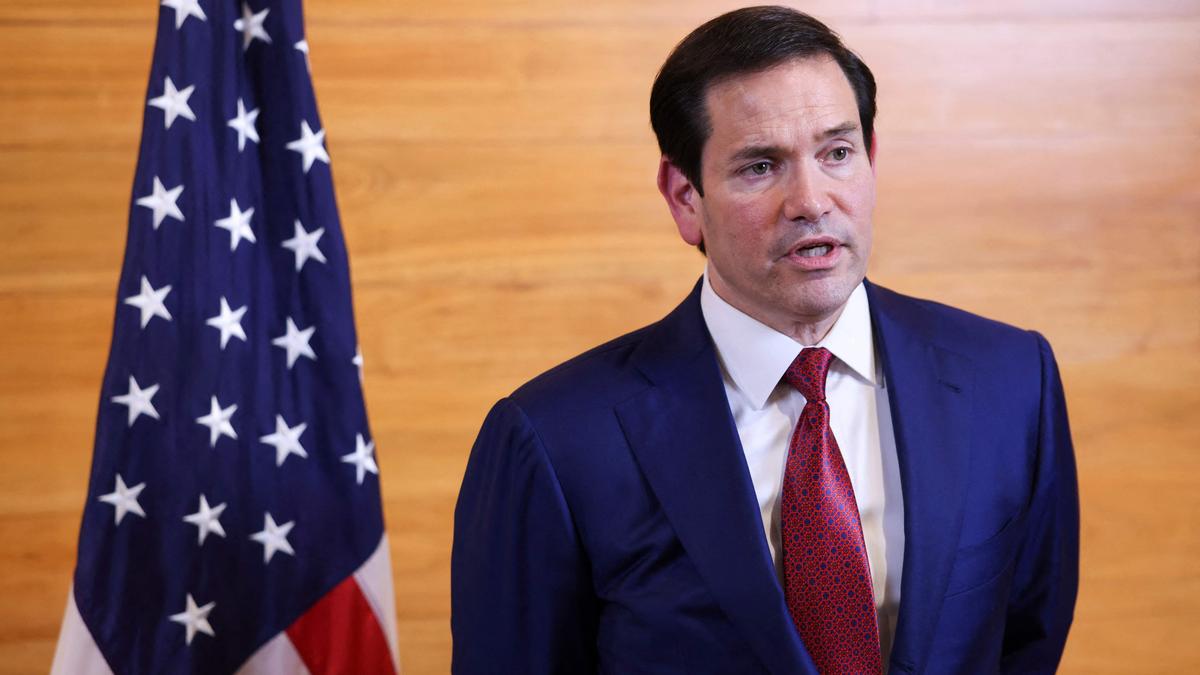
The war in Ukraine has reached a point where the geography of the front lines is no longer the primary map of the conflict. After four years of high-intensity combat and a shifting political tide in Washington, U.S. Secretary of State Marco Rubio recently signaled the definitive end of the "victory through artillery" era. His blunt assessment that the war has no military solution is not a white flag; it is an acknowledgment of a grinding reality where neither side possesses the overmatch required to break the current stalemate.
For years, the metric of success was measured in kilometers of liberated soil. Today, that metric has been replaced by the transactional logic of a new administration. Rubio’s comments in late February 2026, delivered while traveling in the Caribbean, underscore a pivot from the Biden-era "as long as it takes" philosophy to a "let’s make a deal" mandate. This shift is driven by a cold calculation: the U.S. believes it has reached the limit of what its industrial base and political capital can achieve on the battlefield without risking a direct, catastrophic escalation with a nuclear-armed Russia.
The Friction of Attrition
The battlefield today is a 700-mile scar of trenches and drone-saturated "kill zones" where movement is nearly impossible. During the winter of 2025 and into early 2026, Russian forces advanced at rates measured in meters per day, often suffering thousands of casualties for the sake of a single tree line or a ruined hamlet in the Donbas. This is not 21st-century maneuver warfare. It is the First World War with fiber-optic drones.
Russia currently occupies roughly 20% of Ukrainian territory. While Moscow has the "upper hand" in terms of raw mass and a war economy that has proven surprisingly resilient to Western sanctions, the cost of their gains is astronomical. Western intelligence estimates suggest combined Russian and Ukrainian casualties could hit the two-million mark by the end of this spring. For the Kremlin, this is a price they are willing to pay to maintain the initiative. For the West, and specifically for an American administration focused on domestic "America First" priorities, the return on investment for continued military aid is being questioned with increasing frequency.
The Secret 20 Point Architecture
Rubio and the White House are betting everything on a diplomatic "catalyst" role that only Washington can play. The administration has been circulating a evolving peace framework—at various times described as a 28-point or 20-point plan—that attempts to bridge the gap between Kyiv’s survival and Moscow’s territorial demands.
The core of this doctrine involves several bitter pills for all parties involved:
- The Frozen Front: A de facto ceasefire that leaves Russian troops in control of current positions while stopping the "senseless killing" that President Trump has repeatedly decried.
- The Neutrality Trade: Ukraine would likely be required to shelve its NATO ambitions for a set period, potentially decades, in exchange for "hard" security guarantees from a coalition of European powers and the U.S.
- The Mineral Mandate: A controversial element involving joint ventures for Ukraine’s vast rare-earth mineral deposits, essentially using the country's natural wealth as collateral for its own reconstruction and as an incentive for American engagement.
- The G8 Carrot: The potential readmission of Russia into global forums and the gradual lifting of sanctions in exchange for verified compliance with a settlement.
This is not a "peace" in the traditional sense. It is a managed de-escalation. Critics argue it rewards aggression, while proponents, including Rubio, argue it prevents the total collapse of the Ukrainian state and the potential for a wider European war.
The European Schism
As the U.S. moves toward a transactional settlement, a visible rift has opened between Washington and its European allies. For countries like Poland and the Baltic states, Rubio’s "no military solution" rhetoric feels like a betrayal of the security architecture that has held since 1945. They view any concession as an invitation for Putin to rest, refit, and strike again in three to five years.
The European Union is now grappling with the reality that it may soon have to shoulder the lion’s share of Ukraine’s defense and reconstruction. Without the U.S. as a guarantor of military aid, the EU is forced to decide if it can transform from an economic bloc into a serious security actor. The "Munich moment" of early 2026 saw Rubio essentially telling European leaders that the era of total American security subsidization is over.
The Mineral Equation
Underneath the rhetoric of peace and sovereignty lies a raw economic reality. Ukraine holds some of the world's largest reserves of critical minerals—titanium, lithium, and graphite—necessary for the global energy transition. The Trump administration has been transparent about its interest in these resources.
In early 2025, a high-stakes meeting in the Oval Office between President Trump and President Zelenskyy reportedly centered on a "Mineral Resources Agreement." The logic is simple: the U.S. provides the security and diplomatic muscle, and in return, American firms get preferential access to the resources needed to compete with China. For Kyiv, this is a desperate play to keep Washington interested. For Washington, it transforms a "forever war" into a strategic investment.
The Myth of the Breakthrough
Military analysts have spent years waiting for a "Surovikin Line" to break or a "Kharkiv-style" collapse to occur. It hasn't happened. The density of mines, the ubiquity of surveillance drones, and the lack of air superiority for either side have created a tactical stalemate that no amount of F-16s or Abrams tanks has yet been able to solve.
Russia’s strategy is now one of "strategic patience." They believe they can outlast the political will of the West. Rubio’s pivot to a diplomatic solution is an attempt to snatch the initiative back from Putin by changing the game from a war of attrition to a negotiation of interests. It is a high-risk gamble. If the U.S. pulls back its support to force Ukraine to the table, and Russia refuses to negotiate in good faith, the result won't be a peace deal—it will be a Ukrainian rout.
The Secretary of State’s insistence that the United Nations, France, or the EU cannot facilitate this peace is a clear assertion of American exceptionalism. It is a "Washington-only" approach that seeks to settle the largest conflict in Europe since 1945 through bilateral and trilateral deals, often bypassing traditional multilateral institutions.
The war is not ending because justice has been served or territory has been returned. It is entering a new phase because the primary benefactor of the defense has decided that the cost of a military "win" is too high and the timeline too long. The Rubio Doctrine is a recognition that in the current global order, a "messy ceasefire" is preferable to a "perfect war." Whether this leads to a lasting stability or merely a pause before a larger storm depends entirely on whether the "deal" being crafted in Geneva and Abu Dhabi has more teeth than the failed agreements of the past.
Would you like me to analyze the specific economic implications of the proposed Ukraine-U.S. Mineral Resources Agreement?