The sound of a dying herd is not a roar. It is a dry, rattling cough that blends into the whistle of the wind over cracked earth. In the Gedo region of Somalia, this sound has become the background radiation of existence. When the rain fails for the fifth consecutive season, the silence that follows is more terrifying than any storm.
Hassan stands over the carcass of a goat that was, only a week ago, his family’s bank account, their refrigerator, and their children’s education. He does not weep. There is no moisture left in his body for tears. He simply watches as the heat waves distort the horizon, turning the scrubland into a shimmering lake of deception. This is not just a weather pattern. It is a slow-motion erasure of a civilization. For another look, read: this related article.
The Red Cross calls it a "protracted crisis." For Hassan, it is the Tuesday his youngest daughter stopped asking for milk because she realized there was none.
The Arithmetic of Agony
We often treat famine as a sudden explosion, a localized blast of misfortune. The reality is more like a mathematical equation where the variables are stripped away one by one until only zero remains. To understand the scale of what is happening across the Horn of Africa, you have to look at the numbers, but you must see the faces behind the digits. Related coverage on this trend has been published by USA Today.
Over 6.5 million people in Somalia are currently facing acute food insecurity. That is half the population. Imagine every person in a major European or American city suddenly losing access to their next meal, not just for a day, but for the foreseeable future. The International Committee of the Red Cross (ICRC) has sounded the alarm because the traditional safety nets—the kinship sharing, the resilient camel herds, the deep-bore wells—have all frayed to the point of snapping.
The drought is a thief. It steals the livestock first. Then it steals the seeds. Finally, it steals the people, forcing them into displacement camps where the only thing more abundant than the dust is the shared desperation. By the time an official "famine" is declared, the tragedy is already in its final act. Most of the deaths occur during the "pre-famine" phase, where malnutrition weakens the body until a simple bout of diarrhea or a common cold becomes a death sentence.
Why the Clouds Remained Empty
It is tempting to blame the sky and leave it at that. But the sky is only half the story. The current disaster is a collision of three distinct forces, a "triple threat" that has created a perfect environment for catastrophe.
First, there is the climate cycle. La Niña has gripped the region with a stubbornness rarely seen in recorded history. It has pushed the rain clouds away, season after season, leaving the soil to bake into a brick-like consistency that rejects water even when it does fall. When the rare, sporadic flash floods hit, they don't nourish; they wash away the topsoil and the remaining hope.
Second, the global economy has turned its back. Somalia imports nearly 90% of its wheat from Russia and Ukraine. When that supply chain was severed by war thousands of miles away, the price of a loaf of bread in a Mogadishu market didn't just rise; it soared beyond the reach of the average laborer. Inflation is a nuisance in the West. In the Horn of Africa, it is a guillotine.
Third, the ghost of conflict. You cannot farm a field if you are dodging mortar fire or if the roads to the market are controlled by armed groups demanding "taxes" that exceed the value of the crop. The ICRC warns that the overlap of violence and climate change has created "hunger pockets" that are nearly impossible for aid workers to reach.
The Ghost of the 2011 Famine
There is a specific kind of trauma that comes from remembering. In 2011, a quarter of a million people died in Somalia from famine. Half of them were children under the age of five. Those who survived that era now look at the horizon with a chilling sense of déjà vu.
"We are seeing the same signs," says an aid worker who has spent a decade in the field. "The livestock are dying in the same patterns. The prices are spiking in the same ways. But this time, the world is distracted."
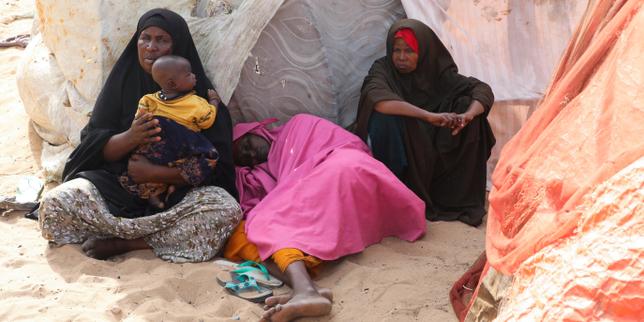
The human body is remarkably resilient until it isn't. When a person enters the later stages of starvation, the body begins to consume itself. It burns the fat, then the muscle. The heart shrinks. The brain fogs. In the displacement camps outside Baidoa, mothers sit in rows, holding children who are so lethargic they no longer have the energy to swat away the flies. It is a quiet, rhythmic suffering.
The Myth of the Handout
A common misconception is that these communities are waiting for a "handout." This could not be further from the truth. The pastoralist culture of Somalia is built on a foundation of extreme self-reliance and sophisticated environmental management. They are experts at surviving in one of the harshest climates on Earth.
When a Somali herder loses his animals, he loses his identity. He is not just "unemployed." He is a captain without a ship, a scholar without books. The intervention required is not just sacks of grain, though those are vital for immediate survival. The real work lies in "resilience building"—a sterile term for something deeply human. It means solar-powered pumps that can reach the deep aquifers that haven't dried up. It means drought-resistant seeds and mobile veterinary clinics that can keep the last of the breeding stock alive.
The Red Cross isn't just delivering food; they are trying to keep the social fabric from unraveling. If the elders can't feed their families, the young men become vulnerable to recruitment by extremist groups. Hunger is the greatest recruiter the world has ever known.
The Invisible Stakes
Why should a reader thousands of miles away care about Hassan and his goat?
Beyond the moral imperative—the simple fact that no child should starve to death in an age of surplus—there is a cold, geopolitical reality. A collapsed Somalia is a vacuum. It is a source of mass migration that ripples across continents. It is a breeding ground for instability that ignores borders.
But the most compelling reason is more intimate. We are all living on the same planet, governed by the same volatile climate. The Horn of Africa is the "canary in the coal mine." They are facing today what many more regions will face tomorrow. If we cannot find a way to sustain life in the drylands of Somalia, we are admitting that our global systems are incapable of protecting the most vulnerable when the environment turns hostile.
Consider the irony of a mother who has never driven a car or worked in a coal plant, yet her children are the first to pay the price for a warming globe. The carbon footprint of a Somali nomad is virtually zero, yet they are on the front lines of the climate's counter-attack.
The Window is Closing
The urgency in the Red Cross reports is not hyperbole. It is a countdown. There is a very narrow window between "food insecurity" and "mass mortality." We are currently in that window.
The response from the international community has been fragmented. Pledges are made, but the actual cash flow often lags behind the speed of the drought. By the time the funding is fully realized, the cost of saving a life has quadrupled because the person has moved from "hungry" to "severely malnourished," requiring specialized therapeutic milk and 24-hour medical care.
It is cheaper, more effective, and infinitely more humane to intervene now.
A Choice of Shadows
Hassan walks back toward his makeshift shelter, constructed from sticks and scraps of orange plastic. Inside, his wife is boiling water. There is nothing to put in the water, but the ritual of cooking provides a psychological anchor, a way to tell the children that they are still a family, that they are still trying.
The sun begins to set, painting the dust in hues of violet and gold. For a moment, the land looks beautiful, masking the lethality of the heat. In a few hours, the temperature will drop, and the cold of the desert night will begin to gnaw at those who haven't eaten.
We live in a world of incredible connectivity, where we can see the grain of the sand on Mars but often fail to see the empty plates in our own neighborhood. The crisis in Somalia is not a "natural" disaster. It is a test of logistics, empathy, and political will.
The dust is rising. It settles on the skin, in the lungs, and over the future. Whether that dust becomes a shroud or the foundation for a rebuilt life depends entirely on the speed of the world’s shadow as it moves to provide cover.
The goat is gone. Hassan's daughter is still waiting. The clouds are still empty. And the clock is ticking in a language that requires no translation.
Would you like me to help you draft a series of social media posts or a fundraising pitch based on this narrative to help raise awareness?