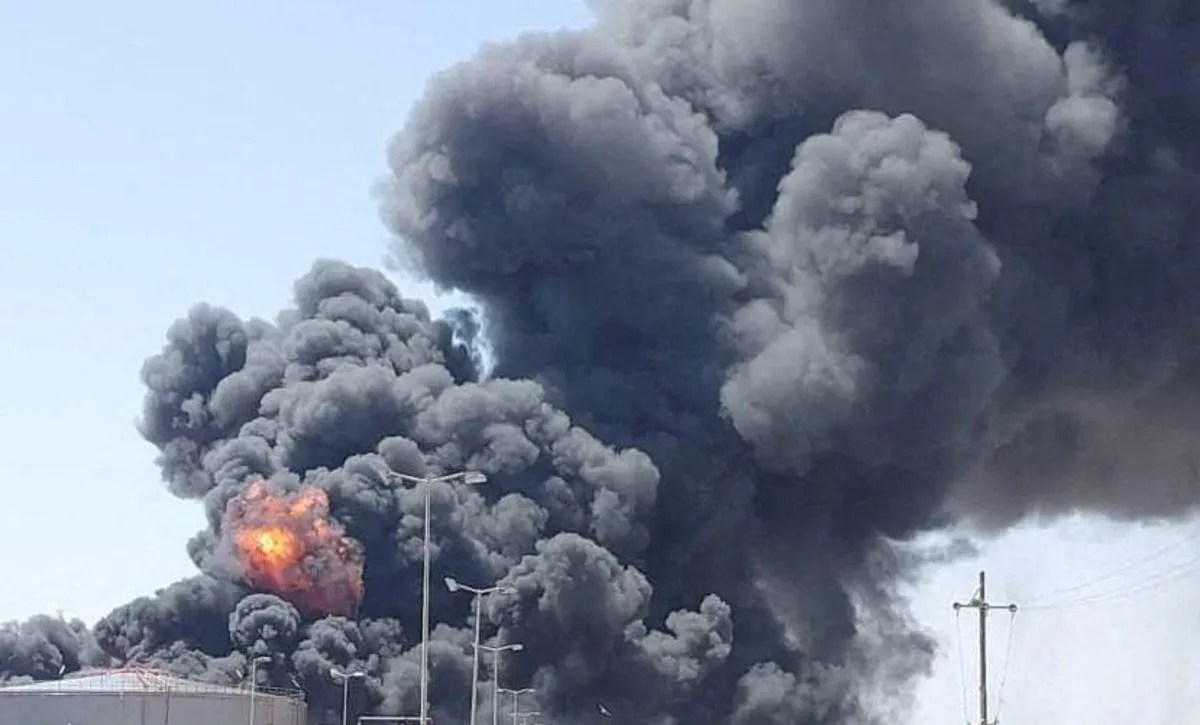
The sun over Sudan’s Gezira State does not rise; it bleeds. It spills a harsh, unrelenting light over fields that were once the breadbasket of a nation, illuminating the cracked earth and the ghosts of villages that used to hum with the sound of evening prayers and children chasing goats. Now, there is only a heavy, suffocating silence, broken periodically by the rhythmic thud of boots and the sharp, staccato crack of gunfire.
On a Tuesday that should have been like any other, the world moved on. Stock markets fluctuated. People argued over coffee in distant cities. But in a small cluster of homes in the Gezira region, the world simply ended.
The Rapid Support Forces (RSF) arrived not as a military unit, but as a storm. They didn't come with demands or negotiations. They came with the cold, calculated intent of those who have forgotten the value of a human heartbeat. By the time the dust settled, fourteen people—neighbors, fathers, sons—lay still in the dirt.
The Weight of Fourteen Souls
Numbers are dangerous. They are sterile. When we read "14 killed," our brains process it as a statistic, a small data point in a sprawling conflict that has displaced millions. We mentally file it away under "foreign tragedy" and continue scrolling.
But imagine a man named Ahmed. Ahmed is a hypothetical focal point for this tragedy, a composite of the many who stood their ground. He wasn't a soldier. He was a man who knew the precise time the wind shifted in the afternoon and which of his neighbors’ gates creaked the loudest. When the RSF trucks roared into his village, Ahmed didn't reach for a rifle; he reached for his daughter’s hand.
The RSF—a paramilitary force born from the Janjaweed militias of Darfur—has turned the systematic terror of the past into a modernized machine of domestic destruction. Their presence in Gezira is a strategic play for resources and a psychological war against the Sudanese people. To them, Ahmed and the thirteen others weren't people. They were obstacles. They were messages written in blood, intended to tell the rest of the country that nowhere is safe.
The Mechanics of Terror
Why Gezira? Why now? The state is more than just land. It is the heart of Sudan’s agricultural identity. By seizing control here, the RSF isn't just winning a battle; they are holding a knife to the throat of the nation’s food supply.
The violence follows a chillingly predictable pattern. First, the communications go dark. Internet towers are sabotaged or seized, cutting off the victims from the outside world. This creates a vacuum where the only truth is the one the men with the guns dictate. Then comes the "looting and leveling." Markets are emptied. Silos are burned. It is a scorched-earth policy designed to ensure that even if the people survive the bullets, they cannot survive the peace.
Consider the psychological toll of living in a state of "maybe." Maybe today they come. Maybe today we run. Maybe today we die. This constant cortisol spike rewires a community. It dissolves the social glue that keeps a village together. When the RSF executed those fourteen people, they didn't just kill individuals; they murdered the sense of security for thousands of others who watched from the shadows or heard the echoes from the next ridge over.
The Invisible Stakes
The global community looks at Sudan and sees a complex civil war. It sees General Burhan and General Dagalo (Hemedti) locked in a power struggle that seems too tangled to unravel. But for the person standing in the dusty street of a Gezira village, the geopolitics are irrelevant.
The real stake is the preservation of the human thread. Each time a massacre like this happens—small enough to miss the front page of major Western outlets, but large enough to hollow out a community—the probability of a unified Sudan slips further away.
The RSF relies on this exhaustion. They bet on the fact that the world will tire of hearing about "another massacre in Sudan." They count on the numbness that sets in when the death toll becomes a repetitive drumbeat. But the reality is that these fourteen lives represented fourteen distinct universes of memory, skill, and potential. One might have been the only person who knew how to fix the village well. Another might have been the storyteller who kept the history of the tribe alive in the minds of the youth.
When you kill the people who hold the local knowledge, you kill the future of the land itself.
The Anatomy of an Incursion
The reports are often dry: "RSF attacked a village, 14 dead."
Let’s look closer at the anatomy of such an event. The RSF usually arrives in "technicals"—pickup trucks mounted with heavy machine guns. These vehicles are the symbols of modern asymmetric warfare in Africa. They are fast, loud, and terrifying.
The soldiers don't just target combatants. In Gezira, the targets are often the intellectuals, the community leaders, or simply the young men who might one day resist. The executions are frequently public. They serve as a theater of power. By killing fourteen people in cold blood, the RSF asserts a total, nihilistic sovereignty. It is their way of saying, "Your laws, your God, and your dreams do not exist here. Only we exist."
The survivors are left with a choice that is no choice at all: stay and starve or flee into the unknown. Most flee. They join the millions of internally displaced persons (IDPs) huddling in camps, their lives reduced to a plastic tarp and a plastic bowl. The Gezira region, once lush and productive, is becoming a graveyard of ambition.
The Silence of the World
There is a specific kind of bitterness that grows in the hearts of those left behind when the world remains silent. It is the realization that some lives are deemed more "reportable" than others.
We must ask ourselves why a tragedy of this magnitude feels like a footnote. Is it because the geography is unfamiliar? Is it because the perpetrators don't fit into a convenient narrative of "Good vs. Evil" that the West can easily digest? The RSF’s campaign in Gezira is a test of our collective empathy. If fourteen people can be pulled from their homes and executed without a ripple of international outrage, then the very concept of "universal human rights" is a polite fiction we tell ourselves at dinner parties.
The logistics of aid are failing too. With the RSF controlling key transit points, food and medicine are being used as weapons of war. They are not just killing with lead; they are killing with the absence of calories.
Beyond the Horizon
The problem isn't just the fourteen dead. It’s the million who are waiting for their turn.
The RSF’s expansion into Gezira marks a turning point in the conflict. It shows a force that is no longer content with regional dominance but is actively seeking to dismantle the structural integrity of the Sudanese state. They are targeting the middle class, the farmers, and the local governance systems.
To understand the weight of this, you have to look past the smoke. You have to see the schoolbooks rotting in the rain because the school is now a barracks. You have to see the unharvested crops turning to black mush in the fields because the harvesters are buried in a mass grave or walking toward a border they may never reach.
The tragedy of the fourteen in Gezira is a microcosm of a larger, darker transformation. It is the sound of a country being torn apart, stitch by stitch, by men who have decided that power is worth more than the soil they stand on.
The sun eventually sets over Gezira, casting long, distorted shadows across the empty streets. The trucks have moved on to the next village, leaving behind a silence that is louder than the gunfire ever was. In a small house, a woman sits on the floor, staring at a patch of dirt where her husband stood only hours before. She does not cry for the geopolitics of Sudan. She does not cry for the international community's failure. She cries for the man who will never again walk through that door, and for the fourteen voids that can never be filled, no matter how many reports are written or how many statistics are cited.
The dust settles, but the earth remembers the blood. It waits for a day when the light over Gezira is something other than a warning. Until then, the silence continues to grow.