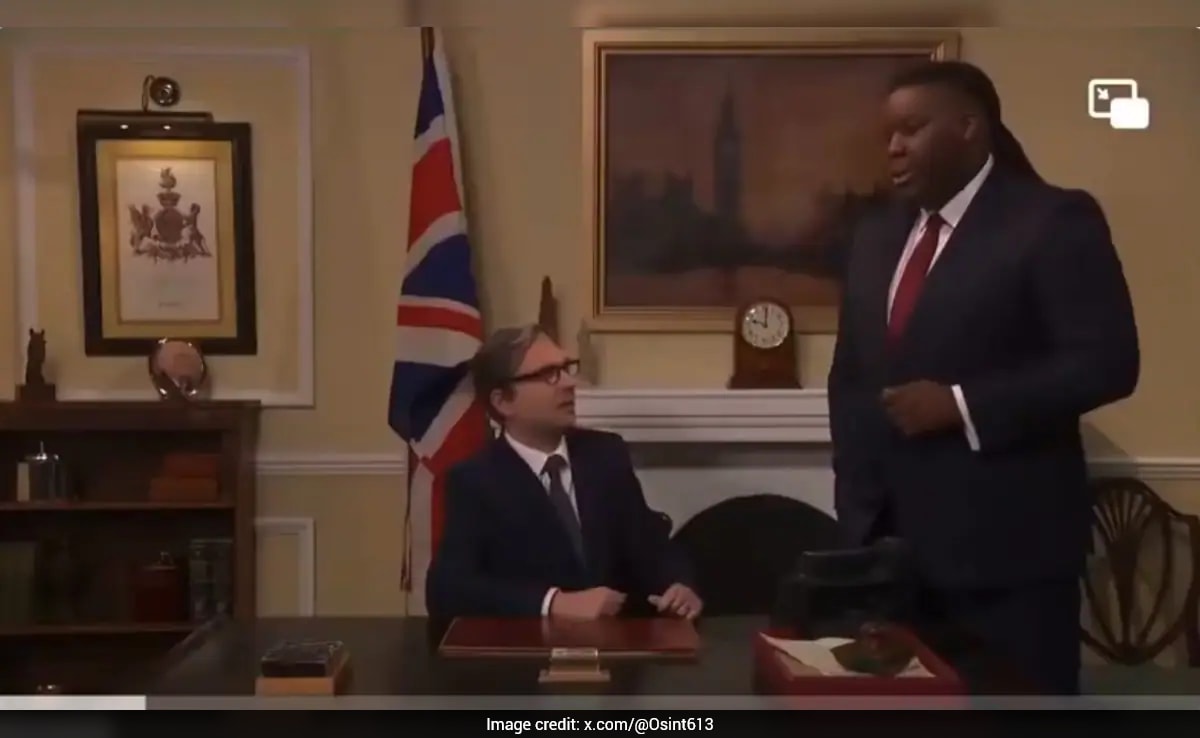
The modern intersection of social media amplification and head-of-state diplomacy has created a structural imbalance in how international relations are conducted. When Donald Trump shared a video mocking UK Prime Minister Keir Starmer—specifically highlighting Starmer’s past rhetoric regarding potential interactions with the former U.S. President—it was not merely a moment of political theater. It was a calculated application of asymmetric diplomatic friction. This tactic leverages a high-engagement digital platform to bypass traditional State Department or Foreign Office channels, forcing a sitting head of government into a reactive posture that carries significant domestic and international opportunity costs.
To analyze this interaction, one must look past the superficial humor or personal animosity and examine the underlying mechanics of Digital Power Projections and the Constraint of Statecraft.
The Architecture of Diplomatic Asymmetry
Diplomacy historically relied on the principle of reciprocity and "quiet rooms." The digital era, however, introduced the Feedback Loop of Perceived Weakness. When a candidate or former leader of a superpower uses a massive digital megaphone to target a sitting leader, the recipient faces a "no-win" decision matrix:
- The Silence Penalty: Ignoring the provocation allows the narrative of subservience or "shouting" vulnerability to solidify among domestic and foreign audiences.
- The Escalation Trap: Responding directly elevates the provocation to an official diplomatic incident, granting the provocateur the status of a peer-adversary and potentially damaging future working relationships.
In the specific case of the Starmer video, the content focused on "What if Donald shouts at me?"—a phrase designed to frame the UK Prime Minister as structurally timid. This targets a specific psychological vulnerability in the "Special Relationship," where the UK is often scrutinized for its perceived junior status. By amplifying this, Trump utilized a Low-Cost, High-Impact Narrative Vector. The cost to Trump was zero (a repost), while the cost to the UK government is the consumption of "Cycle Time"—the limited bandwidth of press offices and diplomatic staff who must now calibrate a response that balances national dignity with the pragmatism required for a potential second Trump term.
The Three Pillars of Narrative Dominance
The effectiveness of this digital maneuver rests on three distinct pillars that define how modern political communication overrides traditional policy.
1. Linguistic Framing and Mental Models
The phrase "shouting" is a linguistic anchor. It moves the conversation from policy (defense spending, trade deals, AUKUS) to personality and temperament. Once the public begins to view a leader through the lens of a "shouting" dynamic, every subsequent interaction is filtered through that power imbalance. This is a classic application of Reframing Theory, where the person who defines the terms of the encounter controls the outcome of the encounter.
2. Algorithmic Distribution as a Weapon
Traditional diplomatic snubs happen in private or through leaked memos. Digital snubs are engineered for virality. The reposting of a video functions as a Force Multiplier. By leveraging the architecture of social media platforms, the provocateur ensures that the message reaches the constituent base of the target. This creates internal pressure on Starmer from both his critics (who see weakness) and his supporters (who demand a forceful defense), narrowing his room for diplomatic maneuver.
3. Pre-emptive Leverage
By mocking Starmer now, Trump establishes a baseline for future negotiations. If Trump returns to the White House, the "shouting" narrative acts as a psychological "sunk cost" for the UK. Starmer would enter the room needing to prove he is not the person in the video, potentially leading him to overcompensate or concede on policy points to demonstrate "toughness."
The Cost Function of Reactive Statecraft
Every hour the UK government spends addressing a viral video is an hour lost to substantive policy execution. This is the Geopolitical Opportunity Cost. In a period defined by the war in Ukraine, economic stagnation in the Eurozone, and the complexities of post-Brexit trade, the diversion of mental and political capital into "personality management" represents a net loss in governance efficiency.
The UK’s reliance on "strategic patience" is often tested by this specific brand of American populism. While the UK Civil Service is built on a foundation of Incrementalism and Protocol, the Trumpian model is built on Disruption and Direct-to-Consumer Politics. These two systems are fundamentally incompatible. The friction generated at their touchpoints is not a bug of the system; for the provocateur, it is the intended feature.
Quantifying the "Special Relationship" Under Stress
To measure the health of the UK-US alliance in this context, we must move beyond the rhetoric of "shared values" and look at the Functional Alignment Metrics:
- Policy Convergence: Are the two nations moving closer or further apart on key issues like NATO funding and China-de-risking?
- Access Parity: Does the UK Prime Minister have the same level of informal access to the U.S. executive as other G7 leaders?
- Public Sentiment Volatility: How quickly does domestic UK opinion of the U.S. shift following these digital interactions?
The reposting of the video suggests a breakdown in the Informal Protocol Layer. While official channels may remain functional, the "Vibe Shift" in digital spaces creates a toxic environment for civil servants trying to negotiate long-term deals. If the public perceives the relationship as one of bullying versus submission, the political mandate for deep cooperation withers.
The Risk of Symmetrical Response
A common suggestion from strategic analysts is for the UK to adopt its own version of digital assertiveness. However, this ignores the Constitutional Constraints of the British parliamentary system. A Prime Minister is a representative of the Crown and the State; their communications are legally and traditionally bound by a level of decorum that a private citizen or a U.S. presidential candidate is not.
Attempting a symmetrical response—shouting back, so to speak—would result in Brand Dilution for the UK government. It would signal that the Prime Minister has been dragged down to the level of a social media personality, further eroding the prestige of the office.
The Mechanics of the "Shouting" Trope
The specific focus on "shouting" is a masterclass in High-Context Mockery. It draws on a stereotype of the British "stiff upper lip" being shattered by "American brashness." It is a trope that resonates because it feels directionally true to the cultural archetypes of both nations. By using a video that features Starmer's own words or likeness, the provocateur utilizes Hostile Attribution Bias, forcing the viewer to interpret Starmer’s past cautiousness as a present-day character flaw.
This creates a Logical Bottleneck for Starmer’s communications team. If they release a video of him looking "tough," it looks staged and defensive. If they ignore it, the original trope remains the dominant narrative.
Strategic Realignment: The Decentralized Diplomacy Model
The only effective counter to asymmetric digital friction is to decouple the "State" from the "Personality." The UK government must transition toward a Decentralized Diplomacy Model. This involves:
- Lowering the Target Profile: Reducing the Prime Minister's personal exposure in digital spaces where he is vulnerable to meme-based attacks.
- Surrogate Saturation: Utilizing cabinet members and high-profile ambassadors to handle the "friction" of digital discourse, allowing the Prime Minister to remain above the fray.
- Institutional Hardening: Focusing public messaging on institutional achievements—treaties signed, defense milestones met, economic indicators improved—rather than personality-driven narratives.
The goal is to render the "shouting" irrelevant by proving it has no impact on the machinery of the state. If the "shouting" does not result in a change in policy or a visible flinch in protocol, the tactic loses its utility.
The current tension is a symptom of a larger transition in global power dynamics. As the U.S. internal political landscape becomes increasingly fragmented and personality-driven, traditional allies must develop a Diplomatic Immune System capable of filtering out digital noise while maintaining the core functions of the alliance. The Starmer-Trump interaction is not an isolated incident of "mocking"; it is a stress test for the future of international engagement in an era of algorithmic volatility.
The strategic play for the UK is not to engage with the video, but to aggressively accelerate the Institutionalization of the Relationship. By locking in long-term, multi-decade agreements (such as AUKUS or specific trade carve-outs) that are shielded from executive whim or social media cycles, the UK can mitigate the "Person-to-Person" risk. The objective is to make the relationship "Trump-proof" or "Starmer-proof" by ensuring the cost of breaking institutional ties is prohibitively high for any individual leader, regardless of how much they might shout.