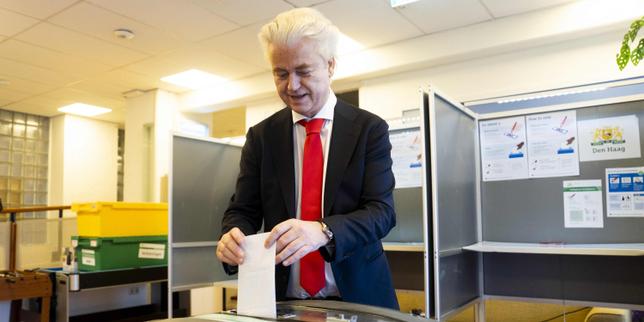
The victory of Geert Wilders’ Partij voor de Vrijheid (PVV) in November 2023 created a deceptive veneer of absolute dominance that is currently undergoing a structural fragmentation. While the PVV remains the largest force in the Tweede Kamer, the transition from a protest movement to a governing anchor has triggered a "Paradox of Participation." By entering a coalition, Wilders has traded ideological purity for administrative relevance, a move that effectively lowers the barrier to entry for competing radical-right factions. The current Dutch political environment is no longer a monopoly; it is a competitive market where the PVV’s brand equity is being cannibalized by coalition partners and peripheral agitators who are not bound by the compromises of the Schoof cabinet.
The Institutional Tax on Charismatic Authority
The erosion of Wilders’ grip on the far-right electorate is a function of institutionalization. Historically, the PVV operated as a "personal party" with a membership of exactly one: Geert Wilders. This structure allowed for maximum agility and a lack of internal dissent. However, the requirement to populate a cabinet—led by a non-partisan Prime Minister, Dick Schoof—has forced the PVV to outsource its influence to technocrats and secondary figures.
This transition introduces three primary vectors of decay:
- Administrative Accountability: When a radical-right party moves from the "anti-establishment" periphery to the "establishment" core, it inherits the failures of the state. Problems such as the housing shortage and the nitrogen crisis are no longer grievances to be exploited but KPIs that Wilders must now hit.
- The Dilution of Narrative: To maintain a four-party coalition (PVV, VVD, NSC, and BBB), Wilders had to "park" his most controversial constitutional proposals, including bans on the Quran and mosques. In doing so, he has vacated the ideological "high ground" of uncompromising nativism, leaving it open for occupation by more extreme or more consistent actors.
- The Professionalization Gap: The PVV has long lacked a deep bench of policy experts. By relying on the VVD (liberal-conservative) and NSC (centrist-reformist) for the actual mechanics of governance, the PVV risks appearing as a decorative layer on a traditional center-right administration.
Competitive Cannibalization: The BBB and NSC Factor
The Dutch radical-right landscape is currently being reshaped by the BoerBurgerBeweging (BBB) and the Nieuw Sociaal Contract (NSC). These parties do not compete with Wilders on his specific brand of Islamophobia, but they are successfully stripping away his broader populist base through two distinct strategies.
The Rural-Agrarian Pivot (BBB)
The BBB has captured the "territorial" grievance. While Wilders focuses on national identity and immigration, the BBB focuses on the physical land—farming rights, provincial autonomy, and the rejection of EU-mandated environmental regulations. For a significant portion of the PVV’s 2023 voters, the "identity" at stake is not just Dutch-ness, but a specific rural way of life that the BBB defends with more granular detail than the PVV.
The Institutional Integrity Pivot (NSC)
Pieter Omtzigt’s NSC appeals to the "rational populist." These are voters who are frustrated with the Hague’s elite but prioritize "good governance" and constitutional reform over cultural warfare. By joining the coalition, the NSC acts as a regulator on Wilders’ impulses. This creates a friction point: if the government fails to deliver, the NSC can blame PVV radicalism, while the PVV blames NSC bureaucracy. The result is a zero-sum game within the coalition that prevents Wilders from claiming a unified mandate.
The Cost Function of Governance
The PVV’s decline in absolute influence can be modeled through the "Cost of Governing" (CoG). For radical-right parties, the CoG is disproportionately high because their primary value proposition is being the outsider.
- The VVD’s Strategic Co-option: The center-right VVD has shifted its own rhetoric on migration to match the PVV’s intensity. This creates a "standardization" of radical-right policies. When the mainstream adopts the radical's platform, the radical loses its USP (Unique Selling Proposition).
- The Extremist Flank: Outside the parliament, figures like Thierry Baudet (FvD) or even more fringe elements are no longer overshadowed by Wilders. As Wilders moves toward the center to keep the government alive, he creates a vacuum on the far-right flank. Every time Wilders agrees to a budget compromise or a pro-Ukraine aid package, he pays a "legitimacy tax" to his more radical base.
The Mechanism of Narrative Drift
The shift in power is visible in the way the "asylum crisis" is handled. Wilders promised an "asylum stop," but the legal reality of international treaties and EU law makes this an impossibility without a "Nexit," which he has also been forced to sideline. This creates a gap between Performative Sovereignty and Operational Sovereignty.
- Performative: Wilders’ tweets and rhetorical attacks on the opposition.
- Operational: The actual legislation produced by the Schoof cabinet, which remains largely within the bounds of liberal democratic norms.
As the discrepancy between these two modes grows, the PVV’s "hand" (mainmise) weakens. The voter perceives that the PVV is in power, but the system is still functioning as it did before. This leads to voter disillusionment or, more likely, a migration toward "pure" protest parties that haven't been "tainted" by the necessity of ruling.
The Fragmented Hegemony
The Dutch far-right is moving from a Unipolar system (Wilders as the sun) to a Multipolar system (a constellation of populist interests). In this new model, the PVV is merely a first among equals.
The structural risk for Wilders is that his power was built on being the permanent opposition. By becoming the largest party in a coalition, he has effectively capped his growth. He cannot move further right without collapsing the government, and he cannot move further toward the center without losing his core identity.
Strategic actors within the Dutch political sphere should observe the upcoming provincial and European data points. The indicator of Wilders' fading grip will not be a sudden drop in polling, but rather the increasing frequency with which his coalition partners—specifically the VVD—successfully block his core initiatives while publicly adopting his language. This is "hegemony through imitation," where the establishment survives by wearing the mask of the populist, eventually making the original populist redundant.
The survival of the Wilders project now depends on a high-stakes gamble: can he deliver a "visible win" on immigration fast enough to offset the loss of his "outsider" status? If the bureaucracy or the courts stall the "asylum emergency" measures, the PVV will find itself in the worst possible position: responsible for the status quo but powerless to change it. At that point, the fragmentation of the Dutch radical right will accelerate, as new entrepreneurs of grievance emerge to claim the space Wilders spent twenty years building and six months compromising.