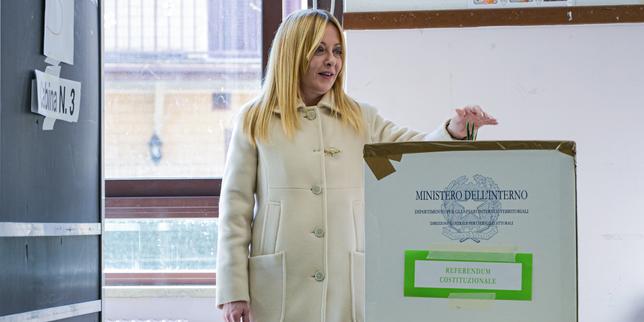
The myth of Giorgia Meloni’s invincibility just hit a brick wall. After months of framing a complex judicial overhaul as a do-or-die moment for Italy’s future, the voters handed her a definitive "No" this week. On March 23, 2026, the final tallies confirmed what many in Rome had whispered for weeks: the government overplayed its hand. With 54% of voters rejecting the reform, the Prime Minister isn't just facing a policy setback. She's staring at a shifted political reality.
It wasn't supposed to go this way. Meloni and her Justice Minister, Carlo Nordio, pitched this as a "historic opportunity" to fix a broken, sluggish system. But in the end, the campaign turned into something else entirely. It became a referendum on her leadership style and the perceived creep of executive power over the courts. If you liked this post, you might want to read: this related article.
The Reform That Nobody Asked For
At its core, the "Nordio Reform" was a technical beast that most Italians found alienating. The big selling point was the "separation of careers." In Italy, judges and prosecutors have historically belonged to the same professional body. They’re both "magistrates." You could be a prosecutor one year and a judge the next. Meloni’s team argued this created a cozy "esprit de corps" that biased judges toward the prosecution.
They wanted to split them into two distinct worlds. No more switching. Two separate governing bodies (the CSM). They even proposed choosing members of these bodies by "sortition"—basically a lottery—to break the power of internal judicial factions. For another perspective on this story, see the recent coverage from The Washington Post.
It sounds logical on paper. But for the average person waiting seven years for a civil case to wrap up, it felt like a distraction. Critics, led by the National Association of Magistrates (ANM) and opposition leader Elly Schlein, successfully framed it as a "Polish-style" attempt to bring the judiciary to heel. They argued that by isolating prosecutors, the government was actually making them easier to control.
When Technicalities Meet Identity Politics
The campaign was ugly. Justice Minister Nordio didn't help things by calling the High Council of the Judiciary a "quasi-mafia" system. That kind of rhetoric usually plays well with the hardcore base, but it backfired with the moderates. It made the government look like it was at war with the state itself.
The opposition didn't win because they had a better plan for the courts. They won because they managed to unite. For the first time in years, the center-left and the Five Star Movement found a common enemy. They turned the "No" vote into a shield for the Constitution.
- The Turnout Factor: Experts predicted low interest. They were wrong. Nearly 59% of voters showed up. In a country where apathy is the norm, that’s a massive statement.
- The Trump Shadow: It’s impossible to ignore the timing. Meloni’s alignment with Donald Trump’s second term—and his controversial foreign policy in the Middle East—is wearing thin at home.
- The Economy: Italians are feeling the pinch. The EU-funded post-pandemic recovery money (NRRP) is drying up. When you’re struggling to pay your heating bill, a constitutional reform about how a judge is picked by lottery feels incredibly out of touch.
The Fallibility of One-Woman Rule
Meloni’s big mistake was making this personal. She could have stayed in the background. Instead, she put her face on the "Yes" posters. She called it a "missed opportunity to modernize." Now, she has to live with the fallout.
It’s not just about the courts anymore. This result is a flashing red light for her next big project: the "Premiership" reform. That’s the one where she wants to allow Italians to directly elect the Prime Minister. If she couldn't get a technical judicial change through a referendum, how is she going to rewrite the very nature of Italian democracy?
Her allies, Lega’s Matteo Salvini and Forza Italia’s Antonio Tajani, aren't exactly crying themselves to sleep tonight. They’ve been overshadowed by Meloni’s "Fratelli d'Italia" for years. This defeat gives them leverage. They can now push for their own priorities, knowing the boss isn't as untouchable as she looked last Christmas.
Where Italy Goes From Here
Meloni has already said she won't resign. It’s a smart move. Italy doesn't need another government crisis right now. But the "I'm staying" video she posted on X felt more like a defensive crouch than a victory lap.
The opposition is finally smelling blood. Elly Schlein and Giuseppe Conte have a blueprint for the 2027 elections. They know that Meloni can be beaten if the "No" coalition stays together. That’s a big "if," given the history of the Italian left, but it’s more hope than they’ve had in years.
If you're watching the markets or the corridors of power in Brussels, the takeaway is clear. Italy’s period of absolute stability is over. The "Meloni Era" is entering its most difficult phase. She still has a majority in Parliament, but she’s lost the mandate of the street.
For the legal world, the status quo remains. Judges and prosecutors will keep sharing a canteen and a career path. The lottery system for their governing body is dead. And for the millions of Italians with a court case gathering dust in a file cabinet? Nothing changes.
The real work of making Italian justice faster and fairer—the stuff that actually matters to the person in the street—has once again been sacrificed for a high-stakes political gamble that didn't pay off. Meloni bet her credibility on a technicality, and the voters called her bluff. Now, she has to figure out how to lead a country that just told her "No."
The next few months will show if she can pivot to a more collaborative style of leadership or if she'll double down on the rhetoric that just failed her. Either way, the "invincible" Meloni is a thing of the past.