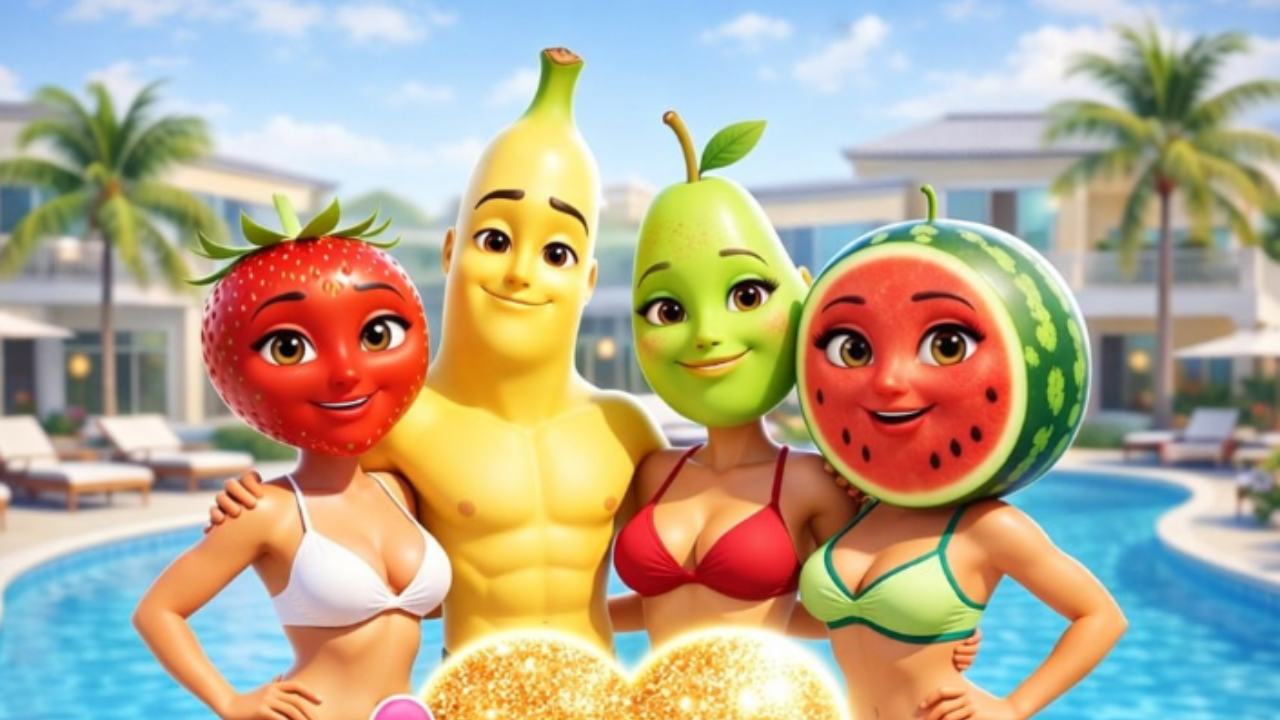
The glow of a smartphone screen at 2:00 AM does strange things to the human psyche. In that blue-light haze, the boundaries between the real and the simulated begin to dissolve. You are scrolling, mindlessly, through a sea of dance challenges and kitchen hacks, and then you see her. She is a strawberry. She has eyes that flutter with a simulated bashfulness, and she is currently weeping because a muscular pineapple just told her he isn’t looking for anything serious.
You don't scroll past. You stay. You watch. And then, you realize three million other people are watching with you. Also making waves in this space: The Logistics of Survival Structural Analysis of Ukraine Integrated Early Warning Systems.
In the span of just nine days, a TikTok account titled "Fruit Love Island" amassed a following larger than the population of many European cities. It didn't feature celebrities, high-octane stunts, or even real human beings. It featured a cast of anthropomorphic, AI-generated produce trapped in the familiar, high-stakes drama of a reality dating show. To look at the raw data—3.1 million followers in under 240 hours—is to see a viral anomaly. But to look at the comments section is to see something much more profound: a collective, global surrender to the absurd.
The premise is a beat-for-beat parody of the ITV juggernaut Love Island. There are "re-couplings," "bombshells" entering the villa, and tearful confessionals. The only difference is that the contestants are high-fidelity digital renders of watermelons, grapes, and citrus fruits. They speak with the unmistakable, slightly disjointed cadence of AI-generated voices, yet they carry the emotional weight of a Shakespearean tragedy. Further information on this are detailed by MIT Technology Review.
We are living through a moment where the "Uncanny Valley" isn't a place of fear anymore. It has become a playground.
The Architect in the Machine
Consider a hypothetical creator named Leo. Leo isn't a Hollywood producer with a $100 million budget. He’s a guy with a decent laptop and access to a few generative AI tools. A year ago, creating a single minute of consistent animation involving multiple characters would have taken Leo months of painstaking labor. Today, he can prompt a model to "generate a dramatic argument between a flirtatious peach and a stoic banana," and the machine provides the raw clay.
Leo isn't just a technician; he’s a digital puppeteer. The magic isn't in the AI itself, but in the way Leo harnesses it to mock our own obsession with televised melodrama. He uses the tools to bypass the traditional gatekeepers of entertainment. He doesn't need a casting director or a lighting crew. He only needs an internet connection and an understanding of why humans can't stop watching beautiful people—or in this case, beautiful produce—behave badly.
This is the democratized frontier of storytelling. When the cost of production drops to near zero, the only remaining currency is the strength of the hook. The hook here is a masterful bait-and-switch: we come for the "weird AI art," but we stay because the AI has accidentally mirrored the exact tropes that keep us glued to "trash TV."
Why Our Brains Accept the Strawberry
Psychologically, there is a reason we are susceptible to the plight of a heartbroken fruit. Humans are hardwired for anthropomorphism. We have spent millennia seeing faces in the moon and ghosts in the rustling of leaves. When an AI gives a pear a set of expressive eyebrows and a trembling lip, our mirror neurons fire. We know, intellectually, that there is no nervous system behind those pixels. We know there is no "soul" in the software.
It doesn't matter.
The emotional resonance is a byproduct of the narrative structure. By using the Love Island template, the creator taps into a pre-existing "story map" in our brains. We know how these stories go. We know the betrayal of a "snaky" move during a recoupling. When the AI-generated Apple "chooses" the Orange over the Banana, we feel a phantom spark of indignation.
The speed of the account's growth—the 3.1 million followers in nine days—is a testament to the friction-less nature of modern consumption. TikTok’s algorithm is a feedback loop that rewards the bizarre. When a user lingers on a video of a crying strawberry for five seconds longer than a standard video, the algorithm interprets that as a "high-value engagement." It then pushes that video to ten more people. If five of them linger, it goes to a hundred.
The "Fruit Love Island" phenomenon is a perfect storm of algorithmic efficiency and human curiosity. It is the first true "blockbuster" of the generative AI era, proving that you don't need a soul to have a brand.
The Invisible Stakes of the Infinite Feed
But beneath the surface of the "meme," there is a shift happening in how we perceive reality and labor.
If a single creator can generate a viral empire in nine days using AI, what happens to the thousands of writers, animators, and editors who spent decades mastering the craft of traditional media? There is a quiet, underlying anxiety that accompanies the laughter. We are laughing at the fruit, but the fruit is a harbinger of a world where content is no longer "made"—it is "summoned."
The stakes are invisible because they feel like fun. We aren't being "replaced" by robots in a dramatic, sci-fi battle; we are being entertained by them until we forget the difference.
There is a specific kind of exhaustion that comes with the "always-on" creator economy. The demand for new content is a hungry beast that never sleeps. Traditionally, this led to burnout. But the AI doesn't burn out. The AI can generate forty different "Fruit Love Island" scenarios while the creator is at lunch. This creates a new pace for the internet—one that is faster than human thought.
A Mirror Made of Pixels
Watching these videos feels like looking into a mirror that has been slightly cracked. The reflections are recognizable, but the edges don't quite line up.
The most captivating part of the "Fruit Love Island" saga isn't the technology. It’s the audience. It’s the millions of people who have decided to lean into the joke. They write long, impassioned comments defending the Grape’s honor. They create fan art. They treat the simulation as a shared reality.
This is how we cope with the overwhelming influx of technology: we domesticate it. We take the terrifying power of large language models and diffusion networks, and we use them to make a joke about a flirtatious avocado. It is a deeply human response to a digital revolution. We make it small. We make it funny. We make it ours.
But don't be fooled by the absurdity. The 3.1 million followers represent a pivot point. We have crossed a threshold where the "realness" of the actors is secondary to the "realness" of the dopamine hit.
The blue light of the smartphone continues to glow. On the screen, a lemon is explaining why he can’t trust the lime. You know it’s fake. You know it’s just math and pixels and a clever prompt.
You watch anyway.
The fruit is digital, but the fascination is real.
The villa is empty, yet everyone is moving in.
One day, we might look back at the week the world fell in love with a bunch of AI fruit and realize it wasn't a joke at all. It was an audition.
The machine passed.
Would you like me to explore how the specific AI tools used for "Fruit Love Island" are changing the landscape for independent creators?