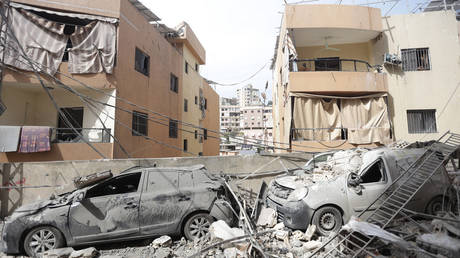
The assassination of a top Iranian security official in the heart of Damascus, coupled with Tehran’s flat rejection of Western back-channel de-escalation offers, marks the end of the "controlled friction" era. For decades, the friction between Israel and Iran followed a predictable, if violent, script. Both sides knew where the lines were drawn. That script has been shredded. By eliminating the head of Iran’s regional intelligence apparatus, Israel has signaled that it no longer views Iranian proxies as the primary target, but rather the nerve center that directs them. Meanwhile, Iran’s refusal to entertain diplomatic off-ramps suggests a shift from strategic patience to a high-stakes gamble on regional instability.
This is not a flare-up. It is a fundamental recalibration of power that ignores the traditional levers of international mediation.
The Targeted Strike on the Architect of Influence
The recent strike was a surgical removal of a high-value asset. This wasn't a broad bombing run or a message sent through collateral damage. It was the precise termination of an individual responsible for synchronizing the "Ring of Fire" strategy that encircles Israel. Intelligence reports suggest the target was instrumental in managing the logistical flow of precision-guided munitions and drone components across the northern corridor.
Israel’s intelligence community appears to have breached the inner sanctum of Iranian communications. To hit a target of this magnitude, the intelligence must be real-time and internal. It suggests a level of penetration that makes any Iranian counter-move inherently risky. When the people running your security apparatus are being tracked in real-time, your ability to plan a retaliatory strike without it being intercepted is severely compromised.
This creates a paradox for Tehran. If they do not respond, they look weak to their regional allies. If they do respond, they risk a direct confrontation that they are currently ill-equipped to win on a conventional battlefield.
Why Diplomacy has Hit a Brick Wall
Washington and several European capitals have spent the last 72 hours frantically trying to open lines of communication. The offers on the table were familiar: frozen asset releases, a softening of specific sanctions, and a promise of renewed nuclear dialogue in exchange for Iranian restraint.
Tehran’s response was a chilling silence followed by a public rejection.
The reason for this intransigence is internal. The hardliners within the Islamic Revolutionary Guard Corps (IRGC) have effectively sidelined the more pragmatic elements of the Iranian foreign ministry. To these commanders, de-escalation is a trap. They view Western offers as stalling tactics designed to let Israel dismantle their proxy network piece by piece. From their perspective, the only way to stop the assassinations is to make the cost of carrying them out too high for the Israeli public to bear.
The Failure of the Economic Carrot
For years, the West believed that the Iranian economy was the pressure point that would force a deal. This was a miscalculation. While the Iranian people suffer under the weight of inflation and a devalued currency, the elite units responsible for regional operations operate on a different ledger. They have built a parallel economy. Through a network of front companies and illicit oil sales, the IRGC remains funded regardless of what happens in Geneva or Vienna.
When you cannot buy cooperation, you are left with only two options: containment or conflict. We are currently witnessing the messy transition from the former to the latter.
The Technological Edge in the Shadow War
The kinetic side of this conflict is fueled by a massive leap in surveillance and autonomous systems. This isn't just about F-35s. It is about the integration of signals intelligence (SIGINT) and artificial intelligence that can sift through petabytes of data to find a single pattern of life.
Israel has turned the entire region into a digital dragnet. Every cell phone ping, every encrypted message that suffers a minor cryptographic flaw, and every satellite image is processed to build a 4D map of Iranian movement. The "security chief" killed in the recent strike likely thought he was invisible. He wasn't. He was a data point that finally met a kinetic end.
The Drone Proliferation Problem
Iran has countered this high-tech advantage with a low-tech volume play. Their drone program is the Great Equalizer. They don't need to match Israel's air force. They just need to overwhelm the Iron Dome and David’s Sling with cheap, one-way attack munitions. These drones are essentially flying lawnmowers packed with explosives and basic GPS guidance. They are inexpensive to build and difficult to intercept when launched in swarms.
This creates a dangerous math. If it costs $50,000 to build a drone and $2 million for the missile that shoots it down, the defender eventually goes bankrupt or runs out of interceptors. Iran is betting that they can outlast the Israeli defense budget.
The Proxy Dilemma
The groups often referred to as proxies—Hezbollah in Lebanon, the Houthis in Yemen, and various militias in Iraq—are no longer just tools of Tehran. They have become a self-sustaining ecosystem. They share intelligence, manufacturing techniques, and tactical successes.
When Israel strikes a commander in Syria, the response might not come from Iran directly. It might come from a launch site in Yemen or a hidden tunnel in southern Lebanon. This decentralization makes traditional diplomacy nearly impossible. Who do you negotiate with when the decision-makers are spread across five different countries, each with their own local grievances?
The "Security Chief" was the bridge between these groups. By removing him, Israel is trying to break the chain of command, but the links in that chain have become increasingly autonomous.
Red Lines in the Sand
We are now entering a phase where the red lines are invisible. Traditionally, a strike on a diplomatic mission or a high-ranking general would be an automatic trigger for total war. Today, it is just another Tuesday. This normalization of high-intensity strikes is perhaps the most dangerous development of all.
When the "unthinkable" becomes routine, the threshold for actual war drops. Both sides are currently operating on the assumption that they can keep the conflict limited. History suggests this is a fantasy. Miscalculations are the primary cause of major wars, and the room for error has never been smaller.
Israel believes it can continue the "Campaign Between the Wars" indefinitely. Iran believes it can absorb the hits and continue its long-term strategy of encirclement. Neither side is willing to blink because blinking is seen as an existential threat.
The Geopolitical Fallout
Russia and China are watching this with intense interest. For Moscow, a distracted West is a gift for their operations in Ukraine. For Beijing, the instability offers a chance to position themselves as the "rational" alternative to American-led security frameworks.
Neither Russia nor China has a vested interest in a peaceful Middle East if that peace is brokered by the United States. They are perfectly content to watch the region burn if it means the depletion of Western military resources and diplomatic capital. This makes the prospect of a UN-led resolution laughable. The security council is paralyzed by the very powers that should be enforcing stability.
The Reality of the "New Normal"
The idea that we can return to the status quo of 2022 is a delusion. The technological, political, and military landscape has shifted too far. Israel has demonstrated that no Iranian official is safe, anywhere. Iran has demonstrated that it is willing to let the region slide into chaos rather than give up its regional ambitions.
The diplomats in the West are still using a 20th-century playbook for a 21st-century ideological and technological war. They are talking about "proportionality" and "restraint" to actors who view those concepts as signs of decadence and decline.
The next move will not be a treaty. It will not be a grand bargain. It will be another strike, another retaliation, and another funeral. The only question remains how long the fuse is before it reaches the main powder keg. The death of the security chief wasn't just a loss of personnel for Iran; it was the final nail in the coffin of the idea that this conflict can be managed through traditional means.
You cannot negotiate with a ghost, and you cannot deter an adversary who believes that time and demographics are on their side. The shadow war has stepped into the light, and it is far more brutal than anyone anticipated.
The next time a back-channel offer is made, don't look for a press release. Look for the smoke on the horizon.